
Container House Design: Floor Plans, Costs, Codes, and Build Details
A practical container house design guide covering layouts, container sizes, structural cuts, insulation, moisture control, foundations, costs, codes, and detailing mistakes to avoid.
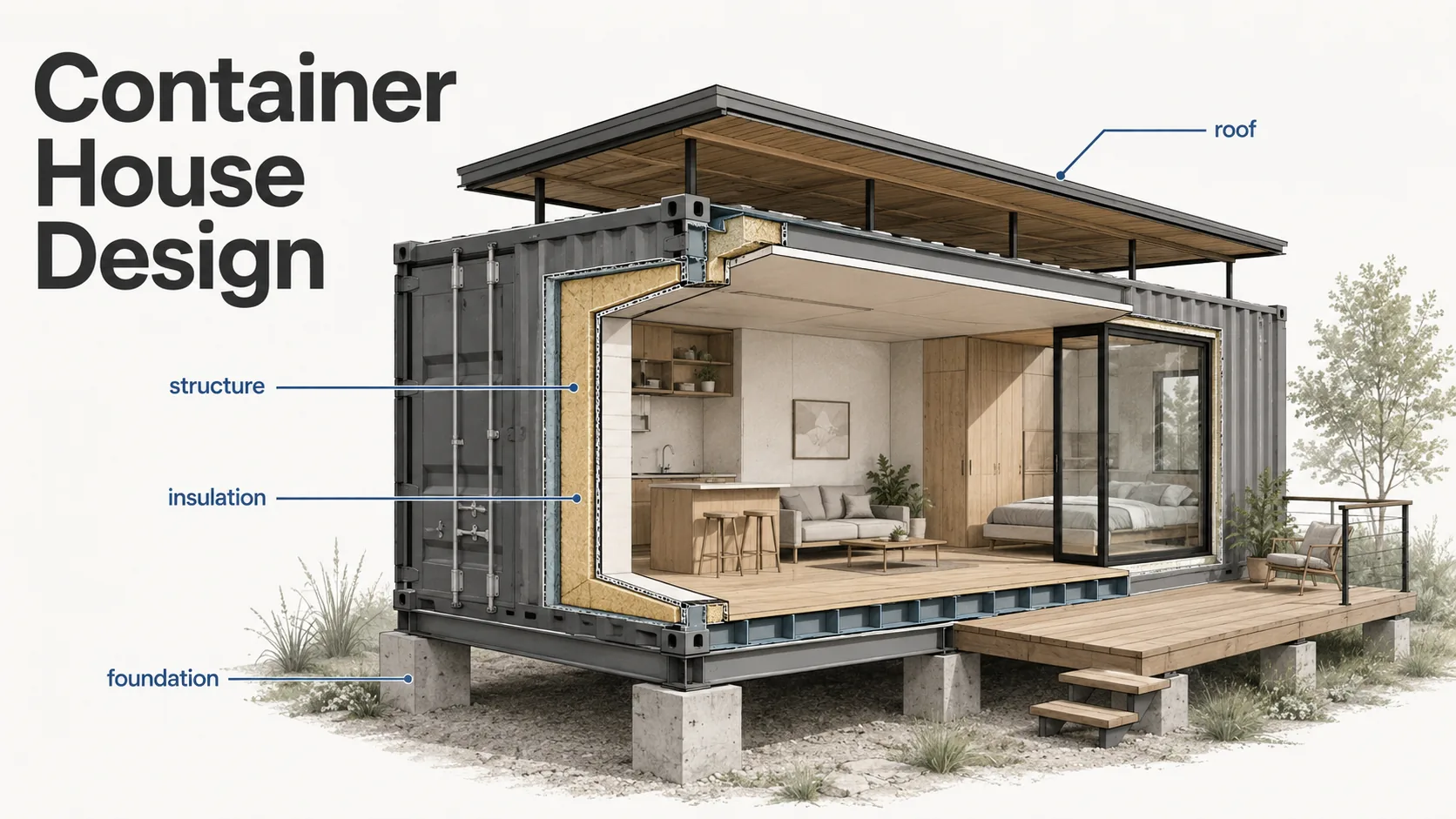
Container house design starts with a simple idea: transform a steel shipping container into a compact, durable home. But the best container homes are not just stylish steel boxes. They are carefully planned buildings with structure, insulation, moisture control, daylight, ventilation, foundations, code compliance, and long-term maintenance designed from the beginning.
A container gives you a strong modular frame, predictable dimensions, transportable geometry, and a distinctive architectural language. It does not automatically give you a comfortable house. A successful container home must solve the narrow interior width, thermal bridging, condensation, structural cuts, corrosion, roof drainage, plumbing, fire safety, and local approval process.
For a built ArchStacks example, study Offroadhouse by Józef Franczok, where a recycled shipping container becomes a compact woodland retreat. For the broader sustainability argument, compare container reuse with Embodied Carbon in Architecture and Adaptive Reuse Architecture.
Local codes, climate, soil, labor, transport access, and contractor practices vary widely. Use this guide as a design framework, then confirm your project with the local authority, architect, structural engineer, energy consultant, and licensed contractors.
Key takeaways
- High-cube containers are usually better for housing because the extra height helps with insulation, ceilings, ducts, lighting, and comfort.
- Large openings, joined containers, stacked layouts, and cantilevers need structural engineering.
- The biggest risks are condensation, thermal bridging, poor flashing, corrosion, weak foundations, and unrealistic cost assumptions.
- Simple one- or two-container homes are usually easier to build than dramatic stacked compositions.
- Used containers need inspection for corrosion, dents, flooring, coatings, previous repairs, and unknown cargo history.
- A container home is often fastest and most cost-effective when the design respects the module instead of fighting it.
What is container house design?
Container house design is the process of converting ISO intermodal shipping containers into habitable residential buildings. ISO 668 establishes the classification, external dimensions, ratings, and some minimum internal and door dimensions for Series 1 freight containers, which is why the basic module is so predictable across shipping systems: ISO 668:2020.
In residential design, a container can work as:
- A compact complete dwelling such as a studio, guest suite, rental cabin, backyard unit, or tiny house.
- A modular room block where several containers are joined side by side, stacked, offset, or arranged around a courtyard.
- A hybrid building component combined with conventional framing, steel portals, timber roofs, decks, porches, and service cores.
Good container homes respect the module’s strengths: corner-post load paths, a durable steel shell, repeatable geometry, and off-site prefabrication potential. Poor designs remove too much structure, ignore the narrow width, or assume the original cargo shell can perform like a finished residential envelope without added layers.
Standard container sizes for house planning
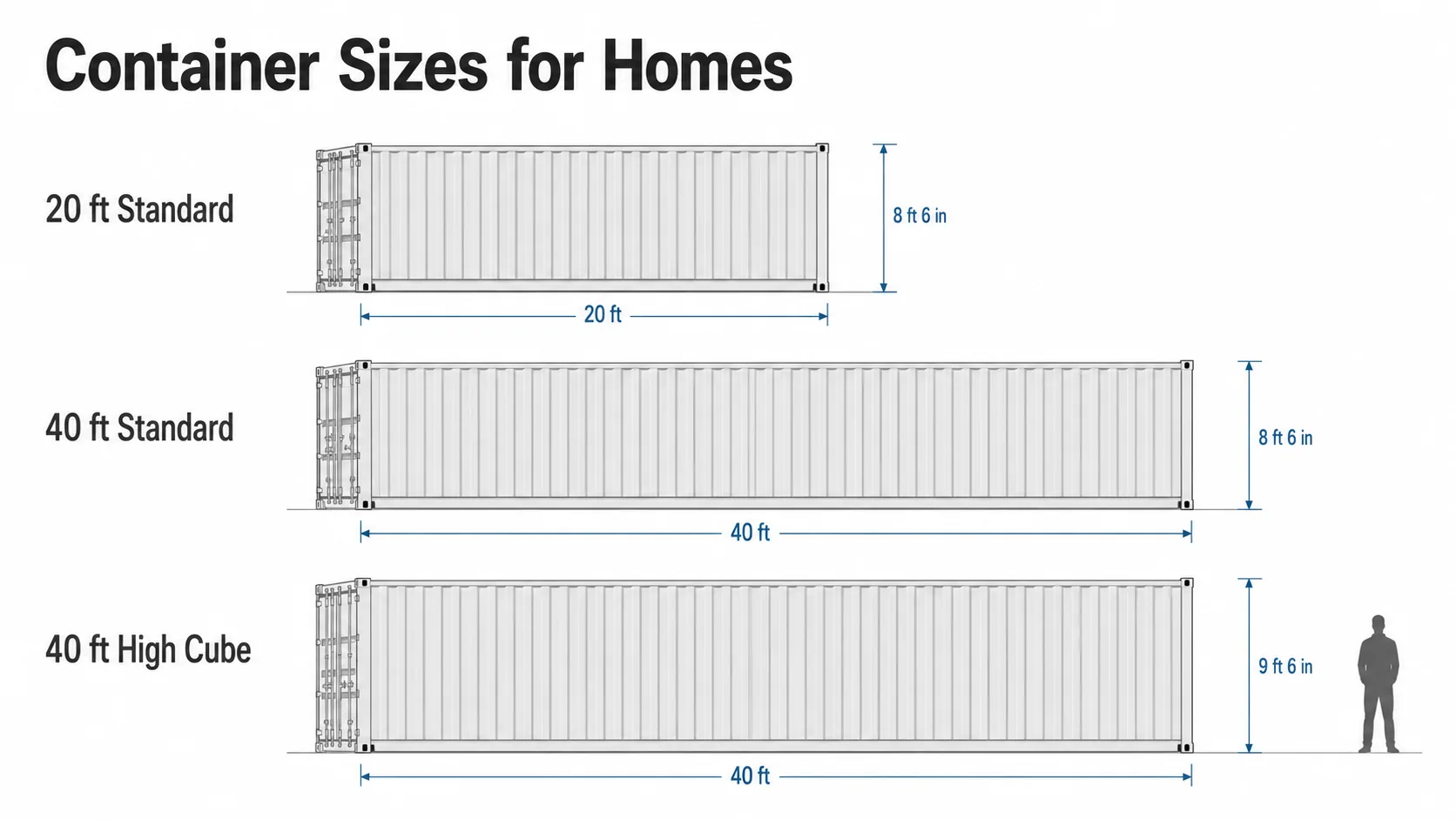
Most container house design starts with 20-foot, 40-foot, and 40-foot high-cube units. Exact dimensions vary by manufacturer, age, and condition, so verify the data plate and supplier documentation before design development. Hapag-Lloyd lists a 40-foot high-cube container with internal dimensions around 12,032 mm long, 2,350 mm wide, and 2,700 mm high: 40' Standard High Cube.
| Container type | Approx. external size | Typical residential use | Main planning issue |
|---|---|---|---|
| 20 ft standard | 6.06 × 2.44 × 2.59 m | Studio, office, bath pod, guest room | Very compact plan |
| 40 ft standard | 12.19 × 2.44 × 2.59 m | Tiny home, one-bedroom unit | Limited ceiling build-up |
| 40 ft high cube | 12.19 × 2.44 × 2.90 m | Best general housing module | Usually the most practical choice |
| 45 ft high cube | 13.72 × 2.44 × 2.90 m | Larger layouts where available | Transport and availability |
The main constraint is width. A container is about 8 feet wide outside and roughly 7 feet 8 inches inside before insulation, services, and lining. Once wall build-up is added, a single-container room can feel narrow. That makes linear planning, built-in storage, pocket doors, compact kitchens, end-wall glazing, and furniture selection critical.
Container house design layouts that work
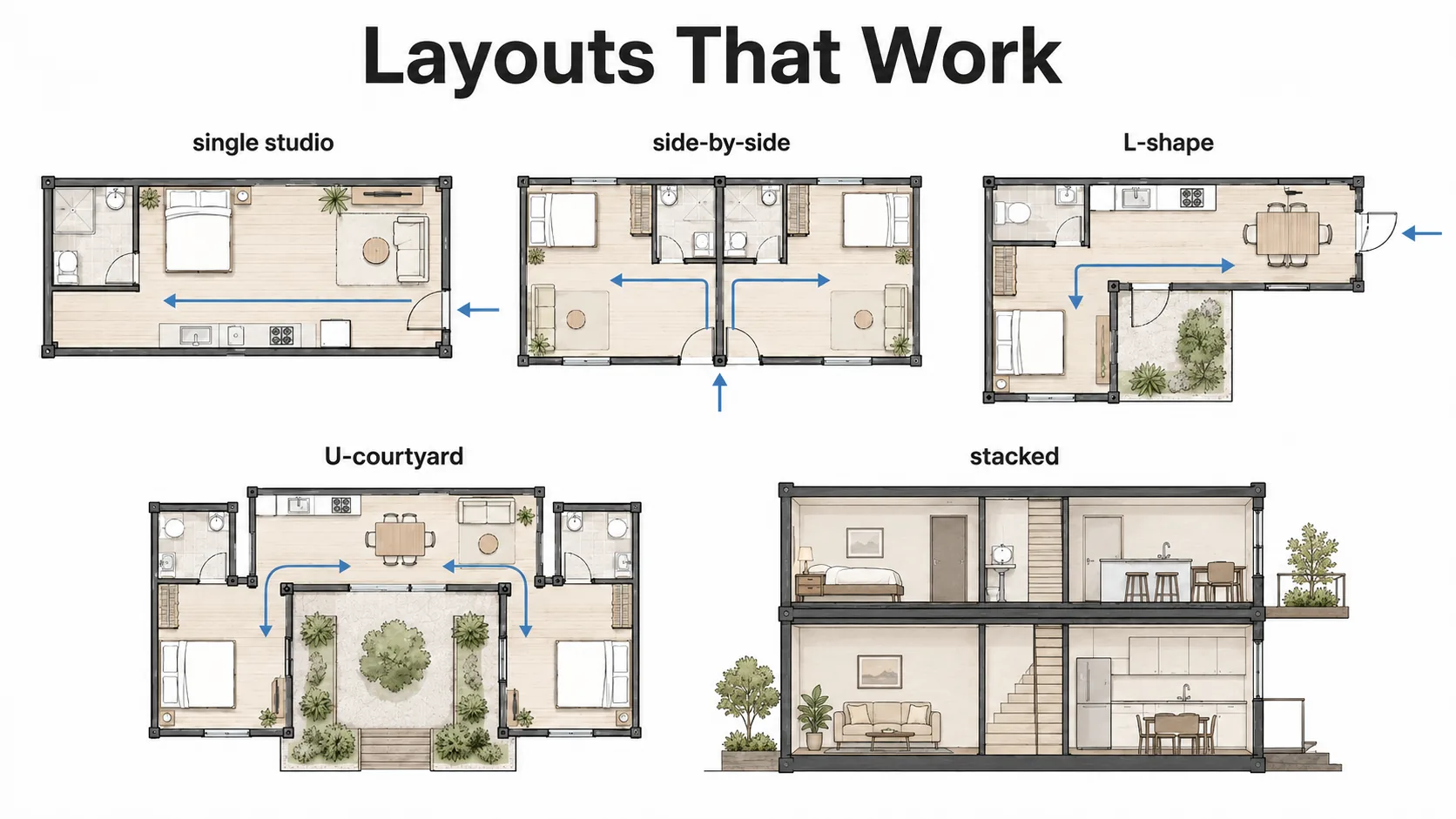
Single-container studio
A 40-foot high-cube container can become a compact studio with sleeping space, kitchenette, bathroom, storage, and sitting area. Keep the bathroom and kitchen close together to reduce plumbing runs. Use glazing at one short end or one carefully reinforced long-side opening to prevent the interior from feeling like a corridor.
Best for guest suites, short-term rentals, remote cabins, student housing, and accessory units where permitted.
Main risk: poor furniture planning. Oversized sofas, deep cabinets, and swing doors quickly make the plan feel cramped.
Two containers side by side
Two 40-foot containers placed parallel and joined along the long side create a wider plan that feels closer to a conventional apartment. This layout can support a real living area, dining space, kitchen, bedroom, bathroom, and storage.
Best for small homes, downsizing houses, ADUs, and accessible one-level plans.
Main risk: the shared wall opening. Corrugated side walls contribute to stiffness, so large openings need engineered reinforcement.
L-shaped container house
An L-shaped plan separates public and private zones while forming a sheltered patio. One container can hold bedrooms and bath; the other can hold kitchen, dining, and living areas. The inside corner works well as an entry porch, outdoor dining area, mudroom edge, or planted court.
Best for warm climates, view sites, rural retreats, and lots where privacy matters.
Main risk: inside-corner waterproofing. Roof drainage, flashing, and wall intersections must be detailed carefully.
U-shaped courtyard layout
A U-shaped plan uses three or more containers around a central outdoor room. It can improve daylight, cross-ventilation, privacy, and outdoor living when the courtyard is designed as part of daily life.
Best for family retreats, holiday rentals, dry climates, and indoor-outdoor living.
Main risk: cost. More containers usually mean more foundations, roof edges, joints, cladding, flashing, and service coordination.
Stacked or offset containers
Stacking saves land, creates views, forms shaded outdoor rooms, and produces a dramatic architectural profile. Containers are strongest when loads align through their corner posts. Offset stacking, cantilevers, roof decks, and double-height cuts need added steel, engineer-stamped details, and precise crane placement.
Best for tight urban sites, sloped sites, scenic views, and compact footprints.
Main risk: renderings make stacking look easy. In real projects, stairs, fire separation, bracing, roof drainage, crane access, and reinforcement can change the budget quickly.
Container house design rules for better floor plans
Start with the site, not the container. Check road access, crane reach, overhead wires, setbacks, zoning, soil bearing, utilities, flood risk, wind exposure, wildfire exposure, solar orientation, privacy, and drainage before buying containers.
Use the narrow width deliberately. Single-container interiors should be planned more like compact apartments, boats, or train cabins than suburban rooms. Built-in benches, shallow wardrobes, wall-mounted lights, fold-down desks, under-bed storage, and sliding doors can save valuable width.
Keep wet areas together. Align the bathroom, kitchen, laundry, and mechanical equipment where possible. This reduces plumbing runs, pipe penetrations, maintenance complexity, and freeze risk in cold climates.
Design daylight early. A container can feel dark if windows are treated as decoration. Prioritize end-wall glazing, carefully reinforced long-side openings, skylights under secondary roofs, and exterior shading where solar gain is intense.
Reserve space for systems. Water heaters, electrical panels, filters, ducts, batteries, inverters, heat pumps, ventilation equipment, and plumbing manifolds need real access. A tiny mechanical closet that cannot be serviced is not a detail; it is a future failure.
Structural design and building codes
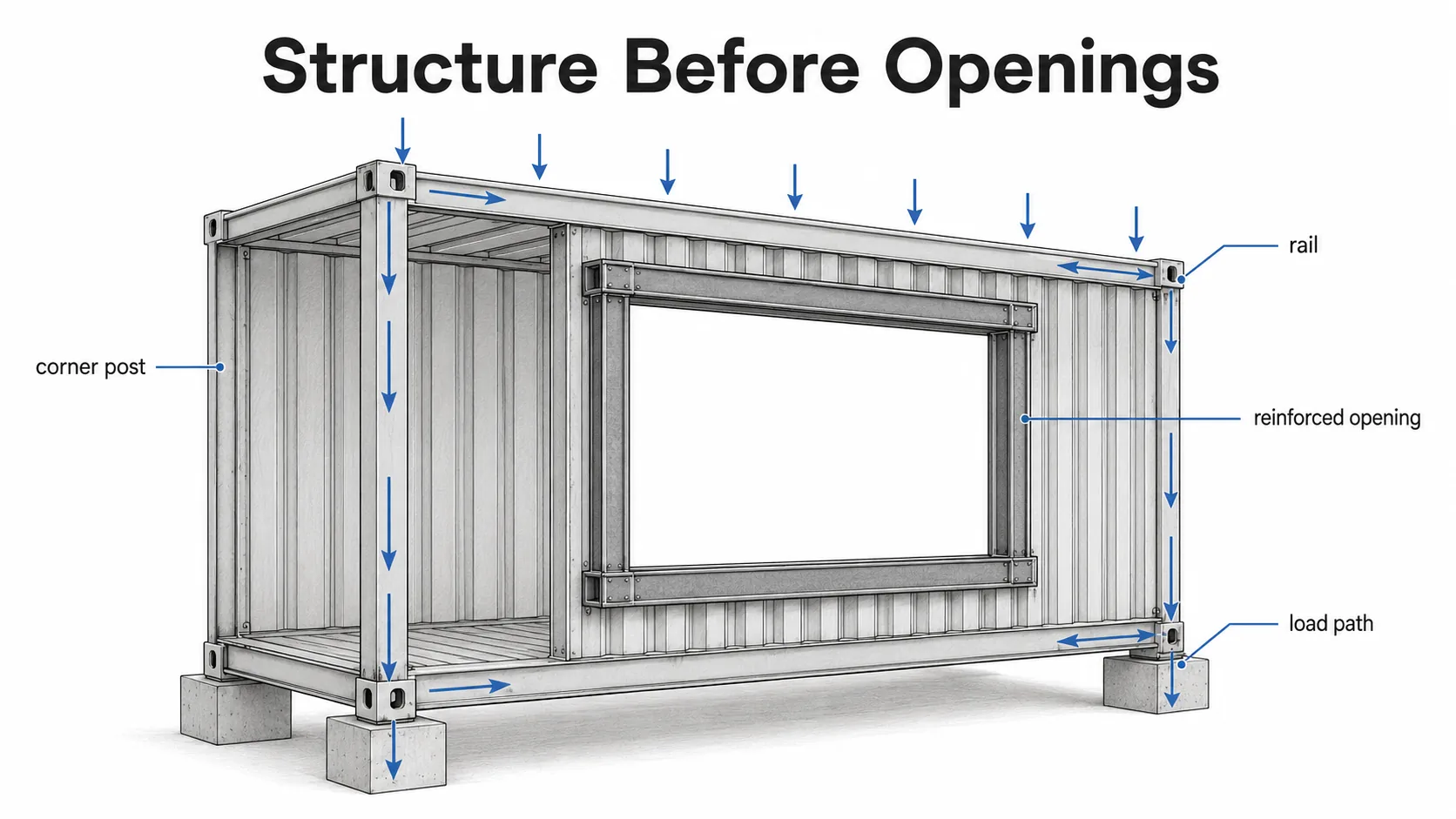
Shipping containers are strong because their corner posts, rails, crossmembers, roof, floor structure, and corrugated panels work together. When you cut openings for doors, windows, sliding walls, or joined rooms, the original load path changes.
The 2021 International Building Code includes Section 3115 for intermodal shipping containers used as buildings or parts of buildings: IBC 2021 Chapter 31. STRUCTURE Magazine explains that Section 3115 introduced a more consistent framework for repurposed containers, including detailed and simplified structural design paths: Shipping Container Design.
Important checks include:
- container condition, corrosion, dents, weld damage, and previous repairs
- data plate information and container documentation
- foundation bearing locations and support points
- wind, seismic, snow, floor, roof, and occupancy loads
- reinforcement around windows, doors, and joined-container openings
- lateral stability after removing corrugated wall panels
- stacked loads and corner-post alignment
- welds, bolted connections, plates, anchors, and corrosion protection
- fire resistance, egress, accessibility, and separation where required
Do not assume a cut-out wall panel can be replaced with trim. Large openings often need steel tube frames, lintels, jamb reinforcement, welded plates, posts, and engineer-stamped details.
Foundations for container houses
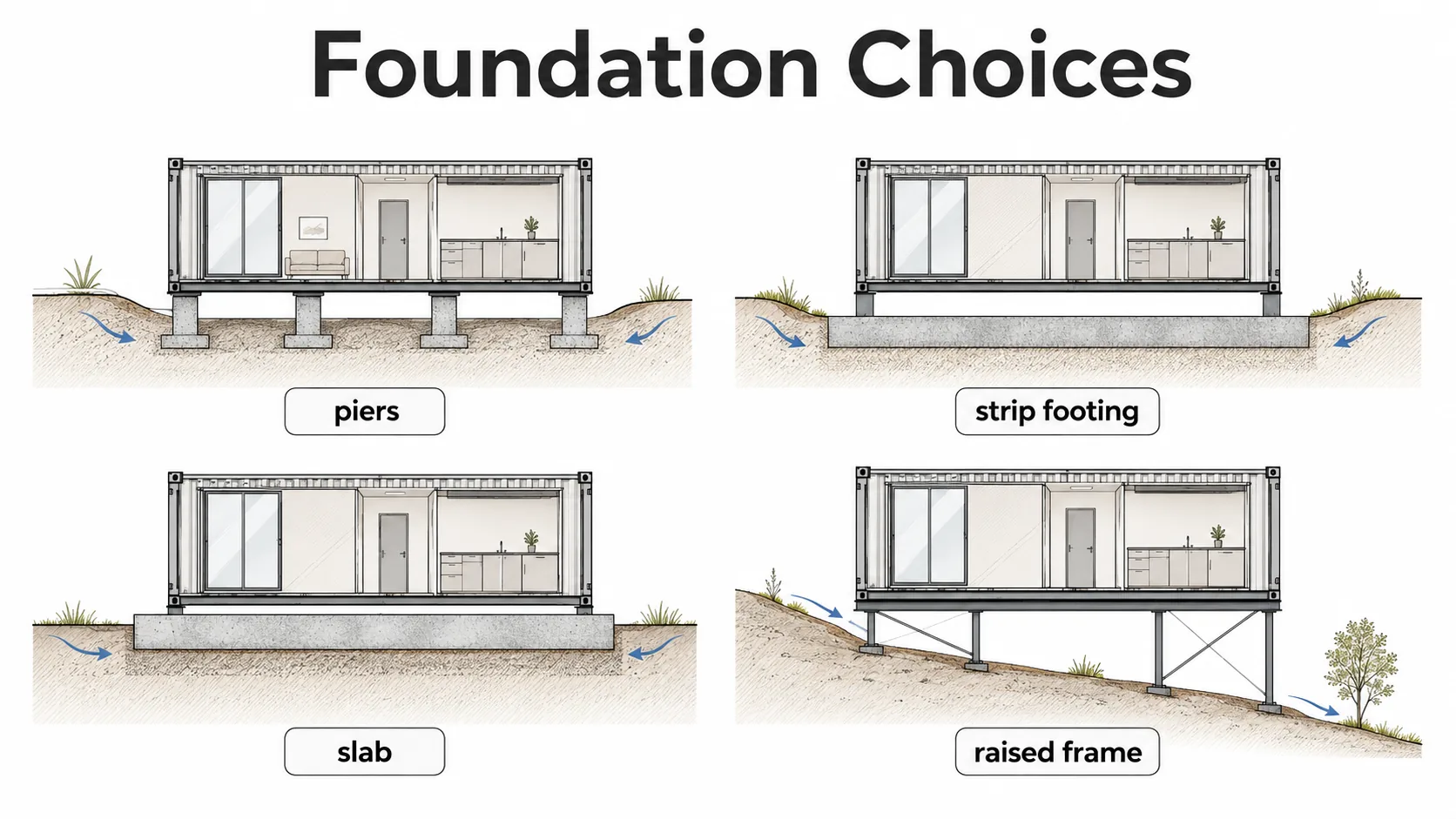
A container house foundation must match the soil, loads, frost depth, drainage, climate, and long-term use. The cheapest foundation is not always the safest or most durable.
| Foundation type | Best use | Key notes |
|---|---|---|
| Concrete piers | Small cabins, light sites, minimal excavation | Must resist settlement, uplift, lateral movement, and corrosion at bearing points |
| Strip footings | Joined modules and linear support | Useful where side walls are heavily modified |
| Concrete slab | Permanent one-level homes | Needs vapor barrier, insulation, drainage, anchors, and utility sleeves |
| Crawlspace | Sloped sites or projects needing service access | Needs a clear moisture-control strategy |
| Raised frame or basement | Flood sites, cold climates, complex terrain | Higher cost but sometimes necessary |
Design the foundation before the container arrives. Anchor plates, bearing pads, utility sleeves, drainage falls, termite protection, service access, underfloor insulation, and crane staging are easier to coordinate before placement.
Insulation, condensation, and thermal bridging
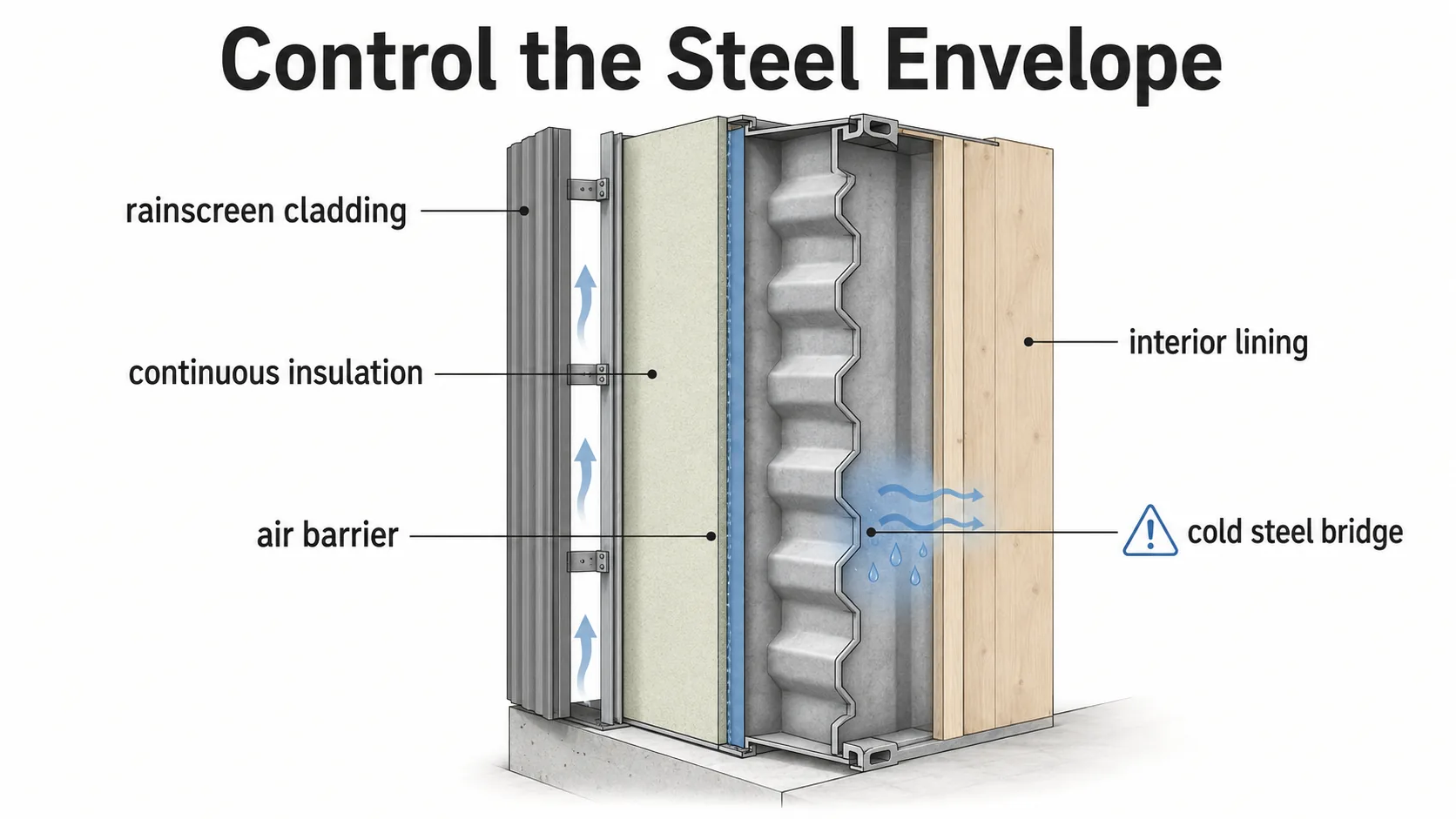
Steel conducts heat quickly. That makes container homes highly sensitive to thermal bridging and condensation. If warm humid indoor air reaches cold steel, water can condense behind finishes. Hidden moisture can lead to mold, corrosion, damaged insulation, odors, and poor indoor air quality.
A durable container envelope needs four control layers:
- Water control layer: sheds rain and prevents bulk water entry.
- Air control layer: stops uncontrolled air leakage.
- Thermal control layer: reduces heat flow through steel and framing.
- Vapor control strategy: manages seasonal vapor movement based on climate.
Closed-cell spray foam is common because it can adhere to steel and provide air sealing, but it is not the only option. Exterior rigid insulation with a ventilated rainscreen often gives stronger thermal bridge control, especially when the container will be clad. Building Science Corporation’s spray foam guidance discusses condensation control and climate-specific foam strategies: Residential Spray Foam Guide.
The U.S. Department of Energy notes that vapor retarders should be part of a broader moisture-control strategy, and Building Science Corporation emphasizes that vapor-control location depends on climate, assembly materials, and interior conditions: DOE Vapor Barriers or Vapor Retarders, BSD-106 Understanding Vapor Barriers.
Interior-only insulation preserves the exterior container look but reduces clear width and leaves more steel exposed to temperature swings. Exterior insulation and cladding usually produce a more robust envelope, but they add cost and may reduce the raw industrial aesthetic.
Ventilation and indoor air quality
A well-insulated container home can become airtight. Airtightness is good for energy performance only when paired with planned ventilation. The U.S. EPA notes that inadequate ventilation can increase indoor pollutant levels by failing to bring in enough outdoor air and failing to carry indoor pollutants out: EPA Indoor Air Quality Guide.
A container home should include:
- operable windows sized for comfort and code where applicable
- bathroom exhaust
- kitchen exhaust
- mechanical fresh air or balanced ventilation for tight homes
- dehumidification in humid climates
- low-VOC paints, adhesives, sealants, and finishes
- safe treatment, encapsulation, or replacement of original floors where needed
Used containers may have unknown cargo history, coatings, repairs, spills, or treated plywood floors. Many residential conversions remove the original floor, encapsulate it with an approved system, or build a new insulated floor assembly above it after professional evaluation.
Exterior cladding, roof design, and weatherproofing
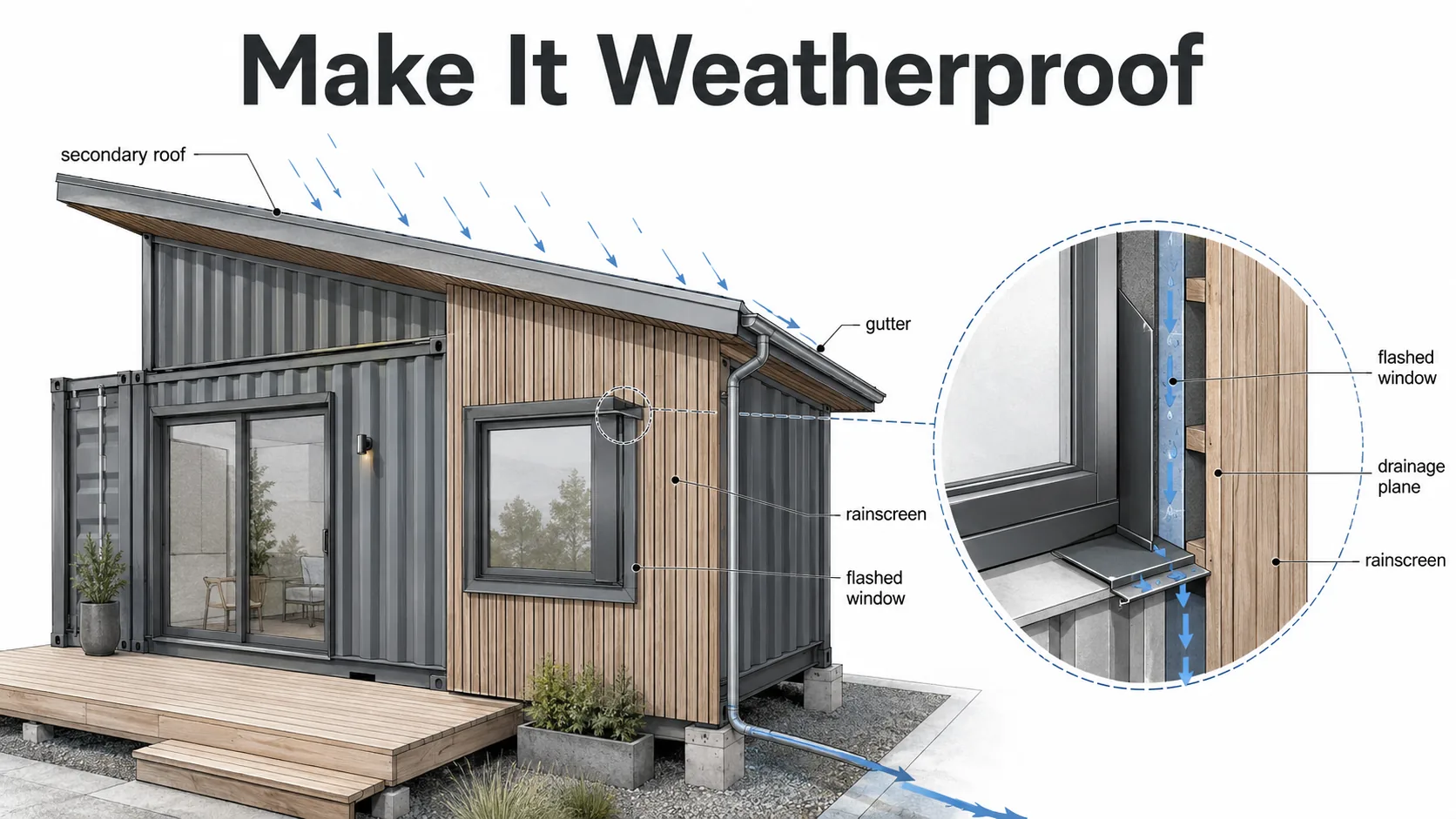
A container’s original shell is designed for transport, not decades as a residential wall assembly with windows, doors, insulation, services, and interior finishes. Once you cut openings or add attachments, the weatherproofing strategy must be redesigned.
Good details include:
- a sloped secondary roof or canopy over the flat container roof
- properly flashed windows and doors
- corrosion treatment at cut edges
- ventilated rainscreen behind exterior cladding
- a durable drainage plane
- sealants used as backup, not the primary waterproofing layer
- separation between dissimilar metals to reduce galvanic corrosion
- inspection access at high-risk joints
A secondary roof is often one of the smartest upgrades. It reduces solar gain, protects the container roof, creates overhangs, hides services, improves drainage, and gives the home a more permanent architectural profile.
Cost factors in container house design
Container homes are not automatically cheaper than conventional homes. In 2026, Angi places custom shipping container homes around $250 to more than $400 per square foot, with cost depending on size, finish level, site work, and construction method: Angi container home cost guide.
Major cost drivers include:
- container purchase, inspection, delivery, and crane placement
- surveys, engineering, permits, energy compliance, and inspections
- foundations, drainage, excavation, and access roads
- steel cutting, welding, reinforcement, and corrosion protection
- windows, doors, skylights, shading, and flashing
- insulation, air sealing, HVAC, and ventilation
- plumbing, electrical, fire safety, and utility connections
- interior finishes, built-ins, appliances, lighting, and millwork
- cladding, secondary roof, decks, stairs, guardrails, and landscaping
The cheapest-looking design is not always the cheapest build. A simple two-container rectangle with modest openings may cost less than a dramatic single-container design with a cantilever, roof deck, oversized glazing, and custom steel stair.
Advantages and limitations
| Aspect | Advantage | Limitation |
|---|---|---|
| Structure | Strong steel frame and corner-post system | Large cuts need reinforcement |
| Speed | Some work can be prefabricated off-site | Site work, approvals, and utilities still take time |
| Sustainability | Reuses an industrial object | Heavy modification can reduce the benefit |
| Planning | Modular geometry simplifies early layout | Narrow width limits furniture and room proportions |
| Aesthetic | Distinctive industrial character | Not all neighborhoods accept the look |
| Cost | Simple builds can be efficient | Complex designs can rival conventional construction |
| Durability | Steel shell can be robust | Corrosion, thermal bridging, and water detailing must be controlled |
Common container house design mistakes
- Buying containers too early. The site, code, layout, and engineering should drive the container choice.
- Removing too much steel. Big openings, joined modules, and stacked layouts need structural design.
- Ignoring condensation. Steel plus humidity plus poor insulation creates hidden failure.
- Assuming the container roof is enough. A secondary roof may be necessary in hot, wet, snowy, or high-UV climates.
- Forgetting mechanical space. Equipment needs access, clearances, drainage, power, and replacement routes.
- Underestimating transport. Delivery route, crane reach, overhead wires, soft ground, and staging can change costs.
- Using generic furniture. Compact interiors need built-ins and furniture selected for narrow spaces.
- Treating renderings as construction drawings. Container homes need specifications, details, structural notes, code coordination, and inspection planning.
Best practices for durable container homes
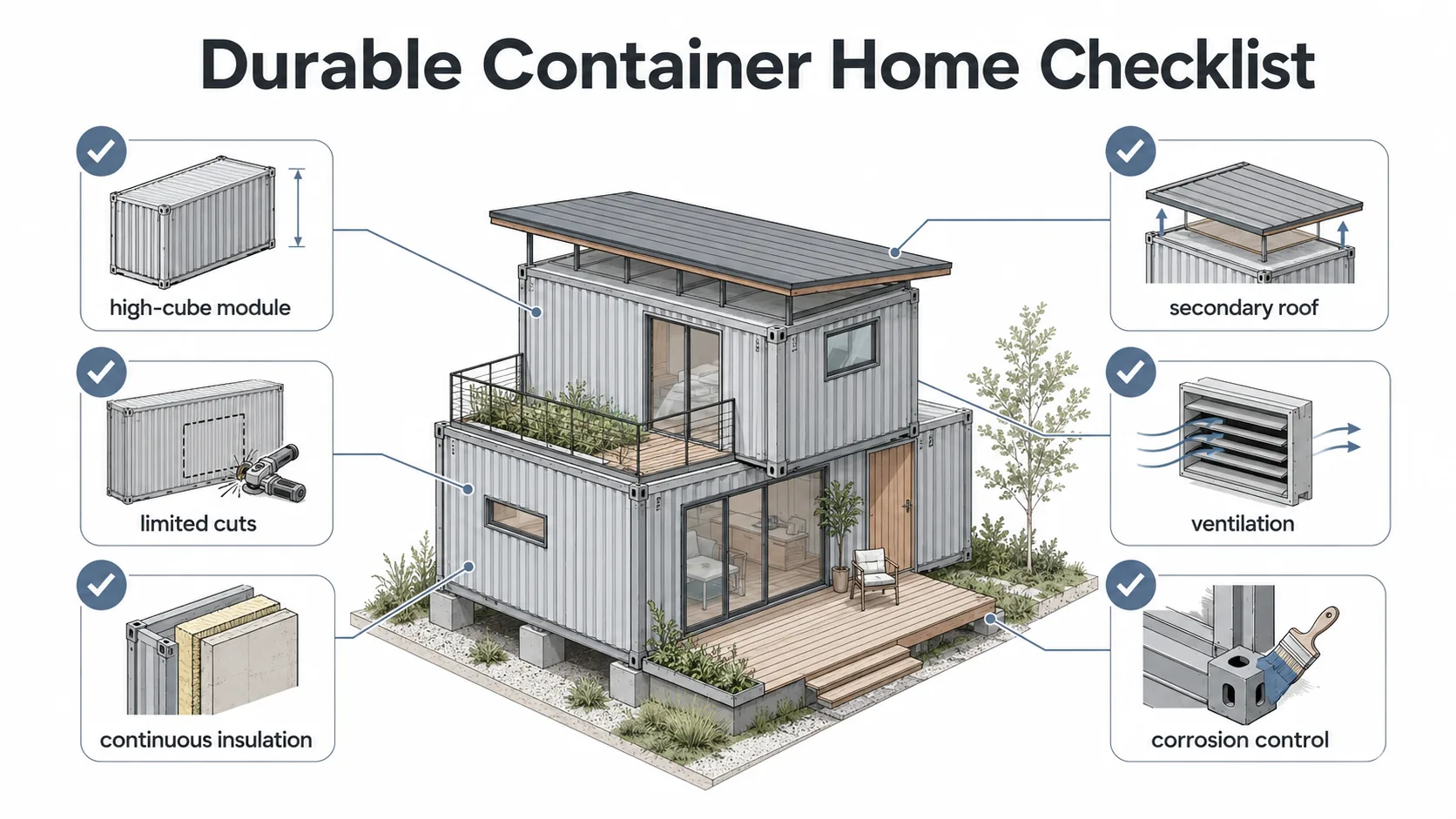
- Prefer high-cube containers for permanent housing.
- Keep structural cuts limited and intentional.
- Align stacked containers through corner posts unless engineered otherwise.
- Use a secondary roof in demanding climates.
- Plan continuous insulation and air sealing.
- Consider exterior insulation and rainscreen cladding for better performance.
- Keep plumbing compact and protected.
- Shade hot exposures.
- Treat cut edges, welds, penetrations, and exposed steel against corrosion.
- Inspect, document, and test used containers before purchase.
- Budget for engineering, permits, site work, contingency, and maintenance.
FAQ
Is a container house cheaper than a normal house?
Sometimes, but not always. Savings are most likely when the design is simple, openings are limited, site work is easy, and prefabrication is well coordinated. Costs rise quickly with stacking, custom steel, difficult sites, high-end finishes, large glazing, and complex utility work.
Which container is best for a house?
A 40-foot high-cube container is often the best starting point because it provides more floor area and an extra foot of height. That extra height helps with insulation, ceiling build-up, ducts, lighting, and comfort.
Can I cut large windows into a shipping container?
Yes, but large openings should be engineered. Corrugated side walls contribute to stiffness, so big windows or sliding doors may need steel frames, headers, jambs, welded reinforcement, and inspection.
Do container homes need insulation?
Yes. Steel transfers heat quickly, so insulation and thermal bridge control are essential. Without a proper envelope and ventilation strategy, the home can overheat, lose heat rapidly, or develop condensation behind finishes.
Can container homes be stacked?
Yes. Containers are designed to stack through their corner posts. Offset stacking, cantilevers, roof decks, and large side-wall cuts require engineering and code review.
Are used containers safe for homes?
They can be, but only after proper inspection. Check corrosion, dents, coatings, floor condition, previous repairs, cargo history where possible, and data plate information. For residential conversions, original floors may need removal, sealing, or encapsulation depending on condition and professional advice.
Conclusion
Container house design succeeds when the container is treated as a useful steel module, not a shortcut around architecture, engineering, or building science. The best projects keep the plan simple, use the narrow module intelligently, protect the steel from water and condensation, reinforce structural cuts, and coordinate foundations, services, insulation, ventilation, and code requirements from the start.
A well-designed container home can be compact, durable, efficient, and visually distinctive. A poorly detailed one can become hot, cold, damp, expensive, and difficult to approve. The difference is not the container itself; it is the quality of the design decisions around it.
References
[1] ISO — ISO 668:2020 Series 1 freight containers — Classification, dimensions and ratings
[2] International Code Council — 2021 International Building Code, Chapter 31 Special Construction
[3] STRUCTURE Magazine — Shipping Container Design
[4] Hapag-Lloyd — 40' Standard High Cube Container Dimensions
[5] Building Science Corporation — GM-2102 Residential Spray Foam Guide
[6] Building Science Corporation — BSD-106 Understanding Vapor Barriers
[7] U.S. Department of Energy — Vapor Barriers or Vapor Retarders
[8] U.S. EPA — The Inside Story: A Guide to Indoor Air Quality
[9] Angi — How Much Does a Container Home Cost? 2026 Data