
Architectural Salvage: The Complete Guide to Reclaimed Building Materials
Learn what architectural salvage is, where reclaimed building materials come from, their benefits, common applications, costs, and how architects use salvaged materials in modern sustainable design.
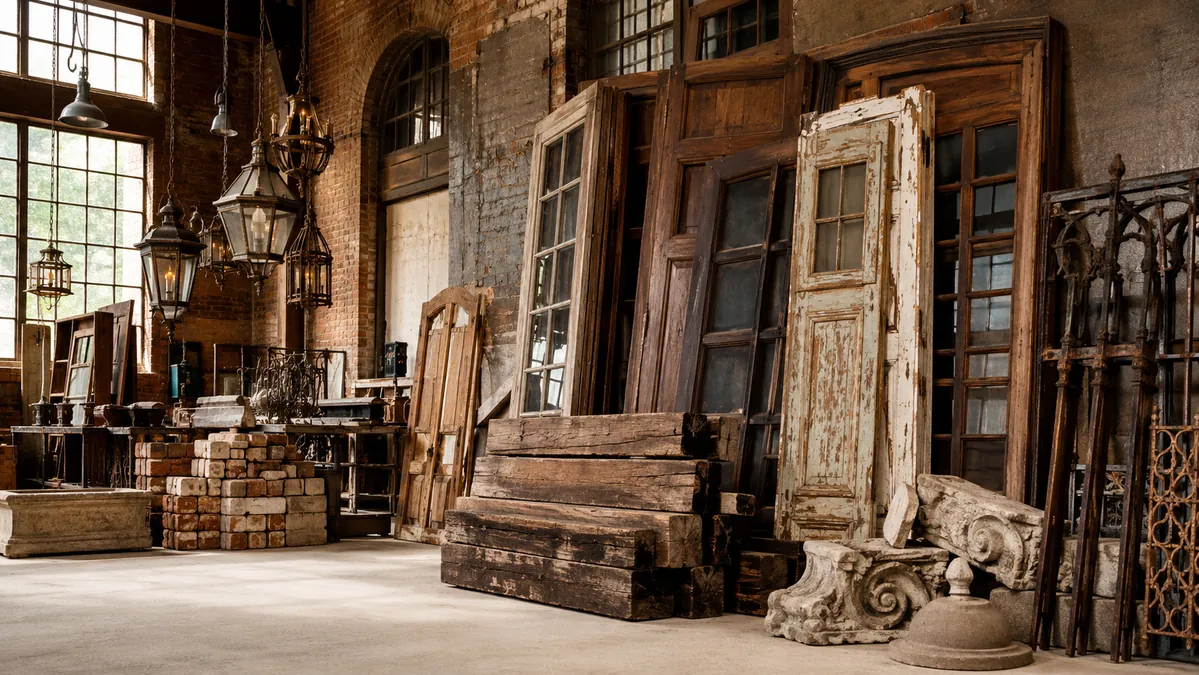
Architectural salvage is the practice of recovering valuable building materials, architectural components, and decorative elements from existing structures before demolition, renovation, or major alteration. Instead of treating old buildings as waste, architectural salvage treats them as material resources.
Doors, windows, timber beams, brick, stone, ironwork, hardware, lighting fixtures, flooring, and decorative details can all be carefully removed, restored, and reused in new construction, interiors, landscape projects, restorations, and adaptive reuse architecture projects.
At its simplest, architectural salvage is about reuse. But at a deeper level, it is about memory, sustainability, craftsmanship, and the idea that buildings do not have to disappear completely when their first life ends.
Architectural salvage is also closely connected to adaptive reuse architecture. Salvage focuses on reusing building parts, while adaptive reuse focuses on giving an existing building a new function. Together, they create one of the strongest approaches to sustainable design: keeping what already exists and giving it a new life.
What Is Architectural Salvage?
Architectural salvage means saving parts of a building before they are lost to demolition or disposal.
These parts may be functional, structural, decorative, or historical.
Common salvaged architectural elements include:
- Reclaimed timber beams
- Vintage doors
- Historic windows
- Brick
- Stone blocks
- Marble slabs
- Cast iron columns
- Steel members
- Stair railings
- Fireplace surrounds
- Decorative moldings
- Ceiling medallions
- Floorboards
- Roof tiles
- Light fixtures
- Door handles and hardware
- Gates and fences
- Plumbing fixtures
- Cabinetry
The goal is to recover these materials in a condition that allows them to be reused, restored, adapted, or reinterpreted in another project.
Architectural salvage can happen at many scales. It may involve saving a single antique door for a house renovation, or it may involve carefully cataloging hundreds of components from a historic building before a major adaptive reuse project.
Why Architectural Salvage Matters
The construction industry produces enormous amounts of waste. Buildings are often demolished long before their materials have reached the end of their useful life.
Architectural salvage helps challenge this wasteful cycle.
Instead of following a simple linear model:
extract → manufacture → build → demolish → discard
architectural salvage supports a circular model:
recover → repair → reuse → adapt → extend material life
This shift matters for three major reasons:
- It reduces construction and demolition waste.
- It preserves embodied energy and embodied carbon.
- It keeps architectural history and craftsmanship alive.
When architects use salvaged materials, they are not only reducing waste. They are also working with materials that already carry age, texture, memory, and cultural value.
This is why architectural salvage is not only a material strategy. It is also a design strategy. It helps architects create buildings and interiors with stronger identity, especially when combined with building reuse and adaptive reuse design.
Architectural Salvage and Sustainability
Architectural salvage is strongly connected to sustainable design.
A salvaged brick, timber beam, or stone element already exists. It has already been extracted, processed, transported, and installed once. Reusing it avoids part of the environmental cost associated with producing a new material from scratch.
Environmental benefits of architectural salvage
Architectural salvage can help:
- Reduce landfill waste
- Reduce demand for virgin raw materials
- Lower embodied carbon
- Preserve embodied energy
- Reduce manufacturing emissions
- Support local reuse economies
- Encourage circular construction
- Extend the life cycle of building components
In sustainable architecture, the greenest material is often the one that already exists.
This is why many architects now view old buildings as material banks. A building is no longer seen only as a finished object. It is also a temporary assembly of materials that may have future lives.
This idea also appears in adaptive reuse architecture, where the building itself is treated as an existing resource rather than something to erase and replace.
The History of Architectural Salvage
Architectural salvage is not a new idea.
Long before modern sustainability movements, builders reused materials out of necessity, economy, symbolism, and availability.
Ancient reuse and spolia
In ancient Rome and later periods, builders often reused columns, carved stones, sculptures, and decorative fragments from older buildings. This practice is commonly known as spolia.
Spolia was practical because high-quality stone and carved architectural elements were valuable. Reusing them saved labor and material cost.
But it was also symbolic. Reused columns or fragments could transfer prestige, memory, or power from one structure to another.
Medieval and traditional building reuse
Throughout medieval cities, stone, timber, and metal were commonly reused. When buildings were damaged, abandoned, or replaced, useful parts were removed and incorporated into new structures.
This was not seen as unusual. It was a normal part of building culture.
Industrialization and mass production
With industrialization, construction materials became easier to manufacture and distribute at scale. Standardized new products became cheaper and more predictable.
As a result, reuse became less central to everyday construction.
Demolition became faster. Waste became more accepted. Buildings were increasingly treated as disposable.
The return of salvage in contemporary architecture
Today, architectural salvage is returning because of several pressures:
- Climate change
- Embodied carbon concerns
- Construction waste
- Scarcity of high-quality natural materials
- Interest in circular economy models
- Desire for authentic, textured, non-generic spaces
- Growing interest in adaptive reuse architecture
In contemporary architecture, salvage is no longer only about nostalgia. It is becoming a serious design and sustainability strategy.
Architectural Salvage vs Adaptive Reuse
Architectural salvage and adaptive reuse architecture are closely related, but they are not the same thing.
| Topic | Architectural Salvage | Adaptive Reuse |
|---|---|---|
| Main focus | Materials and components | Whole buildings |
| Scale | Doors, windows, beams, brick, stone, hardware | Factories, warehouses, schools, churches, offices |
| Goal | Recover and reuse building parts | Give an existing building a new function |
| Design value | Adds material character and history | Preserves urban memory and reduces demolition |
| Example | Reusing old timber beams in a new restaurant | Converting an old warehouse into apartments |
Adaptive reuse often includes architectural salvage, but it goes beyond material recovery. It keeps the building itself alive by giving it a new program.
Architectural salvage can happen inside adaptive reuse projects, but it can also happen independently. A salvaged door from one building may be reused in a completely different project.
If you want to understand the building-scale version of this idea, read the full guide: Adaptive Reuse Architecture.
Common Architectural Salvage Materials
Different materials offer different levels of value, durability, and design potential.
Some are mainly decorative. Others can be structural. Some require careful testing before reuse.
Reclaimed Timber
Reclaimed timber is one of the most popular architectural salvage materials.
It can come from:
- Old warehouses
- Barns
- Factories
- Historic houses
- Roof structures
- Industrial buildings
- Bridges
- Floor systems
Why reclaimed timber is valuable
Older timber is often dense, stable, and visually rich. It may come from old-growth trees that are no longer commonly available.
Reclaimed wood often has:
- Nail marks
- Weathering
- Saw marks
- Color variation
- Patina
- Structural depth
- Aged grain
These qualities are difficult to reproduce artificially.
Common uses
Reclaimed timber can be used for:
- Flooring
- Ceiling beams
- Wall cladding
- Furniture
- Stair treads
- Doors
- Shelving
- Reception desks
- Feature walls
- Structural expression
Design note
Reclaimed timber works best when its age is allowed to remain visible. Over-polishing it can remove the very character that makes it valuable.
In adaptive reuse interiors, reclaimed timber can also create continuity between the old structure and the new program.
Salvaged Brick
Brick is another highly reusable material.
Historic bricks often have irregular colors, soft edges, and surface texture that gives walls a sense of depth and age.
Common uses
Salvaged brick can be used for:
- Interior feature walls
- Exterior facades
- Garden walls
- Paving
- Fireplaces
- Landscape edges
- Courtyard surfaces
Why architects use salvaged brick
Architects use reclaimed brick when they want warmth, texture, and continuity with an older urban context.
A new brick wall may feel too perfect. A salvaged brick wall often feels already embedded in time.
This makes salvaged brick especially useful in adaptive reuse projects, where the goal is often to preserve the memory of the original building while allowing a new use to appear.
Technical considerations
Before reuse, salvaged bricks should be checked for:
- Cracking
- Salt damage
- Moisture absorption
- Mortar compatibility
- Freeze-thaw durability
- Structural suitability
Not every old brick is suitable for every application.
Salvaged Stone
Stone has been reused in architecture for centuries.
Because stone is durable and often expensive to quarry and process, it is one of the most valuable salvage materials.
Common salvaged stone types
- Limestone
- Sandstone
- Granite
- Marble
- Slate
- Travertine
Common uses
Salvaged stone can be used for:
- Flooring
- Stairs
- Cladding
- Garden walls
- Paving
- Countertops
- Thresholds
- Fireplace surrounds
- Landscape features
Design value
Salvaged stone carries weight, age, and permanence. It can make a new project feel grounded and established from the first day.
Salvaged Doors and Windows
Doors and windows are among the most visible and emotionally powerful salvaged elements.
They carry human scale. People touch them, open them, pass through them, and remember them.
Common uses
Salvaged doors and windows can be reused as:
- Functional doors
- Interior partitions
- Decorative wall pieces
- Cabinet fronts
- Screens
- Garden structures
- Restaurant and café features
- Display elements
Why they matter
A reclaimed door can immediately give a space character. It suggests previous lives, previous rooms, and previous occupants.
In architecture, this kind of memory can be powerful.
Technical issues
Old doors and windows may need upgrades for:
- Fire rating
- Acoustic performance
- Weather sealing
- Security
- Accessibility
- Thermal performance
- Safety glass requirements
For exterior use, performance requirements are especially important.
Salvaged Metal and Ironwork
Metal components can be highly valuable, especially when they include craftsmanship that is expensive or difficult to reproduce.
Common salvaged metal elements include:
- Cast iron columns
- Railings
- Gates
- Balustrades
- Grilles
- Staircases
- Steel beams
- Bronze hardware
- Decorative screens
- Industrial machinery parts
Common uses
Salvaged metal can be reused in:
- Interior partitions
- Stair railings
- Facade details
- Landscape elements
- Furniture
- Structural expression
- Lighting fixtures
- Decorative installations
Design value
Metal salvage often brings an industrial character. It works especially well in restaurants, offices, galleries, lofts, and adaptive reuse interiors.
Decorative Architectural Elements
Decorative salvage includes elements that may not be structurally necessary but strongly affect the identity of a space.
Examples include:
- Cornices
- Columns
- Capitals
- Ceiling medallions
- Carved panels
- Fireplaces
- Moldings
- Tiles
- Light fixtures
- Hardware
- Signs
- Mirrors
- Balustrades
These pieces often become focal points.
A single salvaged fireplace or carved timber screen can define the atmosphere of an entire room.
Where Architectural Salvage Comes From
Architectural salvage can come from many sources.
Demolition sites
Buildings scheduled for demolition often contain reusable materials.
If salvage teams are brought in early, valuable items can be removed before heavy demolition begins.
Renovation projects
Major renovations often produce high-quality salvage.
Examples include:
- Removed doors
- Old flooring
- Replaced windows
- Historic fixtures
- Decorative trim
- Built-in furniture
Industrial buildings
Factories, warehouses, and mills can provide:
- Heavy timber
- Steel frames
- Brick
- Machinery parts
- Large doors
- Industrial lighting
- Metal stairs
Industrial buildings are also among the strongest candidates for adaptive reuse architecture, because they often have large spans, high ceilings, flexible plans, and strong material character.
Historic houses
Older houses may provide:
- Doors
- Windows
- Flooring
- Fireplaces
- Hardware
- Stair parts
- Moldings
- Tiles
Salvage yards
Architectural salvage yards collect, organize, and resell reclaimed materials.
They are useful for designers because they make salvage more searchable and accessible.
Auctions and estate sales
Historic buildings, hotels, theaters, and private homes sometimes release architectural elements through auctions or estate sales.
Real-World Examples of Architectural Salvage and Reuse
The strongest examples of architectural salvage are not just about saving materials. They show how reuse can become part of the design concept.
Many of these examples also overlap with adaptive reuse architecture, because the material reuse and building transformation happen together.
Sala Beckett, Barcelona
Architects: Flores & Prats Location: Barcelona, Spain Project type: Adaptive reuse / cultural architecture
Sala Beckett is one of the most important contemporary examples of adaptive reuse and architectural memory.
The project transformed an old workers' cooperative building into a theatre and drama center. Instead of stripping the building clean, Flores & Prats treated the existing structure as an archive.
Doors, windows, wall finishes, fragments, and traces of previous occupation were studied, cataloged, and incorporated into the new design.
The result is not a clean contrast between old and new. It is a layered building where time remains visible.
Why it matters
Sala Beckett shows that architectural salvage can be more than decoration.
It can become a design method.
The architects did not simply reuse old elements because they were attractive. They used them to preserve the social memory of the building.
Lesson for architects
Salvage works best when it is integrated early into the design process.
If reused elements are treated as afterthoughts, they can feel decorative or forced. When they are studied and designed with care, they can shape the identity of the whole project.
Waldorf Astoria Restoration, New York
Architect: Skidmore, Owings & Merrill Location: New York City, USA Project type: Restoration / adaptive reuse / hospitality
The Waldorf Astoria restoration demonstrates salvage and preservation at a monumental scale.
Rather than demolishing the historic Art Deco hotel, the project restored significant public interiors, architectural details, windows, finishes, and decorative elements while adapting the building for contemporary hotel and residential use.
This project is important because it shows that reuse is not only for small boutique interiors or rustic materials. It can also apply to large, complex, high-value buildings.
Why it matters
The Waldorf Astoria project shows how preservation and modernization can work together.
Historic elements were not treated as obstacles to progress. They became assets.
Lesson for architects
In major projects, architectural salvage requires documentation, conservation expertise, historical research, and careful coordination between architects, engineers, contractors, and preservation specialists.
Villa Welpeloo, Netherlands
Architect: Superuse Studios Location: Enschede, Netherlands Project type: Residential architecture
Villa Welpeloo is a well-known example of architecture designed around available waste and reclaimed materials.
A large portion of the house was constructed using salvaged materials, including steel from former industrial machinery and wood from cable reels.
The project is especially important because the architects did not simply insert a few reclaimed features into a conventional design. They actively searched for available waste streams and allowed those materials to influence the architecture.
Why it matters
Villa Welpeloo shows that salvage can be systematic.
Instead of asking, “What new materials should we buy?” the project asks, “What useful materials already exist nearby?”
Lesson for architects
Architectural salvage can influence form, structure, detailing, and procurement. It is not only a finishing strategy.
Kamikatsu Zero Waste Center, Japan
Architect: Hiroshi Nakamura & NAP Location: Kamikatsu, Japan Project type: Civic / recycling / community architecture
The Kamikatsu Zero Waste Center is a strong example of architecture shaped by the idea of waste reduction.
The building supports a town-wide zero-waste culture and includes recycling, sorting, educational, and community functions.
The project uses reused materials and is designed with future disassembly and maintenance in mind.
Why it matters
This project expands the idea of architectural salvage from isolated material reuse to a broader circular design philosophy.
It is not only a building made with reused materials. It is a building that teaches reuse.
Lesson for architects
The most powerful sustainable buildings are not only efficient objects. They can also change behavior.
Warehouse Conversions
Old warehouses are among the most common buildings reused in contemporary architecture.
They often contain:
- Brick walls
- Heavy timber structures
- Steel frames
- Large windows
- Concrete floors
- Industrial doors
- Exposed services
- Generous ceiling heights
These features make warehouses suitable for conversion into:
- Offices
- Apartments
- Galleries
- Restaurants
- Studios
- Hotels
- Retail spaces
Why warehouses work well for reuse
Warehouses usually have open floor plates and strong structures. This makes them flexible.
Their materials also carry an industrial character that many designers intentionally preserve.
Warehouse conversions are a major part of adaptive reuse architecture, because the building’s existing structure becomes the starting point for the new program.
Lesson for architects
In warehouse conversions, the best design move is often restraint.
Keeping the original structure visible can be more powerful than covering it with new finishes.
Churches, Schools, and Civic Buildings
Historic churches, schools, and civic buildings often contain valuable architectural elements.
These may include:
- Stone walls
- Timber roofs
- Stained glass
- Large doors
- Decorative plaster
- Tile floors
- Wood paneling
- Iron railings
When these buildings are adapted for new uses, salvage can help preserve their cultural identity.
Possible new uses include:
- Libraries
- Community centers
- Cultural venues
- Offices
- Housing
- Restaurants
- Event spaces
The challenge is to balance respect for the original building with the needs of the new function.
This is one of the main challenges discussed in adaptive reuse architecture, where old buildings must be transformed without losing the qualities that made them valuable.
Most Valuable Salvaged Materials
Not all salvaged materials have the same value.
Some are valuable because they are rare. Others are valuable because they are durable, expensive to reproduce, or visually distinctive.
| Material | Common Uses | Why It Is Valuable |
|---|---|---|
| Old-growth timber | Beams, flooring, furniture, cladding | Dense, stable, difficult to replace |
| Historic brick | Facades, paving, interior walls | Texture, color variation, local character |
| Natural stone | Flooring, stairs, cladding, landscaping | Durable, expensive, visually rich |
| Cast iron | Columns, railings, gates | Craftsmanship, strength, decorative quality |
| Bronze hardware | Doors, cabinets, restoration projects | Detail, durability, patina |
| Vintage doors | Interiors, restaurants, homes | Human scale, character, history |
| Steel beams | Adaptive reuse, exposed structures | Structural potential, industrial identity |
| Decorative tiles | Kitchens, bathrooms, walls | Pattern, craft, color |
| Fireplaces | Living spaces, hotels, restaurants | Strong focal point |
| Light fixtures | Hospitality, homes, commercial interiors | Atmosphere, period character |
How Architects Use Architectural Salvage
Architectural salvage can be used in many ways depending on the project type.
As a focal point
A salvaged fireplace, antique door, or carved screen can become the main visual anchor of a room.
As a material strategy
Reclaimed brick, timber, or stone can define the general material palette of a project.
As a storytelling device
Salvaged elements can connect a project to its site, history, or community.
As a sustainability strategy
Reuse reduces demand for new materials and helps reduce construction waste.
As a contrast with new design
Old materials can be placed beside modern glass, concrete, or steel to create tension between past and present.
As a continuity tool
In adaptive reuse architecture, salvaged materials can help preserve the character of the original building while allowing new functions to emerge.
How Architects Specify Salvaged Materials
Using salvaged materials successfully requires more than finding beautiful old objects.
Architects need to think technically, legally, and practically.
1. Identify salvage opportunities early
Salvaged materials should be considered during concept design, not only during construction.
Early planning helps with:
- Inventory
- Budget
- Testing
- Storage
- Detailing
- Code review
- Contractor coordination
This is especially important in adaptive reuse projects, where the existing building may provide both the structure and the material palette for the new design.
2. Document the material
Each salvaged element should be documented.
Useful information includes:
- Source building
- Original use
- Dimensions
- Material type
- Condition
- Quantity
- Photographs
- Removal date
- Storage location
- Required repairs
3. Test structural materials
Structural reuse requires careful review.
Timber, steel, and masonry should be assessed for:
- Strength
- Damage
- Moisture
- Corrosion
- Fire performance
- Deflection
- Connections
- Code compliance
4. Check regulations
Older materials may not automatically meet modern building codes.
Issues may include:
- Fire rating
- Accessibility
- Energy performance
- Safety glazing
- Guardrail height
- Slip resistance
- Lead paint
- Asbestos
- Moisture damage
5. Coordinate storage
Salvaged materials often need to be stored before reuse.
Poor storage can damage materials through:
- Moisture
- Warping
- Theft
- Breakage
- UV exposure
- Contamination
6. Design around uncertainty
Unlike new catalog products, salvaged materials may vary in size, color, condition, and quantity.
Good salvage-based design allows some flexibility.
Cost of Architectural Salvage
Architectural salvage is not always cheaper.
Sometimes it saves money. Sometimes it costs more.
The cost depends on:
- Material rarity
- Removal difficulty
- Cleaning and repair needs
- Transportation
- Storage
- Labor
- Certification
- Installation complexity
- Quantity required
When salvage can be cheaper
Salvage may reduce cost when:
- Materials are locally available
- The material needs minimal restoration
- The design can adapt to available sizes
- Labor is simple
- New equivalent materials are expensive
When salvage can be more expensive
Salvage may cost more when:
- Materials require careful removal
- Restoration is complex
- Structural testing is needed
- Quantities are limited
- Custom detailing is required
- Code upgrades are necessary
Design advice
Do not assume salvage is automatically cheap.
Think of it as a value decision, not only a cost decision.
The value may come from sustainability, authenticity, uniqueness, or historical continuity.
Architectural Salvage in Interior Design
Interior designers often use architectural salvage because it brings immediate character to a space.
Common interior uses include:
- Reclaimed timber tables
- Old doors as sliding partitions
- Salvaged windows as internal screens
- Vintage lighting
- Reused brick walls
- Antique mirrors
- Restored fireplaces
- Historic tiles
- Iron railings
- Reclaimed cabinetry
Salvage is especially popular in:
- Restaurants
- Cafés
- Boutique hotels
- Retail spaces
- Galleries
- Homes
- Creative offices
In these projects, salvaged materials help create atmosphere.
They make spaces feel less generic and more lived-in.
Architectural Salvage in Landscape Design
Architectural salvage is also useful in landscape architecture.
Common applications include:
- Stone paving
- Brick paths
- Garden walls
- Old gates
- Reclaimed timber benches
- Water features
- Sculptural fragments
- Steps
- Edging
- Courtyard surfaces
Salvaged materials work well outdoors because weathering often adds to their character.
A reclaimed stone step or brick path can make a new landscape feel established and mature.
Architectural Salvage and Local Identity
One of the strongest arguments for architectural salvage is local identity.
When materials from a city, neighborhood, or site are reused, the project retains a physical connection to its context.
This is especially valuable in places where rapid development erases older buildings.
Salvage can preserve fragments of memory even when full preservation is not possible.
For example:
- Bricks from a demolished factory can be reused in a new community center.
- Timber from an old warehouse can become furniture in a new office.
- Stone from a historic building can be reused in a public plaza.
- Doors from an old school can be reused in a cultural space.
These gestures are not only aesthetic. They help people recognize continuity in a changing city.
This is also one reason adaptive reuse architecture is so powerful: it preserves not only materials, but also the building’s role in the city.
Architectural Salvage and Circular Construction
Circular construction is a building approach that tries to keep materials in use for as long as possible.
Architectural salvage is one practical part of this larger movement.
Circular construction includes:
- Reusing existing buildings
- Salvaging materials
- Designing for disassembly
- Avoiding unnecessary demolition
- Using mechanical connections instead of permanent adhesives
- Documenting materials
- Creating material passports
- Designing adaptable buildings
In this model, buildings are not endpoints. They are temporary material assemblies.
A wall, beam, door, or facade panel may have multiple lives across different projects.
When circular construction happens at the scale of the whole building, it often becomes part of adaptive reuse design.
Material Passports and the Future of Salvage
A major challenge with reuse is information.
When a material is removed from a building, designers need to know what it is, where it came from, how it performs, and whether it can be safely reused.
Material passports aim to solve this problem.
A material passport is a digital record that may include:
- Material type
- Manufacturer
- Dimensions
- Installation date
- Performance data
- Carbon data
- Fire rating
- Maintenance history
- Disassembly instructions
- Reuse potential
If material passports become common, future architectural salvage will become easier, safer, and more scalable.
Instead of discovering materials only during demolition, architects may be able to search buildings as future material libraries.
Design for Disassembly
Architectural salvage is easier when buildings are designed to be taken apart.
Design for disassembly means creating buildings so their components can be removed and reused in the future.
This can include:
- Bolted connections instead of welded ones
- Screws instead of permanent adhesives
- Modular components
- Accessible joints
- Standardized dimensions
- Reversible details
- Separable material layers
- Clear documentation
This approach changes how architects think.
A detail is no longer only about how a building goes together. It is also about how the building may come apart later.
Challenges of Architectural Salvage
Architectural salvage has many benefits, but it is not simple.
Limited availability
Salvaged materials are often unique. If a project needs 500 identical doors, salvage may not be realistic.
Irregular dimensions
Old materials may not match modern standard dimensions.
This can affect detailing, installation, and cost.
Unknown performance
Some materials require testing before reuse, especially if they are structural or exposed to weather.
Labor intensity
Careful removal takes time.
Demolition is fast. Salvage is slower.
Storage
Materials may need to be stored for months before reuse.
Code compliance
Older components may need upgrades to meet current regulations.
Design coordination
Salvage requires coordination between architects, contractors, suppliers, engineers, and clients.
Best Practices for Using Architectural Salvage
Start with a salvage inventory
Before design decisions are finalized, create an inventory of available materials.
Include photos, dimensions, quantities, and condition notes.
Match material to use
Not every salvaged material should be reused in the same way.
A structural beam that no longer meets structural requirements may still work as furniture, cladding, or a decorative feature.
Keep the story visible
If a material has a meaningful history, allow that story to appear in the project.
This can be done through:
- Design expression
- Signage
- Project narrative
- Material labels
- Exhibition displays
- Website content
Avoid fake aging
The value of salvage is authenticity.
Do not over-style reclaimed materials until they become artificial.
Combine old and new carefully
Salvaged materials often work best when paired with simple contemporary details.
This allows the old material to stand out without making the space feel like a theme set.
This old-new contrast is also one of the main design strategies in adaptive reuse architecture.
Plan for maintenance
Old materials may need specific care.
Make sure clients understand maintenance requirements.
Architectural Salvage Ideas by Project Type
Homes
- Reclaimed timber flooring
- Vintage front doors
- Salvaged fireplace surrounds
- Antique hardware
- Old brick garden walls
- Reused stone thresholds
- Restored windows as interior partitions
Restaurants and Cafés
- Reclaimed wood counters
- Vintage lighting
- Salvaged tile walls
- Old factory windows
- Antique mirrors
- Industrial metal shelving
- Reused doors and screens
Offices
- Reclaimed timber meeting tables
- Salvaged brick feature walls
- Reused steel partitions
- Industrial lighting
- Old doors as privacy screens
- Reclaimed flooring
Hotels
- Antique furniture
- Reclaimed stone flooring
- Restored decorative elements
- Salvaged doors
- Historic lighting
- Reused timber wall panels
Cultural Buildings
- Preserved building fragments
- Reused doors and windows
- Historic wall finishes
- Salvaged seating
- Restored stair elements
- Material displays explaining the building history
Landscape Projects
- Reclaimed brick paving
- Salvaged stone benches
- Old gates
- Reused timber decks
- Stone steps
- Garden walls
- Water features made from recovered elements
Architectural Salvage Checklist
Before using salvaged materials, ask:
- What is the source of the material?
- Is the material structurally sound?
- Does it need testing?
- Is there enough quantity?
- Can it meet current codes?
- Does it contain hazardous substances?
- How will it be cleaned or restored?
- Where will it be stored?
- Who is responsible for installation?
- Does the design allow variation?
- Is the material story important to the project?
- Can it be reused again in the future?
For whole-building transformations, this checklist should be used together with an adaptive reuse assessment. See: Adaptive Reuse Architecture.
Architectural Salvage FAQ
What is architectural salvage?
Architectural salvage is the recovery and reuse of building materials, components, and decorative elements from existing structures before demolition or renovation.
What materials can be salvaged?
Common salvaged materials include timber, brick, stone, doors, windows, steel, ironwork, hardware, lighting fixtures, tiles, flooring, and decorative moldings.
Is architectural salvage sustainable?
Yes. Architectural salvage reduces construction waste, extends the life of existing materials, reduces demand for new materials, and supports circular construction.
Is architectural salvage cheaper than buying new materials?
Sometimes, but not always. Salvage can save money when materials are locally available and easy to reuse. It can cost more when restoration, testing, storage, or custom installation are required.
Can salvaged materials be used in modern buildings?
Yes. Salvaged materials can be used in modern architecture, interiors, landscapes, and adaptive reuse projects. They are often combined with contemporary materials to create contrast and depth.
What is the difference between reclaimed and salvaged materials?
The terms are often used together. “Salvaged” usually refers to materials recovered from existing buildings. “Reclaimed” often refers to materials that have been processed, cleaned, repaired, or prepared for reuse.
What is the difference between architectural salvage and adaptive reuse?
Architectural salvage focuses on reusing parts of a building, such as bricks, doors, timber, stone, windows, and hardware. Adaptive reuse architecture focuses on reusing the whole building by giving it a new function.
Are salvaged materials safe?
They can be safe if properly inspected, tested, cleaned, and installed. Structural materials, fire-rated elements, and exterior components require special attention.
Where can I buy architectural salvage?
Architectural salvage can be found through salvage yards, demolition contractors, reuse centers, auctions, estate sales, online marketplaces, and specialized reclaimed material suppliers.
What is architectural salvage used for?
It is used for flooring, walls, doors, windows, furniture, lighting, facades, landscape elements, restoration work, interior features, and adaptive reuse projects.
Why do architects use salvaged materials?
Architects use salvaged materials for sustainability, historical continuity, texture, authenticity, cost control, local identity, and distinctive design character.
Conclusion
Architectural salvage is more than the reuse of old materials. It is a different way of thinking about buildings.
Instead of seeing demolition as the end of a structure's life, salvage sees it as a moment of transfer. Materials can move from one building to another. A door can become a screen. A beam can become a table. A brick wall can become part of a new facade. A stone step can continue to carry people for another generation.
For architects, this creates both responsibility and opportunity.
The responsibility is to reduce waste and respect the material value already present in the built environment.
The opportunity is to create spaces with depth, memory, and character that new materials alone often cannot provide.
As circular construction, material passports, design for disassembly, and adaptive reuse architecture become more important, architectural salvage will likely move from a niche practice to a central part of sustainable architecture.
The future of architecture may depend not only on what we build next, but also on how intelligently we reuse what already exists.