
Adaptive Reuse Architecture: Complete Guide to Reusing Existing Buildings
A complete architect-focused guide to adaptive reuse architecture, including design strategies, building types, examples, benefits, challenges, and how reused materials connect to sustainable building design.
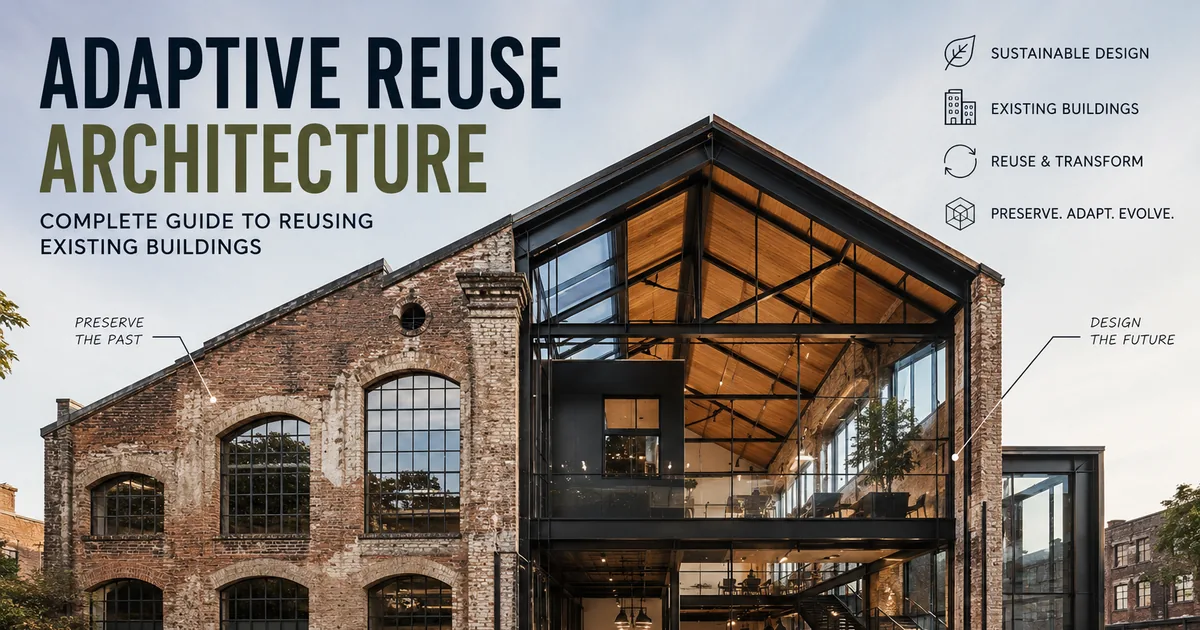
Adaptive reuse architecture is the practice of giving an existing building a new purpose instead of demolishing it and starting again. A warehouse becomes a gallery. A factory becomes an office. A school becomes housing. A church becomes a library. The old structure stays, but its function, circulation, interior, systems, and sometimes its identity are transformed.
For architects, adaptive reuse is not only a sustainability strategy. It is also a design method. It asks a simple but powerful question:
What can this existing building become without erasing what it already is?
Instead of treating old buildings as problems, adaptive reuse treats them as material, memory, structure, and opportunity. The architect works with what already exists: walls, columns, roofs, openings, textures, scars, proportions, and urban context.
This guide explains what adaptive reuse architecture means, how it differs from renovation and restoration, why it matters, what building types are commonly reused, and how architects can approach adaptive reuse projects with clear design strategies.
What Is Adaptive Reuse Architecture?
Adaptive reuse architecture is the process of converting an existing building into a new use while keeping a meaningful part of its original structure, character, or material presence.
The new use may be completely different from the original one. For example:
- An industrial warehouse becomes a co-working space.
- A railway station becomes a market hall.
- A historic house becomes a boutique hotel.
- A shopping mall becomes a mixed-use community hub.
- A factory becomes a museum or cultural center.
- An office building becomes housing.
The goal is not always to preserve the building exactly as it was. Adaptive reuse usually allows change. The building is modified so it can serve a new function, meet current regulations, and support new patterns of use.
Good adaptive reuse balances three things:
- The old building’s value
- The requirements of the new function
- The quality of the architectural transformation
The strongest projects do not hide the old building. They use it as part of the design story.
Adaptive Reuse vs Renovation vs Restoration vs Conservation
These terms are often used together, but they do not mean the same thing.
Adaptive Reuse
Adaptive reuse changes the function of a building. The existing structure is kept, but the program is transformed.
Example: A factory becomes an art museum.
The main question is:
How can this existing building support a new use?
Renovation
Renovation improves or updates a building, usually while keeping the same function.
Example: An old apartment building is repaired, upgraded, and modernized, but it remains housing.
The main question is:
How can this building be improved?
Restoration
Restoration tries to return a building to a previous historical condition. It focuses on accuracy, original materials, and historical details.
Example: A damaged historic facade is repaired to match its original design.
The main question is:
How can this building be brought back to its earlier condition?
Conservation
Conservation focuses on protecting and maintaining important cultural, historical, or architectural value. It is often more careful and less intervention-heavy.
Example: A heritage building is stabilized, cleaned, and preserved without major visual change.
The main question is:
How can this building be protected from loss or damage?
Simple Comparison Table
| Term | Main Goal | Function Changes? | Design Freedom |
|---|---|---|---|
| Adaptive reuse | Give the building a new use | Yes | High |
| Renovation | Improve the existing building | Usually no | Medium |
| Restoration | Return to a former condition | Usually no | Low |
| Conservation | Protect historical value | Usually no | Very low |
Adaptive reuse is usually the most design-driven of these approaches because it requires both preservation and invention.
Why Adaptive Reuse Matters
Adaptive reuse has become more important because cities already contain a huge amount of built structure. Many buildings are empty, outdated, underused, or no longer suitable for their original function.
Demolishing all of them is not always the best answer.
1. It Reduces Demolition Waste
Buildings contain large amounts of concrete, steel, brick, glass, timber, plaster, and finishes. When a building is demolished, much of that material becomes waste.
Adaptive reuse can reduce the amount of material sent to landfill by keeping major parts of the existing building.
2. It Preserves Embodied Carbon
A building already contains energy from extraction, manufacturing, transport, and construction. This is called embodied carbon.
When an existing structure is reused, the project can preserve some of that embodied energy instead of spending more carbon on a completely new structure.
3. It Protects Urban Memory
Old buildings carry traces of the city’s history. Their proportions, materials, openings, and details often hold cultural value.
Adaptive reuse allows cities to grow without becoming visually flat or generic. It keeps layers of time visible.
4. It Can Strengthen Local Identity
A reused building can become a landmark because it feels specific to its place. It does not look like something that could be built anywhere.
The existing structure gives the project a starting identity.
5. It Can Be Economically Practical
In some cases, reusing a structure can save time, reduce structural work, or make use of existing infrastructure. However, this depends heavily on the condition of the building, code requirements, and project scope.
Adaptive reuse is not always cheaper, but it can create high architectural value from an existing asset.
Common Building Types Used in Adaptive Reuse
Many building types can be adapted for new uses. The best candidates usually have strong structure, generous floor heights, flexible plans, or valuable character.
Industrial Buildings
Factories, warehouses, workshops, and mills are among the most common adaptive reuse candidates.
They often have:
- Large open floor plates
- High ceilings
- Exposed structure
- Durable materials
- Strong industrial character
- Large windows or roof lights
Common new uses include offices, galleries, markets, restaurants, universities, studios, and housing.
Historic Houses
Old houses can be transformed into restaurants, cultural centers, boutique hotels, galleries, or offices.
The challenge is usually scale. Houses often have smaller rooms, tighter circulation, and more delicate details.
Schools and Institutional Buildings
Schools, hospitals, government buildings, and civic structures can often support new public or semi-public functions.
They usually have repetitive plans, corridors, classrooms, halls, and courtyards that can be reorganized.
Religious Buildings
Churches, mosques, synagogues, temples, and chapels require careful treatment because they often carry strong cultural, symbolic, or emotional meaning.
Adaptive reuse must respect spatial character, light, acoustics, and community memory.
Office Buildings
Older office buildings can be converted into housing, hotels, education spaces, or mixed-use projects. This can be difficult when floor plates are too deep, daylight is limited, or services are outdated.
Shopping Malls
Many older malls are being reconsidered as mixed-use places. Their large footprints can be transformed into offices, clinics, schools, housing, indoor streets, or community spaces.
The challenge is to break down the scale and make the building feel urban rather than closed and isolated.
Infrastructure Buildings
Train stations, power stations, water towers, silos, parking structures, and bridges can become powerful architectural projects because they have strong forms and unusual spaces.
These projects often require creative programming.
How Architects Approach Adaptive Reuse
Adaptive reuse starts with careful reading. Before designing the new intervention, the architect must understand the existing building.
This includes:
- Structure
- Material condition
- Building age
- Historical value
- Spatial quality
- Daylight
- Circulation
- Floor heights
- Existing services
- Fire escape routes
- Accessibility
- Local codes
- Possible contamination
- Urban context
- Community meaning
The architect should not rush to erase the existing condition. The first step is to observe what is worth keeping.
A good adaptive reuse process usually asks:
- What must be preserved?
- What can be removed?
- What can be repaired?
- What can be exposed?
- What can be inserted?
- What should clearly look new?
- What should quietly blend with the old?
- How will the new function work inside the old structure?
The design is created through negotiation between the existing building and the new program.
Key Design Strategies in Adaptive Reuse Architecture
There is no single formula for adaptive reuse, but several design strategies appear again and again in strong projects.
1. Keep the Existing Shell
One of the clearest strategies is to keep the external walls or main structure while changing the inside.
This works well when the building has a valuable facade, strong street presence, or recognizable massing.
The shell becomes a memory container. Inside it, the architect can insert new floors, rooms, stairs, services, or public spaces.
This strategy is common in:
- Warehouses
- Historic houses
- Industrial halls
- Old civic buildings
- Urban blocks
The main challenge is making sure the old shell can support the new use safely and comfortably.
2. Insert a New Structure Inside the Old Building
Sometimes the old building cannot carry the new program alone. In this case, a new independent structure can be inserted inside it.
This creates a clear relationship between old and new.
The new structure may contain:
- Stairs
- Elevators
- New floors
- Bridges
- Rooms
- Service cores
- Platforms
- Exhibition spaces
This strategy works well when the architect wants the new intervention to be clearly visible but still respectful.
The old building becomes the outer frame. The new structure becomes the active layer.
3. Contrast Old and New
Some adaptive reuse projects clearly separate the old material from the new addition. The old may be brick, stone, concrete, or timber. The new may be steel, glass, aluminum, or clean plaster.
The contrast makes the timeline readable.
This approach can be powerful because it avoids fake historical imitation. Instead of pretending the new work is old, it shows that the building has changed over time.
A good contrast must be controlled. If the new addition is too aggressive, it can overpower the existing building. If it is too weak, it may feel unrelated.
The goal is not just difference. The goal is dialogue.
4. Preserve Key Details
Not every part of an old building needs to be preserved, but some details may carry strong architectural value.
These may include:
- Original doors
- Window frames
- Brick walls
- Timber beams
- Stone steps
- Iron railings
- Tiles
- Columns
- Trusses
- Decorative ceilings
- Signs
- Machinery
- Courtyard walls
- Old floor patterns
Preserving key details can keep the memory of the building alive even when the function changes completely.
This is also where architectural salvage becomes important. Salvaged elements can be reused inside the same project or moved into another project. For a deeper guide on this topic, see Architectural Salvage.
5. Expose the Existing Structure
Many adaptive reuse projects become stronger when the existing structure is exposed rather than hidden.
Exposed structure can include:
- Concrete columns
- Steel beams
- Brick walls
- Timber roof trusses
- Stone foundations
- Old slabs
- Industrial frames
This gives the project depth and honesty. Users can see how the building was made.
Exposed structure also creates texture. It gives the interior a quality that is difficult to create in a completely new building.
However, exposure must be done carefully. Old surfaces may need cleaning, fire treatment, moisture protection, or structural repair.
6. Add a New Circulation System
Many old buildings fail because their circulation no longer works. They may have poor entrances, confusing corridors, inaccessible floors, or unsafe escape routes.
A strong adaptive reuse project often starts by solving circulation.
This may include:
- A new main entrance
- A new stair
- A new elevator
- A new public route
- A new bridge
- A new internal street
- A new courtyard connection
- A new accessible ramp
Circulation is not only technical. It changes how people understand and experience the building.
In adaptive reuse, a new stair or atrium can become the main architectural move.
7. Create a Building Within a Building
Sometimes the best strategy is to place a smaller new building inside a larger old structure.
This is useful when the existing space is too large, too rough, or too open for the new function.
For example:
- A quiet office pod inside an industrial hall
- A climate-controlled gallery inside a warehouse
- A timber box inside a stone ruin
- A lecture room inside a former factory
- A cafe inserted into a train station hall
This strategy protects the old envelope while allowing the new use to meet modern comfort standards.
8. Keep the Imperfections
Old buildings often contain irregularities: uneven walls, patched surfaces, old openings, stains, cracks, rough textures, and traces of previous use.
A weak renovation tries to hide everything.
A strong adaptive reuse project knows what to keep.
Imperfections can make the building feel real. They show time. They give the space character.
The architect must decide which imperfections are beautiful, which are dangerous, and which are distracting.
Adaptive Reuse and Sustainable Architecture
Adaptive reuse is one of the most direct ways architecture can respond to sustainability.
Instead of asking only how to design a new green building, adaptive reuse asks whether a new building is needed at all.
This is important because demolition and new construction can consume major resources. Reusing an existing building can reduce waste, preserve materials, and make better use of land and infrastructure.
However, adaptive reuse is not automatically sustainable. A project can still perform poorly if it ignores insulation, ventilation, daylight, water use, energy systems, or maintenance.
A sustainable adaptive reuse project should consider:
- Thermal performance
- Natural daylight
- Passive ventilation
- Efficient mechanical systems
- Reused materials
- Durable finishes
- Flexible future use
- Low-waste construction methods
- Local repair skills
- Long-term maintenance
The best projects combine reuse with performance.
Adaptive Reuse and Architectural Salvage
Architectural salvage is closely connected to adaptive reuse.
Adaptive reuse focuses on reusing the building. Architectural salvage focuses on reusing building parts.
These parts may include:
- Bricks
- Doors
- Windows
- Tiles
- Timber beams
- Stone pieces
- Ironwork
- Hardware
- Light fixtures
- Flooring
- Decorative panels
- Facade elements
In an adaptive reuse project, salvaged materials can be used in several ways.
They can be kept in their original place, removed and reinstalled, reused as interior elements, or combined with new materials.
For example:
- Old bricks can be cleaned and reused in new walls.
- Timber beams can become furniture or ceiling features.
- Original doors can be restored and reused.
- Stone pieces can be reused in landscape edges.
- Old tiles can become a feature wall or floor insert.
This gives the project material continuity. It also reduces waste and keeps part of the building’s story visible.
Read more here: Architectural Salvage.
Adaptive Reuse Examples by Building Type
The following examples are not specific project case studies. They are common adaptive reuse patterns that architects use across many cities.
Factory to Museum
Factories often have large open spaces, strong structure, and dramatic scale. These qualities can work well for museums and galleries.
The industrial character can support exhibition spaces without needing too much decoration.
Design moves may include:
- Keeping large halls open
- Adding controlled gallery boxes
- Exposing roof structure
- Using old machinery as memory objects
- Creating new visitor circulation
Warehouse to Office
Warehouses are commonly reused as offices because they often have flexible floor plates and generous ceiling heights.
Design moves may include:
- Keeping exposed brick or concrete
- Adding meeting rooms as light partitions
- Creating shared work areas
- Using skylights or large windows
- Adding new service cores
The challenge is to balance open-plan flexibility with acoustic comfort and privacy.
Church to Library
A religious building can become a library because both uses can share a quiet, reflective atmosphere.
Design moves may include:
- Keeping the main volume open
- Inserting bookshelves as furniture-like elements
- Preserving stained glass or roof structure
- Adding reading platforms
- Controlling light and acoustics
The challenge is to respect the emotional and cultural character of the original space.
School to Housing
Old schools can be adapted into housing because classrooms often have good daylight and repeated structural bays.
Design moves may include:
- Converting classrooms into apartments
- Keeping corridors as shared circulation
- Using courtyards as communal gardens
- Adding balconies carefully
- Upgrading services and insulation
The challenge is privacy, services, and making the plan feel domestic.
Mall to Mixed-Use Hub
A declining mall can be transformed into a more urban mixed-use place.
Design moves may include:
- Opening the building to surrounding streets
- Turning internal corridors into public routes
- Adding offices, clinics, education, or housing
- Breaking large retail boxes into smaller units
- Creating outdoor courtyards or green spaces
The challenge is scale. Many malls are too large and inward-facing, so the design must create a more human urban experience.
Benefits of Adaptive Reuse
Adaptive reuse can offer many benefits when the building and program are suitable.
Environmental Benefits
- Less demolition waste
- Lower demand for new materials
- Preserved embodied carbon
- Reduced pressure on undeveloped land
- Opportunity to upgrade energy performance
Cultural Benefits
- Protects local memory
- Keeps historic layers visible
- Maintains neighborhood identity
- Gives old buildings new public value
Urban Benefits
- Revives underused areas
- Supports walkable neighborhoods
- Reuses existing infrastructure
- Can activate neglected streets or districts
Design Benefits
- Rich material character
- Unique spatial conditions
- Stronger project identity
- Clear dialogue between old and new
Economic Benefits
- Makes use of existing assets
- Can attract visitors and tenants
- Can support regeneration
- May reduce some construction costs depending on condition and scope
Challenges of Adaptive Reuse
Adaptive reuse is valuable, but it is not simple. Existing buildings come with limitations.
Structural Uncertainty
Old structures may not meet current load requirements. They may have hidden damage, weak foundations, corrosion, cracks, or undocumented modifications.
A structural assessment is essential.
Code and Safety Requirements
The building may need upgrades for:
- Fire safety
- Accessibility
- Escape routes
- Seismic performance
- Ventilation
- Energy efficiency
- Electrical systems
- Plumbing
- Public occupancy
These upgrades can strongly affect the design.
Unknown Existing Conditions
Old drawings may be missing or inaccurate. Walls may hide pipes, cables, moisture, or structural problems.
Site investigation is critical.
Cost Risk
Adaptive reuse can save money in some areas but create unexpected costs in others. Surprises are common.
A careful contingency budget is important.
Program Fit
Not every building can support every new function. A deep office floor plate may not become good housing. A delicate historic house may not work as a heavy public building.
The new use must fit the existing building.
Heritage Restrictions
Some buildings have protected status. This can limit what can be changed, removed, or added.
The architect may need to work with heritage authorities or conservation specialists.
Architect’s Checklist for Adaptive Reuse Projects
Before starting an adaptive reuse design, architects should study the existing building carefully.
Use this checklist as a starting point.
Building Value
- What is worth preserving?
- Is the building historically important?
- Does it have cultural or local value?
- Which elements define its character?
Structure
- What is the structural system?
- Are there cracks, settlement, corrosion, or moisture issues?
- Can the structure support the new use?
- Are new columns, beams, or cores needed?
Space and Program
- Does the new function fit the existing plan?
- Are the floor heights suitable?
- Is there enough daylight?
- Can circulation work clearly?
- Are there spaces that should remain open?
Envelope
- Are the walls, roof, and openings in good condition?
- Is insulation needed?
- Are windows repairable or replaceable?
- Are there moisture or thermal bridge issues?
Services
- Where can new mechanical systems go?
- Can old service shafts be reused?
- Is there space for ducts, pipes, and equipment?
- Can systems be upgraded without damaging key spaces?
Access and Safety
- Is there accessible entry?
- Are elevators needed?
- Are stairs and exits code-compliant?
- Can fire separation be achieved?
- Are ramps, handrails, and toilets accessible?
Materials
- Which materials can be reused?
- Which materials should be repaired?
- Which materials are unsafe or damaged?
- Can salvaged elements be integrated into the new design?
Future Flexibility
- Can the building change again later?
- Are partitions flexible?
- Are service routes accessible?
- Is the new use too specific or adaptable?
Common Mistakes in Adaptive Reuse
1. Removing Too Much
If too much of the existing building is removed, the project loses the value that made adaptive reuse meaningful in the first place.
The architect should identify the essential character before demolition begins.
2. Preserving Too Much
Keeping everything can also be a problem. Some elements may block the new use, reduce safety, or create poor spatial quality.
Good adaptive reuse requires editing.
3. Hiding the Old Building
Covering every old surface with new finishes can make the project feel like a normal renovation. The existing building should remain visible where it adds value.
4. Faking History
New work should not pretend to be old unless there is a strong restoration reason. In many adaptive reuse projects, it is better to make the new intervention honest and readable.
5. Ignoring Building Codes Early
Fire safety, accessibility, structure, and services can completely change the design. These issues should be studied early, not after the concept is finished.
6. Choosing the Wrong New Function
The new program must fit the existing building. Forcing the wrong use can lead to expensive compromises and weak architecture.
7. Over-Cleaning the Character
Old buildings often have texture and atmosphere. If everything is polished, painted, and flattened, the project may lose its depth.
Adaptive Reuse Design Principles
A strong adaptive reuse project usually follows these principles.
Respect the Existing Building
Respect does not mean freezing the building. It means understanding what gives it value before changing it.
Make the New Use Clear
The building should work well for its new function. Nostalgia should not make the plan confusing or uncomfortable.
Let Old and New Speak Together
The project should not be only preservation or only new design. The power comes from the relationship between both.
Use Material Honestly
Old materials should not be treated as decoration only. They should be part of the architectural logic.
Improve Performance
The building should not only look good. It should become safer, more comfortable, more efficient, and more usable.
Keep the Story Visible
The best adaptive reuse projects allow people to understand that the building had a previous life.
Adaptive Reuse in Architecture Education
Adaptive reuse is also an important topic for architecture students. It teaches design through constraint.
Unlike an empty site, an existing building already has rules. It has columns, walls, openings, levels, damage, memory, and context. The student must respond to these conditions.
This makes adaptive reuse a strong studio topic because it combines:
- Site analysis
- Building documentation
- Material study
- Structural thinking
- Program design
- Sustainability
- Heritage awareness
- Detail design
- User experience
A good student project should not only add a beautiful new form. It should explain why the existing building is worth keeping and how the new use grows from it.
How to Start an Adaptive Reuse Concept
If you are designing an adaptive reuse project, start with the existing building before thinking about style.
A useful process is:
- Document the building.
- Photograph important details.
- Draw the existing plan, section, and facade.
- Identify the strongest spaces.
- Mark what should be kept.
- Mark what can be removed.
- Study daylight and access.
- Test several new programs.
- Choose the program that fits best.
- Design the new intervention as a clear layer.
Do not begin by asking what the new building should look like. Begin by asking what the existing building wants to become.
Future of Adaptive Reuse
Adaptive reuse will likely become more important as cities deal with vacant offices, aging malls, old industrial zones, climate pressure, and the need for more sustainable construction.
Many buildings that once seemed obsolete can become valuable again through intelligent design.
The future of adaptive reuse is not only about preserving beautiful historic buildings. It is also about rethinking ordinary buildings: parking garages, supermarkets, offices, schools, warehouses, and malls.
The most sustainable building may often be the one that already exists.
Conclusion
Adaptive reuse architecture is one of the most meaningful ways to design with the past while building for the future.
It reduces waste, preserves embodied value, protects urban memory, and gives architects rich existing conditions to work with. But it also requires discipline. The architect must understand structure, code, material, program, and history before making design decisions.
A good adaptive reuse project does not simply decorate an old building. It transforms it.
It keeps what matters, removes what prevents new life, and adds a new architectural layer that allows the building to continue.
In that sense, adaptive reuse is not only a technical approach. It is a way of seeing architecture as something that can evolve instead of being erased.
Frequently Asked Questions
What is adaptive reuse in architecture?
Adaptive reuse in architecture is the process of converting an existing building to a new use while keeping important parts of its structure, character, or material identity.
What is an example of adaptive reuse?
A common example is converting an old warehouse into offices, apartments, galleries, restaurants, or a cultural center while keeping the original structure and industrial character.
Is adaptive reuse the same as renovation?
No. Renovation usually improves a building while keeping the same use. Adaptive reuse changes the function of the building, such as turning a factory into a museum or a school into housing.
Why is adaptive reuse sustainable?
Adaptive reuse can reduce demolition waste, preserve existing materials, save embodied carbon, and make better use of buildings and infrastructure that already exist.
What buildings are best for adaptive reuse?
Buildings with strong structure, generous floor heights, flexible plans, good daylight, and strong character are usually good candidates. Warehouses, factories, schools, offices, and historic houses are common examples.
What are the main challenges of adaptive reuse?
The main challenges include structural problems, code compliance, fire safety, accessibility, outdated services, hidden damage, heritage restrictions, and making sure the new function fits the old building.
How does architectural salvage relate to adaptive reuse?
Architectural salvage focuses on reusing parts of buildings, such as bricks, doors, tiles, timber, and ironwork. Adaptive reuse focuses on reusing the building itself. Both approaches can work together in sustainable design.