
Embodied Carbon in Architecture: Complete Guide for Architects
A complete architect-focused guide to embodied carbon in architecture, including what it means, why it matters, how it is measured, and how reuse, material choices, and design decisions can reduce a building’s carbon impact.
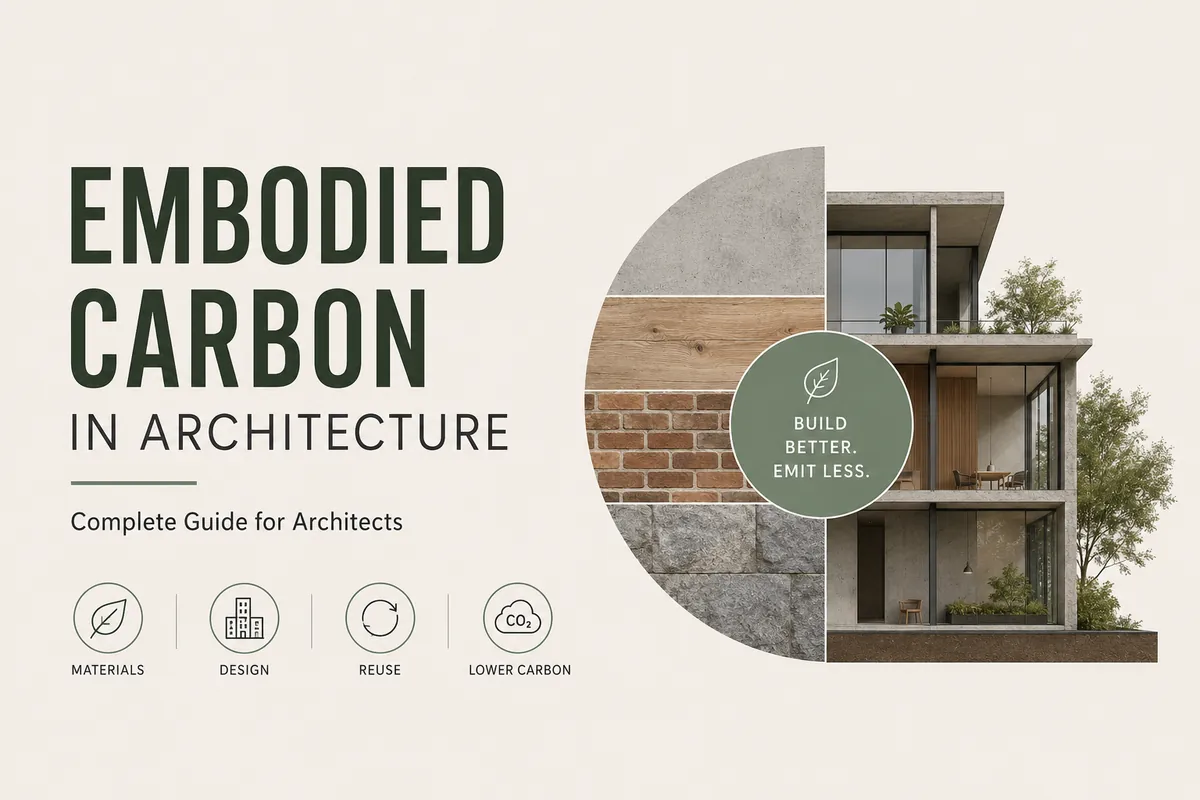
Embodied carbon is one of the most important ideas in sustainable architecture. It changes the way architects think about materials, structure, demolition, reuse, and the full life of a building.
For a long time, sustainable design focused mainly on operational energy: how much energy a building uses for heating, cooling, lighting, and equipment after it is built. That is still important. But a building also carries carbon before anyone even enters it.
That carbon comes from extracting raw materials, manufacturing products, transporting them, constructing the building, maintaining it, replacing components, and eventually demolishing or reusing it.
This is embodied carbon.
For architects, embodied carbon is not just a technical measurement. It is a design issue. Every structural grid, facade system, material choice, demolition decision, and detail can increase or reduce the carbon impact of a project.
This guide explains what embodied carbon means in architecture, where it comes from, why it matters, and how architects can reduce it through better material choices, adaptive reuse architecture, architectural salvage, circular construction, and smarter design decisions.
What Is Embodied Carbon in Architecture?
Embodied carbon is the carbon emissions associated with the materials and construction processes used to create, maintain, and eventually dispose of a building.
It includes emissions from activities such as:
- Extracting raw materials
- Manufacturing building products
- Transporting materials to site
- Constructing the building
- Repairing and replacing materials
- Demolishing the building
- Disposing, recycling, or reusing materials
In simple terms, embodied carbon is the carbon already “inside” the building before and during its life.
A concrete column, a steel beam, a brick wall, a glass curtain wall, a timber floor, and an aluminum frame all have embodied carbon. Their carbon impact depends on how they were made, where they came from, how far they traveled, how long they last, and whether they can be reused later.
Embodied carbon asks architects to look beyond appearance and performance. It asks:
What did this material cost the planet before it arrived on site?
Embodied Carbon vs Operational Carbon
To understand embodied carbon clearly, it helps to compare it with operational carbon.
Operational Carbon
Operational carbon comes from the energy used while a building is occupied and running.
This includes:
- Heating
- Cooling
- Lighting
- Ventilation
- Hot water
- Appliances
- Building systems
- Equipment
A poorly insulated building with inefficient systems may produce high operational carbon over its lifetime.
Embodied Carbon
Embodied carbon comes from the building’s materials and construction process.
This includes:
- Concrete
- Steel
- Brick
- Glass
- Aluminum
- Timber
- Insulation
- Finishes
- Transport
- Construction equipment
- Demolition waste
A building can have low operational energy but still carry high embodied carbon if it uses carbon-intensive materials or requires large amounts of new construction.
Why the Difference Matters
Architects often focus on making buildings efficient after construction. But the carbon from materials is released much earlier.
This means embodied carbon is urgent. It happens now, at the moment of construction, not slowly over decades.
A building with efficient systems but a wasteful material strategy may still have a large environmental impact.
The best sustainable architecture should reduce both:
- Operational carbon
- Embodied carbon
Why Embodied Carbon Matters
Embodied carbon matters because buildings use large amounts of material. Architecture is not lightweight. It consumes concrete, steel, glass, brick, stone, timber, insulation, metals, plastics, and finishes at a massive scale.
Every material decision has consequences.
1. Carbon Is Released Before the Building Opens
Operational carbon is produced during the life of the building. Embodied carbon is often produced before the building is even occupied.
This makes embodied carbon especially important for climate-conscious design.
If a project uses a large amount of new concrete, steel, aluminum, and glass, much of its carbon impact has already happened before the first user arrives.
2. Material Choices Shape the Carbon Footprint
Two buildings with the same area can have very different embodied carbon depending on their structure, envelope, and material palette.
For example:
- A heavy concrete structure may carry a different carbon impact than a lighter timber structure.
- A reused building may have a lower embodied carbon impact than a completely new building.
- A simple compact form may need fewer materials than a complex form with many facade layers.
- A long-lasting durable material may perform better over time than a short-lived material that needs frequent replacement.
This means embodied carbon is not only an engineering issue. It is part of architectural design.
3. Demolition Can Waste Existing Carbon
When a building is demolished, the carbon invested in its materials and construction is often lost.
This is why adaptive reuse architecture is so important. Reusing an existing building can preserve part of the carbon already invested in the structure.
Instead of asking only, “What should we build?” architects should also ask:
What can we keep?
4. It Encourages Better Long-Term Thinking
Embodied carbon forces architects to think about the full life of a building.
A material is not only selected for its look. It should also be judged by:
- How it is made
- How far it travels
- How long it lasts
- How easy it is to repair
- How often it needs replacement
- Whether it can be reused
- Whether it can be recycled
- Whether it creates waste
This creates a deeper and more responsible design process.
Where Embodied Carbon Comes From
Embodied carbon comes from different stages of a building’s life cycle.
A simple way to understand it is to follow the material from origin to end of life.
1. Raw Material Extraction
Every building material begins somewhere.
Stone is quarried. Timber is harvested. Metal ore is mined. Clay is extracted. Sand and aggregates are collected. Oil-based materials begin as fossil resources.
Extraction requires energy, machinery, transport, and land disturbance.
The more raw material a project needs, the larger this impact can become.
2. Manufacturing and Processing
After extraction, materials are processed into building products.
This stage can produce significant emissions, especially for energy-intensive materials.
Examples include:
- Cement production
- Steel manufacturing
- Aluminum production
- Glass manufacturing
- Brick firing
- Insulation production
- Chemical-based finishes
Some materials require very high heat or complex industrial processes. These processes often carry high carbon impact.
3. Transportation
Materials are moved from extraction sites to factories, from factories to suppliers, and from suppliers to the construction site.
Transportation carbon depends on:
- Distance
- Weight
- Transport method
- Number of trips
- Supply chain complexity
A heavy material transported over a long distance may carry more carbon than a local material with similar performance.
This is why local materials can sometimes reduce embodied carbon, especially when they are durable and responsibly sourced.
4. Construction
Construction itself also produces carbon.
This can include:
- Site machinery
- Cranes
- Temporary works
- Concrete pumping
- Material waste
- Worker transport
- On-site energy use
- Rework due to poor coordination
A design that is simple to build, well-coordinated, and low-waste can reduce construction-related carbon.
5. Maintenance and Replacement
A building’s embodied carbon does not stop after construction.
During the building’s life, materials may need to be repaired or replaced.
Common replacement items include:
- Floor finishes
- Ceiling systems
- Paint
- Waterproofing
- Facade panels
- Sealants
- Roofing membranes
- Mechanical equipment
- Interior partitions
A material with low initial carbon may not be the best choice if it fails quickly and needs repeated replacement.
Durability matters.
6. End of Life
At the end of a building’s life, materials may be:
- Demolished
- Sent to landfill
- Recycled
- Downcycled
- Salvaged
- Reused in another project
This is where architectural salvage becomes important.
If materials can be carefully removed and reused, they can continue their life instead of becoming waste.
A building designed for disassembly can make this much easier.
High-Carbon Building Materials
Not all building materials have the same carbon impact.
Some materials are more carbon-intensive because of the energy required to produce them, the chemical reactions involved, or the amount used in construction.
The goal is not always to ban these materials. Many of them are necessary. The goal is to use them intelligently, reduce waste, and choose lower-carbon alternatives where possible.
Concrete
Concrete is widely used because it is strong, durable, flexible, fire-resistant, and familiar to the construction industry.
Its embodied carbon mainly comes from cement, especially Portland cement.
Concrete is often used in large quantities, which makes its carbon impact important even when the carbon per unit seems moderate.
Ways to reduce concrete-related embodied carbon
Architects and engineers can reduce concrete impact by:
- Using less concrete through efficient structural design
- Optimizing spans and grid spacing
- Avoiding unnecessary transfer structures
- Using lower-carbon cement replacements where suitable
- Designing thinner slabs where structurally possible
- Reusing existing concrete structures through adaptive reuse
- Avoiding demolition when the structure can be retained
- Exposing existing concrete instead of covering it with new finishes
The biggest concrete saving often comes from keeping an existing structure rather than building a new one.
Steel
Steel is strong, flexible, recyclable, and useful for long spans, high-rise buildings, bridges, and industrial structures.
Its embodied carbon depends on production method, recycled content, energy source, and supply chain.
Ways to reduce steel-related embodied carbon
Architects can help reduce steel impact by:
- Designing efficient structural systems
- Avoiding oversized members
- Coordinating early with structural engineers
- Using standard sections where possible
- Designing for reuse and disassembly
- Reusing existing steel elements when safe and practical
- Keeping existing steel frames in adaptive reuse projects
- Avoiding unnecessary decorative steel where other materials can work
Steel can also be valuable in circular construction because it can often be recycled or reused if connections are designed carefully.
Aluminum
Aluminum is common in curtain walls, windows, doors, cladding, shading devices, and interior systems.
It is lightweight and corrosion-resistant, but it can be energy-intensive to produce.
Ways to reduce aluminum-related embodied carbon
Design strategies include:
- Reducing unnecessary aluminum cladding
- Using efficient facade systems
- Choosing durable systems with long service life
- Prioritizing recycled aluminum where available
- Designing facade components for repair and replacement
- Avoiding overly complex facade geometries that increase waste
A simple facade can often be lower-carbon than a highly customized facade with many unique parts.
Glass
Glass is essential for daylight, views, and facade expression, but large areas of glazing can increase both embodied and operational impacts.
Glass affects embodied carbon through manufacturing and framing systems. It also affects operational carbon through heat gain, heat loss, glare, and cooling loads.
Ways to use glass more responsibly
Architects can:
- Use glazing where it adds real value
- Avoid excessive glass areas
- Balance daylight with thermal performance
- Use shading devices
- Design for orientation
- Choose appropriate glass specifications
- Reduce unnecessary double-height glazed surfaces
- Use solid wall areas where they improve performance
A sustainable building does not need to be fully glazed to feel open or modern.
Brick and Masonry
Brick, block, and masonry materials vary in carbon impact depending on manufacturing, firing, transport, and installation.
Brick can be durable and long-lasting, but fired clay bricks require energy to produce.
Ways to reduce masonry impact
Architects can:
- Use salvaged brick where suitable
- Reduce unnecessary decorative layers
- Use local masonry materials
- Design walls that last
- Avoid replacing masonry that can be repaired
- Use brick as both structure and finish where possible
- Reuse existing masonry walls in adaptive reuse projects
Salvaged brick can be especially powerful because it combines texture, local memory, and material reuse.
Read more: Architectural Salvage.
Timber
Timber can be a lower-carbon material when it is responsibly sourced and used appropriately.
It is renewable, lightweight, and can store carbon during its service life. But timber is not automatically sustainable. It depends on forestry practices, transport, treatment, durability, and end-of-life strategy.
Ways to use timber responsibly
Architects can:
- Specify certified or responsibly sourced timber
- Use timber efficiently
- Protect timber from moisture
- Design durable details
- Avoid unnecessary chemical treatments
- Use reclaimed timber where possible
- Design timber components for future reuse
Reclaimed timber is one of the most valuable salvage materials because older wood often carries strength, texture, and memory.
Low-Carbon Design Strategies for Architects
Reducing embodied carbon is not one single decision. It is a series of design choices across the whole project.
Here are the most important strategies.
1. Reuse Existing Buildings
The most powerful embodied carbon strategy is often to avoid new construction where possible.
If an existing building can be adapted, extended, repaired, or transformed, the project may preserve a large amount of existing material and structural value.
This is the core idea behind adaptive reuse architecture.
Adaptive reuse can reduce the need for new:
- Foundations
- Columns
- Beams
- Slabs
- Walls
- Facades
- Roof structures
- Site infrastructure
Instead of demolishing a building and replacing it, architects can ask:
Can this building support a new function?
This question can completely change the carbon impact of a project.
2. Keep the Existing Structure
Even when a full adaptive reuse project is not possible, keeping part of the existing structure can reduce embodied carbon.
The structure is often one of the highest-carbon parts of a building, especially when it includes large amounts of concrete or steel.
Architects should study whether they can retain:
- Foundations
- Basement walls
- Columns
- Beams
- Slabs
- Cores
- Staircases
- Roof trusses
- Masonry walls
- Facades
Keeping structure also preserves time, memory, and urban continuity.
3. Use Architectural Salvage
Architectural salvage reduces embodied carbon by extending the life of existing materials.
Instead of sending valuable building components to landfill, architects can recover and reuse them.
Common salvaged materials include:
- Brick
- Timber beams
- Stone
- Doors
- Windows
- Steel members
- Ironwork
- Tiles
- Flooring
- Light fixtures
- Hardware
Salvage is especially useful when a project wants texture, identity, and sustainability at the same time.
A salvaged material does not only reduce demand for new production. It also brings history into the project.
4. Design With Less Material
One of the simplest ways to reduce embodied carbon is to use less material.
This does not mean making weak or poor-quality buildings. It means avoiding unnecessary mass, layers, and complexity.
Architects can reduce material use by:
- Simplifying forms
- Avoiding excessive cantilevers
- Optimizing structural spans
- Reducing unnecessary facade layers
- Avoiding decorative over-cladding
- Using structure as finish
- Designing compact plans
- Reducing basement excavation where possible
A clear, efficient building is often lower-carbon than a complicated one.
5. Choose Lower-Carbon Materials
Material selection matters.
Architects should compare materials not only by cost, appearance, and availability, but also by carbon impact.
This may include:
- Lower-carbon concrete mixes
- Recycled steel
- Responsibly sourced timber
- Reclaimed brick
- Reused stone
- Natural insulation
- Durable local materials
- Low-carbon finishes
The right material depends on the project. A low-carbon decision in one climate, budget, or construction system may not work in another.
The goal is not to follow a trend. The goal is to make informed decisions.
6. Use Local Materials Carefully
Local materials can reduce transport emissions and strengthen local identity.
But local is not automatically low-carbon. A local material with very high manufacturing emissions may still have a larger impact than another material transported from farther away.
Still, local materials often have advantages:
- Shorter transport routes
- Better repair knowledge
- Stronger connection to place
- Easier sourcing
- Better availability
- Lower risk of replacement delay
For architects, local materials are valuable when they combine performance, durability, beauty, and responsible sourcing.
7. Design for Durability
A building that lasts longer can spread its embodied carbon over a longer period of use.
Durability is not only about strong materials. It is also about good detailing.
A durable building needs:
- Proper waterproofing
- Good drainage
- Repairable facades
- Protected timber
- Replaceable parts
- Strong corners and edges
- Suitable material choices
- Easy maintenance access
A low-carbon material used badly may fail early. A higher-carbon material used wisely may last much longer.
Embodied carbon should always be considered together with service life.
8. Design for Adaptability
Buildings often change. Families grow. Offices shift. Retail changes. Schools expand. Technology evolves.
If a building cannot adapt, it may be demolished earlier than necessary.
Designing for adaptability can reduce future embodied carbon by extending the building’s useful life.
Adaptable design may include:
- Flexible structural grids
- Generous floor-to-floor heights
- Simple service routes
- Movable partitions
- Accessible risers
- Multi-use spaces
- Clear circulation
- Expandable zones
- Strong but flexible envelopes
A building that can change is less likely to become waste.
9. Design for Disassembly
Design for disassembly means creating buildings so their parts can be removed, repaired, replaced, or reused in the future.
This supports future salvage and circular construction.
Useful strategies include:
- Bolted connections instead of permanent welded connections where appropriate
- Screws instead of strong adhesives
- Mechanical fixing systems
- Modular components
- Accessible joints
- Reversible details
- Separable material layers
- Clear documentation
- Material passports
A detail should not only answer how a building is assembled. It should also consider how it might come apart later.
This idea connects directly to architectural salvage, because tomorrow’s salvage depends on today’s details.
10. Reduce Construction Waste
Construction waste increases embodied carbon because it means materials were produced, transported, and then discarded without serving their full purpose.
Architects can reduce waste by:
- Using standard material dimensions
- Coordinating drawings carefully
- Reducing design changes during construction
- Avoiding over-customization
- Prefabricating components where suitable
- Planning material storage properly
- Designing with available material sizes
- Working closely with contractors
Waste is not only a site issue. It often begins in design.
Embodied Carbon and Adaptive Reuse
Adaptive reuse is one of the strongest architectural responses to embodied carbon.
When architects reuse an existing building, they preserve part of the carbon already invested in it.
This can include:
- Foundations
- Structure
- Facades
- Roofs
- Walls
- Stairs
- Materials
- Urban infrastructure
A reused building also preserves memory and identity. It keeps the city layered rather than replacing everything with new construction.
Adaptive reuse does not mean doing nothing. It can include major changes:
- New circulation
- New services
- New structure inside old structure
- New facade additions
- New roofs
- New uses
- New public spaces
But the starting point is different.
Instead of treating the existing building as an obstacle, the architect treats it as a resource.
For a deeper guide, read Adaptive Reuse Architecture.
Embodied Carbon and Architectural Salvage
Architectural salvage works at the material scale.
While adaptive reuse focuses on the whole building, salvage focuses on parts of buildings.
Salvaged materials can include:
- Reclaimed timber
- Salvaged brick
- Stone slabs
- Old doors
- Vintage windows
- Iron railings
- Steel members
- Decorative tiles
- Light fixtures
- Hardware
These materials already exist. Reusing them can reduce the need for newly manufactured products.
Salvage also brings visual value. It gives architecture texture, age, and story.
A new material can be clean and precise. A salvaged material can carry memory.
This is why salvage is not only a sustainability tactic. It is also an architectural language.
Read the full guide here: Architectural Salvage.
Embodied Carbon by Building Layer
A building is made of layers. Each layer has a different life span and carbon impact.
Understanding these layers helps architects make better decisions.
Structure
The structure often carries a large part of embodied carbon because it uses heavy materials such as concrete and steel.
Strategies:
- Reuse existing structure
- Optimize spans
- Avoid unnecessary transfers
- Use efficient grids
- Coordinate early with engineers
- Consider lower-carbon structural systems
- Design for future adaptability
Envelope
The envelope includes walls, facades, windows, roofs, insulation, cladding, and waterproofing.
It affects both embodied carbon and operational carbon.
Strategies:
- Balance glazing and solid wall areas
- Avoid excessive facade complexity
- Use durable materials
- Design repairable facade systems
- Choose insulation carefully
- Reduce unnecessary cladding layers
- Reuse existing facades where possible
Interiors
Interior fit-outs can create significant carbon over time because they are replaced more often than structure.
Strategies:
- Use fewer applied finishes
- Expose structure where appropriate
- Use durable flooring
- Choose low-carbon finishes
- Design flexible partitions
- Avoid unnecessary ceiling systems
- Reuse furniture and fixtures
- Select materials that can be repaired
A building with frequent interior replacement may carry high lifetime embodied carbon even if its structure remains unchanged.
Building Services
Mechanical, electrical, and plumbing systems are essential, but they also involve carbon through equipment, ducts, pipes, cables, and replacement cycles.
Strategies:
- Design efficient systems
- Avoid oversizing
- Coordinate service routes
- Make equipment accessible for maintenance
- Plan for replacement
- Use passive design to reduce system demand
- Keep service zones flexible
Services should be integrated early, not forced into the building later.
Landscape and Site Works
Embodied carbon is not only inside the building.
Site works can include:
- Concrete paving
- Retaining walls
- Imported soil
- Stone
- Irrigation systems
- Steel edges
- Outdoor furniture
- Lighting
- Drainage systems
Strategies:
- Reduce unnecessary hardscape
- Reuse existing paving
- Use local stone
- Salvage site materials
- Design with existing topography
- Keep mature trees where possible
- Reduce excavation and retaining structures
The landscape can either increase carbon or become part of a low-carbon design strategy.
Circular Construction and Embodied Carbon
Circular construction aims to keep buildings and materials in use for as long as possible.
Instead of a linear process:
take → make → use → demolish → waste
circular construction supports a loop:
use → maintain → adapt → disassemble → reuse
This approach reduces embodied carbon by extending material life.
Circular construction can include:
- Adaptive reuse
- Architectural salvage
- Material passports
- Design for disassembly
- Modular systems
- Repairable components
- Reused materials
- Recyclable assemblies
- Flexible planning
The circular mindset changes how architects design.
A building is no longer a final object. It becomes a temporary arrangement of materials that may have future lives.
Material Passports
A material passport is a digital record of the materials and components in a building.
It may include:
- Material type
- Quantity
- Dimensions
- Manufacturer
- Source
- Installation date
- Carbon data
- Fire rating
- Maintenance history
- Disassembly method
- Reuse potential
Material passports can make future reuse easier because they give future architects and contractors the information they need.
Without information, reuse becomes risky.
With information, buildings can become material banks.
This is especially important for future architectural salvage, because salvaged materials need documentation to be reused safely and efficiently.
How Architects Can Reduce Embodied Carbon Early
The most important embodied carbon decisions happen early.
By the time a project reaches detailed design or construction, many major carbon decisions are already locked in.
Early design questions should include:
- Can we reuse an existing building?
- Can we keep the existing structure?
- Can we reduce the building area?
- Can we simplify the form?
- Can we reduce basement excavation?
- Can we use a more efficient structural grid?
- Can we use fewer high-carbon materials?
- Can we expose structure instead of adding finishes?
- Can we design for future change?
- Can we use salvaged or reclaimed materials?
- Can we reduce facade complexity?
- Can we choose durable materials that last longer?
Embodied carbon should not be added as a late sustainability note. It should shape the concept from the beginning.
Architect’s Checklist for Reducing Embodied Carbon
Use this checklist during concept and design development.
Existing Building
- Can the existing building be reused?
- Can the structure be retained?
- Can the facade be repaired instead of replaced?
- Can the building support a new program?
- Is adaptive reuse possible?
Structure
- Is the structural grid efficient?
- Are spans reasonable?
- Are transfer beams avoided where possible?
- Is the structure oversized?
- Can lower-carbon structural materials be used?
- Can existing foundations or slabs be reused?
Materials
- Which materials have the highest carbon impact?
- Are lower-carbon alternatives available?
- Can local materials reduce transport?
- Can reclaimed or salvaged materials be used?
- Are materials durable and repairable?
- Are finishes necessary or can structure be exposed?
Envelope
- Is the glazing area appropriate?
- Is the facade too complex?
- Can cladding layers be reduced?
- Are materials durable?
- Can elements be replaced individually?
- Can the existing envelope be upgraded instead of removed?
Interiors
- Are finishes simple and durable?
- Can partitions be flexible?
- Can furniture or fixtures be reused?
- Are ceiling systems necessary?
- Can materials be repaired instead of replaced?
Future Life
- Can the building adapt to new uses?
- Can components be disassembled?
- Are materials documented?
- Can parts be salvaged later?
- Is there a maintenance strategy?
Common Mistakes When Thinking About Embodied Carbon
1. Focusing Only on Operational Energy
A building can be energy efficient in operation but still have high embodied carbon.
Sustainable design must consider both.
2. Demolishing Too Quickly
Demolition is often treated as the easiest option, but it can waste structure, materials, memory, and embodied carbon.
Before demolition, architects should seriously test reuse.
3. Using “Green” Materials Without Context
A material is not sustainable just because it sounds natural or trendy.
The full context matters: sourcing, transport, durability, maintenance, and end of life.
4. Ignoring Quantity
Even a moderate-carbon material can have a large impact if used in huge quantities.
Reducing material quantity is often as important as changing material type.
5. Overcomplicating the Facade
Complex facades can use more material, more substructure, more custom components, and more replacement parts.
Simplicity can be a carbon strategy.
6. Treating Salvage as Decoration Only
Salvaged materials should not be used only as visual props.
They are most powerful when they are integrated into the design logic, material strategy, and project story.
7. Forgetting Future Adaptation
A building that cannot adapt may be demolished sooner.
Future flexibility is a major embodied carbon strategy.
Embodied Carbon in Architecture Education
Architecture students should learn embodied carbon early because it affects the way they think about form, structure, materials, and site.
A studio project should not only ask:
- What is the concept?
- What is the form?
- What is the facade?
- What is the program?
It should also ask:
- What already exists?
- What can be reused?
- What is the structural logic?
- What materials are necessary?
- What materials can be avoided?
- How long will the building last?
- Can it change in the future?
- What happens when it is taken apart?
This does not make architecture less creative. It makes creativity more intelligent.
Design constraints often produce stronger architecture.
Embodied Carbon and Architectural Design Quality
Reducing embodied carbon does not mean architecture must become boring, weak, or visually poor.
In fact, it can lead to better design.
Low-carbon thinking can encourage:
- Clearer structure
- Better material honesty
- Less wasteful detailing
- Stronger reuse of existing buildings
- More durable architecture
- More meaningful material choices
- Better relationship to context
- More disciplined design decisions
A low-carbon building does not need to look like a technical checklist.
It can be beautiful, atmospheric, and deeply architectural.
The difference is that its beauty comes with responsibility.
Future of Embodied Carbon in Architecture
Embodied carbon will become more important as the construction industry moves toward more responsible design.
Architects will need to understand:
- Carbon data
- Life cycle thinking
- Material reuse
- Adaptive reuse
- Design for disassembly
- Circular construction
- Low-carbon specifications
- Durable detailing
- Existing building transformation
The future of sustainable architecture will not only be about better machines and efficient systems. It will also be about using fewer new materials, keeping buildings longer, and designing in a way that respects the carbon already invested in the built environment.
The question will shift from:
How do we build more?
to:
How do we build more intelligently?
Frequently Asked Questions
What is embodied carbon in architecture?
Embodied carbon in architecture is the carbon emissions associated with building materials and construction processes. It includes emissions from extraction, manufacturing, transport, construction, maintenance, replacement, demolition, and disposal.
What is the difference between embodied carbon and operational carbon?
Operational carbon comes from the energy used while a building is running, such as heating, cooling, lighting, and equipment. Embodied carbon comes from the materials and construction process used to create, maintain, and eventually remove the building.
Why is embodied carbon important?
Embodied carbon is important because much of it is released before a building is even occupied. It is directly affected by material choices, structural systems, demolition decisions, and whether existing buildings or materials are reused.
Which building materials have high embodied carbon?
Common high-impact materials include concrete, steel, aluminum, glass, and some types of fired masonry or synthetic insulation. Their impact depends on production method, quantity, transport, recycled content, and how they are used.
How can architects reduce embodied carbon?
Architects can reduce embodied carbon by reusing existing buildings, keeping existing structures, using salvaged materials, reducing material quantities, choosing lower-carbon materials, designing durable buildings, and planning for future adaptation and disassembly.
How does adaptive reuse reduce embodied carbon?
Adaptive reuse architecture can reduce embodied carbon by keeping existing structures, facades, materials, and infrastructure instead of demolishing them and building completely new replacements.
How does architectural salvage reduce embodied carbon?
Architectural salvage reduces embodied carbon by recovering and reusing existing building materials such as timber, brick, stone, doors, windows, steel, and hardware instead of manufacturing new products.
Is timber always low-carbon?
No. Timber can be lower-carbon when responsibly sourced, durable, and used well, but it is not automatically sustainable. Forestry practices, transport, treatment, lifespan, and end-of-life strategy all matter.
Is concrete always bad for embodied carbon?
Concrete can have high embodied carbon because of cement and the large quantities used, but it is also durable, strong, and sometimes necessary. The goal is to use it efficiently, reduce waste, choose lower-carbon mixes where possible, and retain existing concrete structures when practical.
What is circular construction?
Circular construction is an approach that keeps buildings and materials in use for as long as possible. It includes adaptive reuse, salvage, design for disassembly, repairable components, material passports, and future material reuse.
Conclusion
Embodied carbon changes the way architects think about buildings.
It shows that sustainability is not only about energy performance after construction. It is also about the carbon cost of materials, structure, demolition, replacement, and waste.
For architects, this creates a clear responsibility.
We need to question unnecessary demolition. We need to reuse existing buildings when possible. We need to keep structures that still have value. We need to choose materials carefully. We need to reduce waste. We need to design buildings that last, adapt, and eventually come apart intelligently.
This is why embodied carbon connects so strongly to adaptive reuse architecture and architectural salvage. Both approaches begin with the same idea:
What already exists has value.
The future of architecture will not depend only on new forms, new technologies, or new materials. It will also depend on how wisely we use what is already here.
A lower-carbon architecture is not less ambitious.
It is more thoughtful, more precise, and more aware of the real cost of building.