
Cross Ventilation in Architecture: Passive Cooling Strategies, Diagrams, and Design Tips
A clear architectural guide to cross ventilation, how it works, where it works best, and how architects can use openings, room depth, courtyards, and wind direction to improve natural airflow.
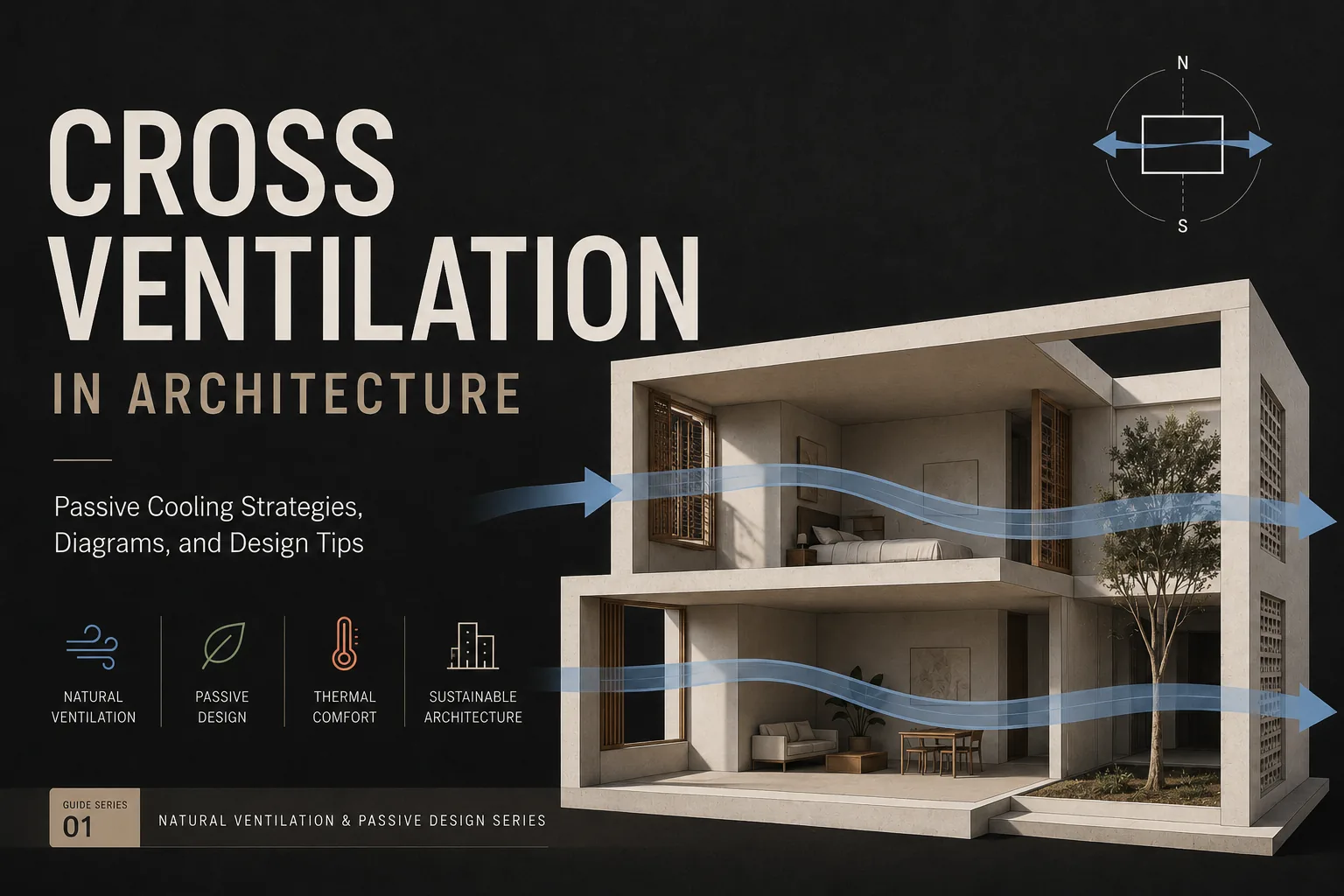
Cross ventilation is one of the simplest and most effective passive cooling strategies in architecture. Instead of depending only on mechanical air conditioning, it uses pressure difference, wind direction, and well-placed openings to move fresh air through a building.
In hot and warm climates, good cross ventilation can improve indoor comfort, reduce heat buildup, and make a space feel more alive. It is not just a technical detail. It is part of how a building breathes.
This guide is the first article in our natural ventilation and passive cooling series. In the next articles, we will look at stack ventilation, courtyard cooling, wind towers, shading strategies, and climate-responsive building forms.
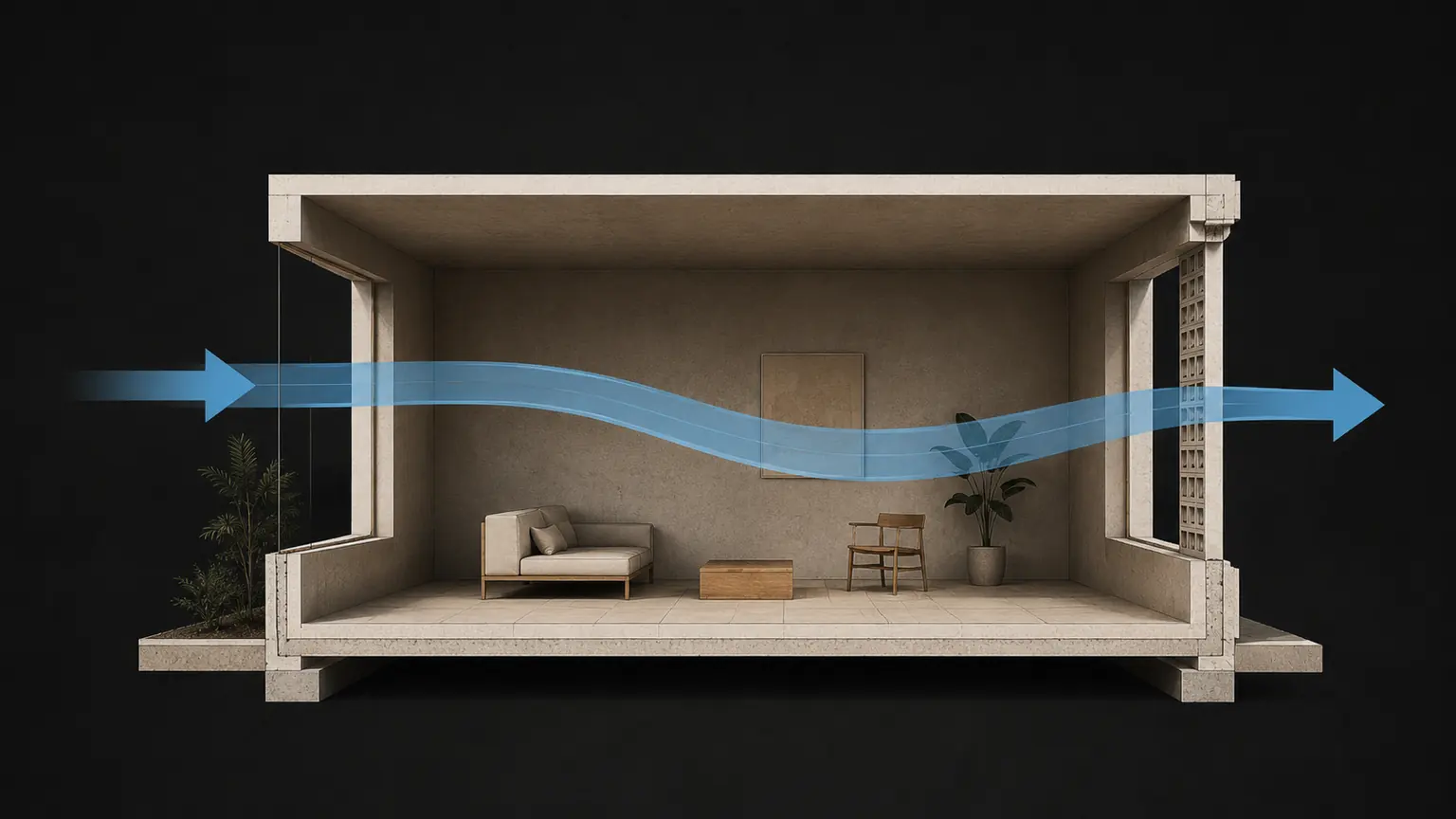
Caption: Cross ventilation works best when air can enter from one side of a space and leave from another, creating continuous airflow.
What Is Cross Ventilation?
Cross ventilation is a natural ventilation method where air enters a building from one opening and exits through another opening on the opposite or adjacent side.
The basic idea is simple:
- Wind creates higher pressure on the windward side of the building.
- Air enters through openings facing or near the wind.
- Lower pressure on the opposite side pulls the air out.
- This movement creates airflow across the interior space.
In architecture, this is useful because air movement helps remove heat, humidity, odors, and stale indoor air. The U.S. Department of Energy’s guide to natural ventilation explains that natural ventilation can be improved through strategic window placement, operable openings, and climate-aware design.
Cross ventilation is especially important in houses, schools, offices, restaurants, and public buildings where comfort depends not only on temperature, but also on air freshness and movement.
Why Cross Ventilation Matters in Architecture
Cross ventilation is not only about “having windows.” Many buildings have windows but still feel hot, humid, or airless because the openings are badly placed.
Good cross ventilation can help with:
- Passive cooling
- Indoor air quality
- Thermal comfort
- Lower energy use
- Reduced dependence on air conditioning
- Better connection between inside and outside
- Healthier and more breathable spaces
In sustainable architecture, cross ventilation is one of the first strategies architects study because it works with the climate instead of fighting against it. The Australian Government’s Your Home passive cooling guide describes passive cooling as a system that uses air movement, shading, thermal mass, and other climate-responsive strategies to improve comfort.
A building that is designed around natural airflow can often feel more comfortable, even before mechanical systems are added.
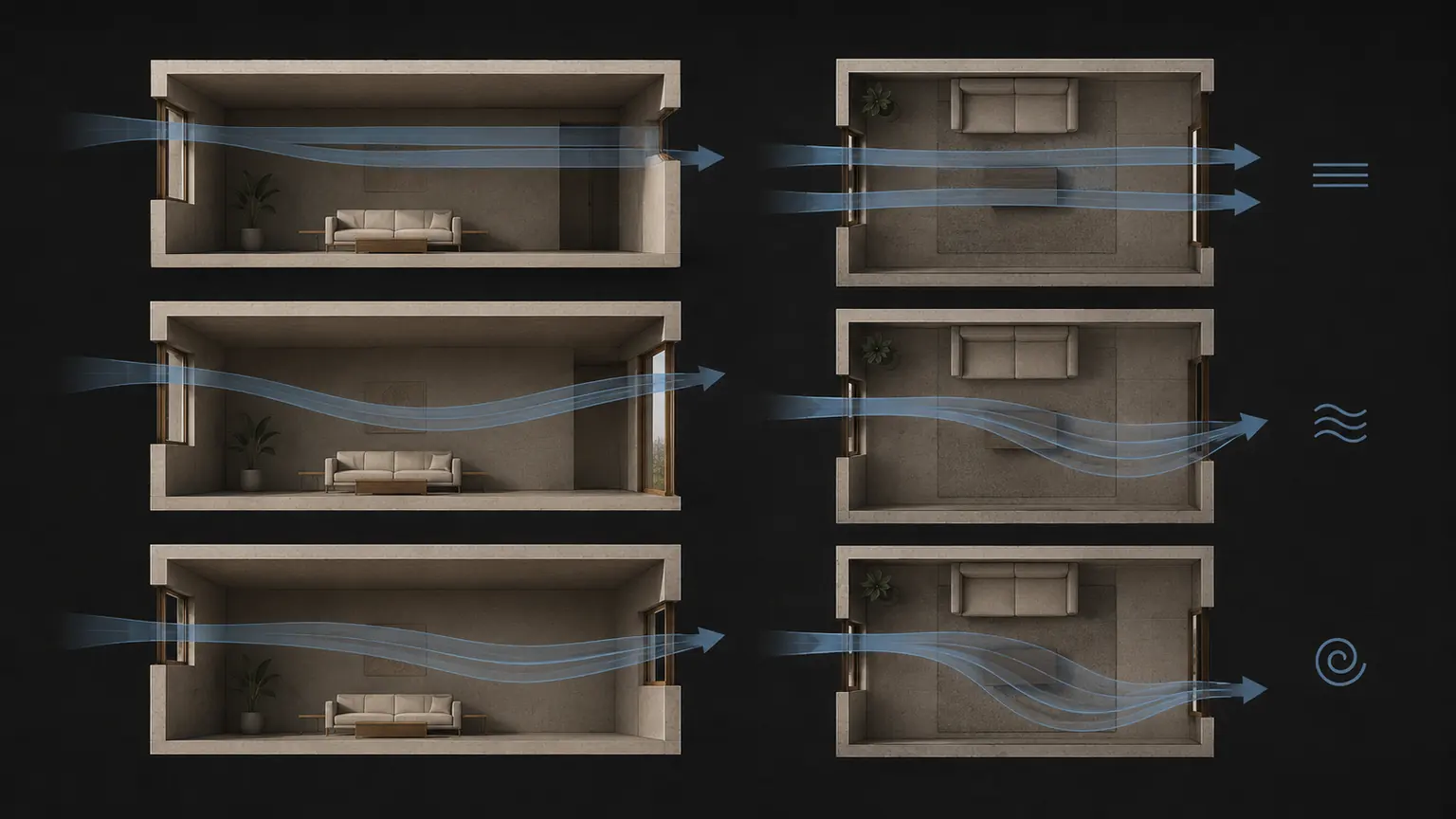
Caption: Window placement has a strong effect on airflow. Openings should create a clear path across the space, not trap air in one corner.
How Cross Ventilation Works
Cross ventilation depends on pressure difference.
When wind hits a building, the side facing the wind becomes a high-pressure zone. The opposite side becomes a lower-pressure zone. Air naturally moves from high pressure to low pressure.
Architecturally, this means the building needs:
- An inlet opening where air enters.
- An outlet opening where air exits.
- A clear path between both openings.
- Enough difference in pressure to keep air moving.
The stronger and cleaner the airflow path, the better the ventilation.
This is why a narrow room with openings on opposite walls usually ventilates better than a deep room with only one window. A natural ventilation design manual hosted by the Whole Building Design Guide also notes that building layout, partitions, and room organization can strongly affect airflow patterns.
Video: Cross Ventilation and Stack Effect Explained
For a deeper technical explanation, this educational video explains how cross ventilation and stack effect work together in building airflow design.
Video: Cross ventilation and stack effect explained through airflow concepts and opening design.
Cross Ventilation vs Single-Sided Ventilation
Single-sided ventilation happens when air enters and exits from the same side of the room. This can work in small spaces, but it is usually weaker.
Cross ventilation is more effective because air has a direction. It moves across the room instead of only circulating near one wall.
Single-sided ventilation may be enough for:
- Small bedrooms
- Small offices
- Bathrooms
- Compact rooms with shallow depth
Cross ventilation is better for:
- Living rooms
- Classrooms
- Open-plan spaces
- Restaurants
- Courtyard houses
- Tropical buildings
- Climate-responsive architecture
The deeper the room, the more important cross ventilation becomes.
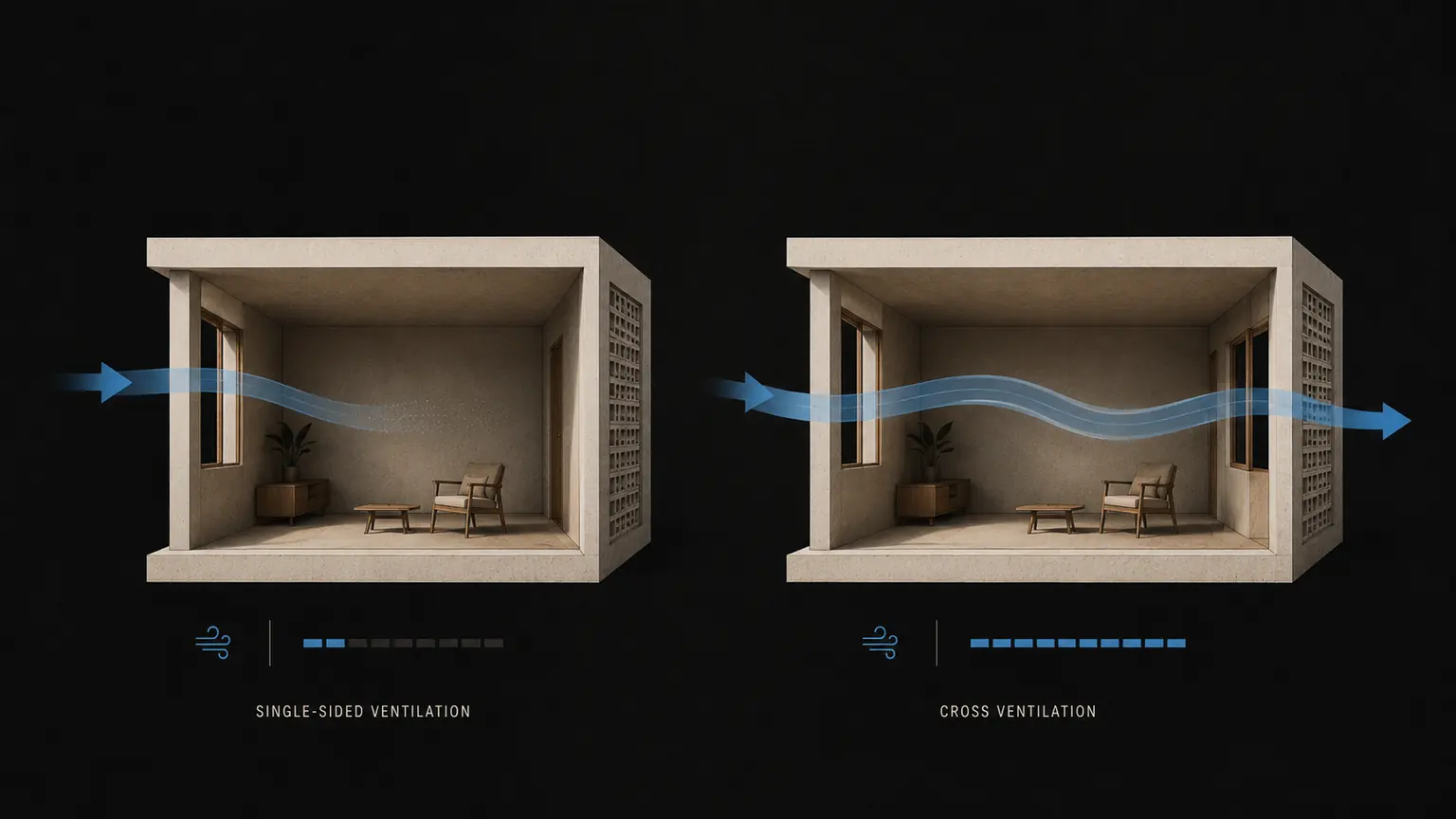
Caption: Cross ventilation usually performs better than single-sided ventilation because it creates a more direct airflow path through the space.
Best Design Strategies for Cross Ventilation
1. Place Openings on Opposite Sides
The most direct strategy is to place windows, doors, vents, or screens on opposite walls.
This allows air to pass through the room clearly.
For example, a living room with one window facing the street and another opening toward a courtyard can create strong natural airflow.
The goal is not just to add more windows. The goal is to align openings so that air can move through the space.
2. Use Adjacent Openings When Opposite Walls Are Not Possible
Sometimes a room cannot have openings on opposite walls. In that case, adjacent openings can still help.
For example, one window on the front wall and another on the side wall can create diagonal airflow.
This is useful in:
- Corner rooms
- Apartments
- Narrow plots
- Urban houses
- Buildings with one exposed facade
Diagonal cross ventilation is usually weaker than direct opposite ventilation, but it is still much better than relying on one opening only.
3. Keep the Air Path Clear
Furniture, partitions, solid doors, deep corridors, and heavy curtains can block airflow.
A room may have two windows but still ventilate poorly if the path between them is blocked.
Good architectural planning should consider airflow as an invisible circulation path. Air needs movement space just like people do.
Use:
- Open layouts
- Perforated partitions
- Internal windows
- High-level vents
- Louvers
- Sliding screens
- Transom openings above doors
These elements help air move through the building even when rooms need privacy.

Caption: Cross ventilation is affected by interior layout. Air needs a clear route through rooms, doors, and partitions.
4. Design for the Local Wind Direction
Cross ventilation should respond to the actual climate of the site.
Before placing openings, architects should study:
- Prevailing wind direction
- Seasonal wind changes
- Sun exposure
- Neighboring buildings
- Site obstructions
- Street orientation
- Courtyard position
A window facing the wrong direction may provide light but very little airflow.
In hot climates, this becomes even more important. Good ventilation design should work together with shading, insulation, thermal mass, and building orientation. The Your Home orientation guide recommends positioning door and window openings to improve cross-ventilation paths and support night purging.
5. Use Courtyards to Improve Air Movement
Courtyards can support cross ventilation by creating protected outdoor spaces that connect different rooms.
In many traditional houses, courtyards help pull air through the building while also providing shade and controlled daylight.
A courtyard can act as:
- An air outlet
- A shaded cooling zone
- A pressure relief space
- A connector between rooms
- A buffer between inside and outside
This is one reason courtyard houses are common in hot and dry regions.
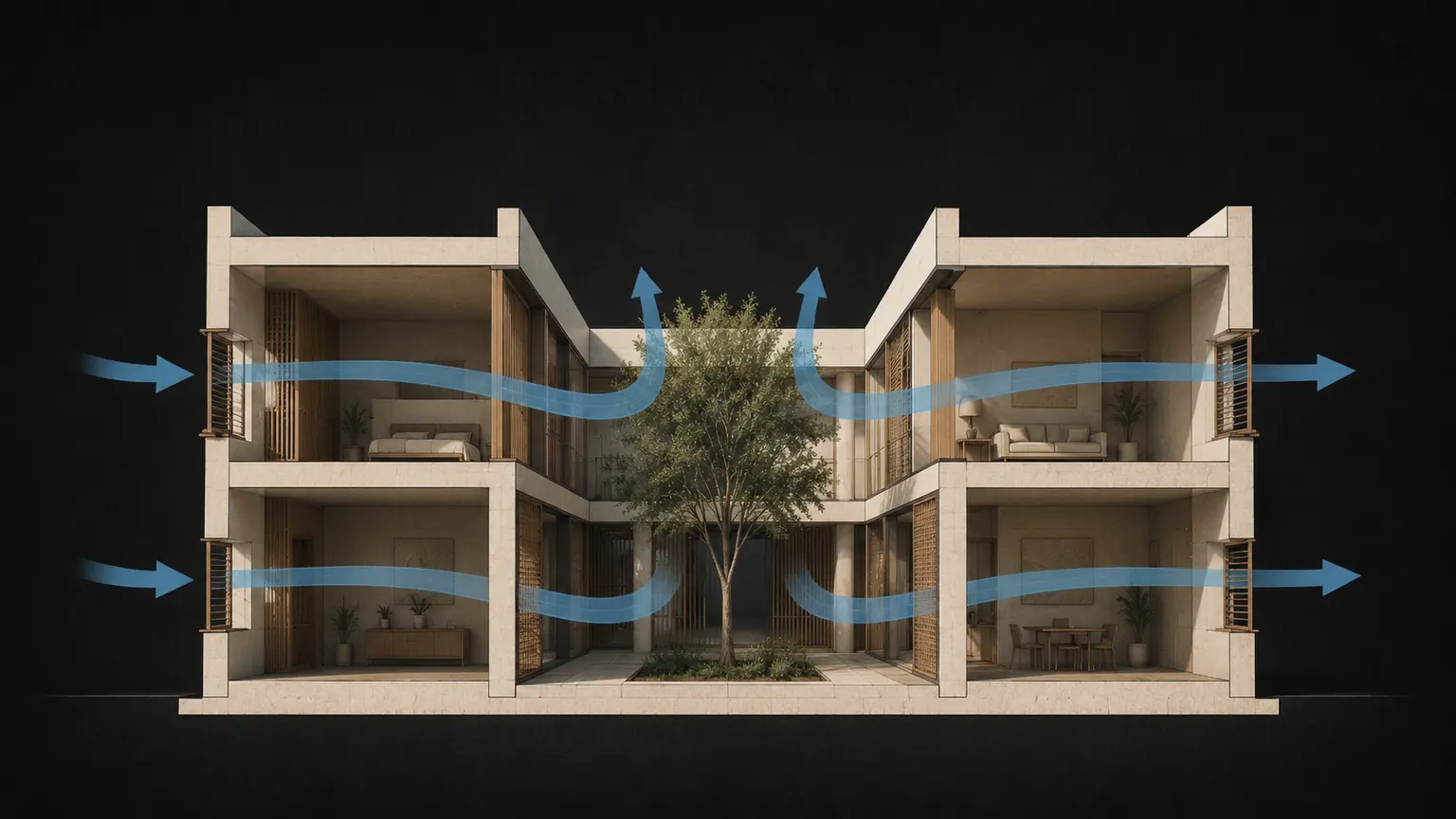
Caption: Courtyards can improve cross ventilation by creating shaded outdoor spaces that help air move between rooms.
6. Combine Low and High Openings
Although cross ventilation is usually horizontal, it can become stronger when combined with vertical air movement.
Low openings can bring cooler air in, while high openings can help warmer air escape.
This is useful because hot air naturally rises.
Architects can use:
- High windows
- Clerestory openings
- Ventilation blocks
- Roof vents
- Double-height spaces
- Stairwells
- Atriums
This begins to connect cross ventilation with stack ventilation, which we will cover in the next article of this series. The Your Home passive cooling guide explains that stack ventilation can support cross ventilation and help remove warm air through higher openings.
Common Mistakes in Cross Ventilation Design
Mistake 1: Adding Windows Without Airflow Logic
More windows do not automatically mean better ventilation.
If the windows are placed on the same wall, or if the outlet is too small, the room may still feel still and uncomfortable.
The placement matters more than the number.
Mistake 2: Ignoring Room Depth
Deep rooms are harder to ventilate naturally.
If the distance between the inlet and outlet is too long, airflow becomes weaker before reaching the other side.
This is why narrow floor plans, courtyards, balconies, and internal voids can help improve natural ventilation.
Mistake 3: Blocking the Outlet
Many designs focus only on where air enters, but the outlet is just as important.
Air needs a way out.
Without a good exit point, air pressure builds up and movement slows down.
A small outlet can reduce the performance of a large inlet.
Mistake 4: Forgetting Privacy and Noise
In real buildings, people may close windows because of privacy, dust, noise, insects, or security.
This means architects should design ventilation openings that can work even when full windows are not open.
Useful solutions include:
- Louvers
- Mashrabiya screens
- Ventilation blocks
- Secure high-level openings
- Filtered vents
- Courtyard-facing windows
- Layered facade screens
Good ventilation design should be comfortable, usable, and realistic.
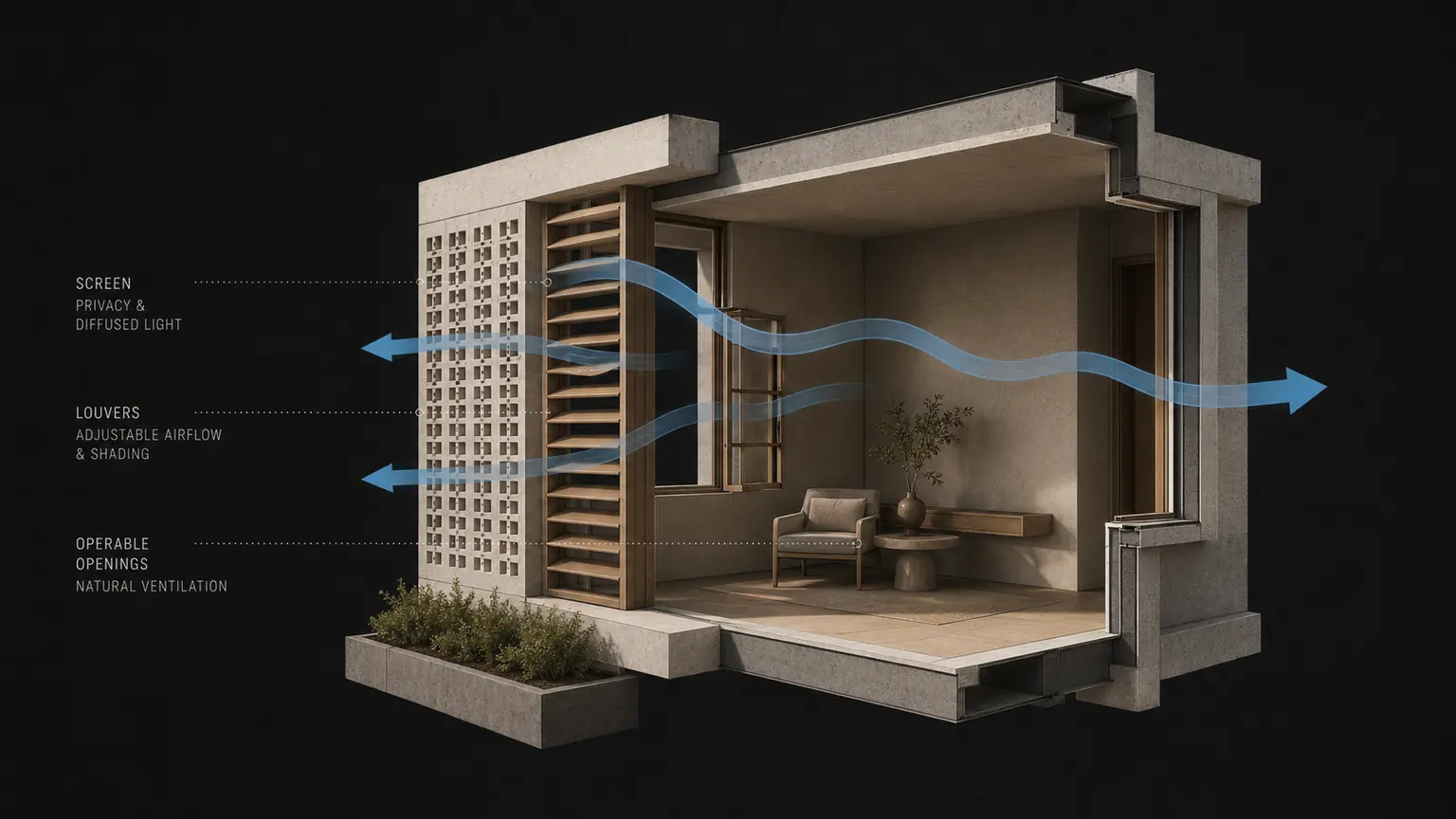
Caption: Screens, louvers, and high-level openings can allow airflow while protecting privacy, security, and comfort.
Cross Ventilation in Hot Climates
In hot climates, cross ventilation should not be used alone. It works best when combined with other passive cooling strategies.
For example:
- Shading reduces heat gain.
- Cross ventilation removes warm indoor air.
- Thermal mass slows temperature change.
- Courtyards create shaded microclimates.
- Vegetation cools the air around the building.
- Light-colored materials reduce surface heat.
If a building receives too much direct sun, ventilation alone may only move hot air around. That is why passive cooling must be designed as a system.
Cross ventilation is powerful, but it becomes much stronger when the whole building form supports it. The Your Home design for climate guide recommends using cross ventilation, shading, insulation, and climate-specific passive strategies together rather than treating them as isolated details.
Cross Ventilation in Apartments
Apartments are often harder to ventilate because they may only have one exposed facade.
Still, architects can improve airflow by using:
- Corner units
- Dual-aspect layouts
- Shared courtyards
- Open corridors
- Ventilated stair cores
- Internal light wells
- Balcony-to-corridor airflow
- High-level internal vents
A good apartment layout should avoid long, deep rooms with only one window at the end.
When possible, living spaces and bedrooms should have access to different orientations, allowing air to pass through the unit. The Your Home glossary defines cross-through or cross-over apartments as units with two opposite aspects, which usually gives them stronger opportunities for natural airflow.
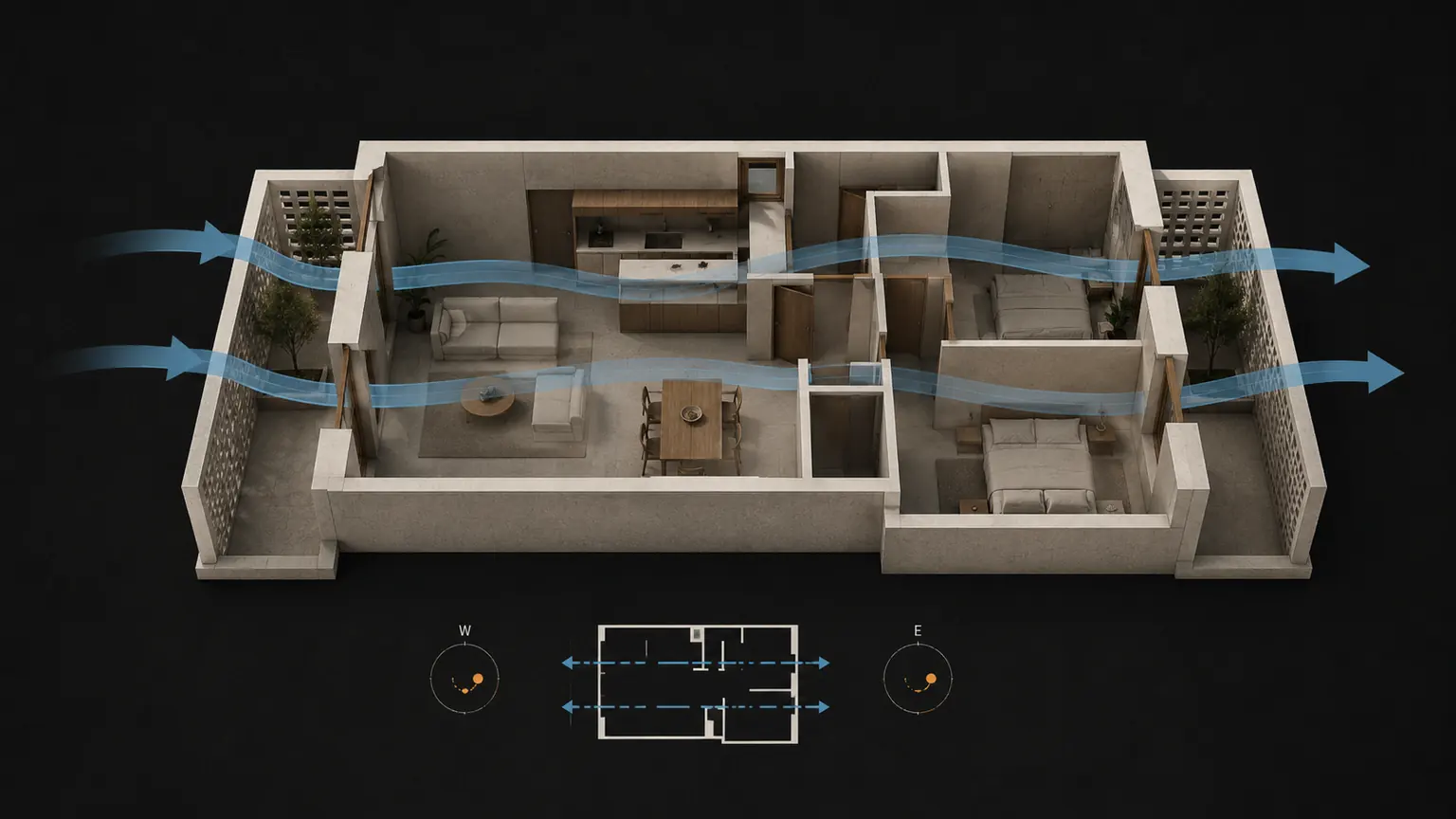
Caption: Dual-aspect apartments usually ventilate better because air can move across the unit from one facade to another.
Cross Ventilation and Sustainable Architecture
Cross ventilation is a key part of sustainable architecture because it reduces the need for active cooling.
This does not mean air conditioning disappears completely. In many climates, mechanical cooling is still needed. But good natural ventilation can reduce how often it is used and how hard it needs to work.
A well-ventilated building can:
- Lower cooling loads
- Improve user comfort
- Reduce energy consumption
- Support passive design goals
- Make indoor spaces feel fresher
- Improve resilience during power outages
Sustainability is not only about adding technology. Sometimes it starts with simple architectural decisions: orientation, openings, depth, shade, and airflow.
For indoor air quality, architects should also remember that natural ventilation must still meet health and performance requirements. ASHRAE Standards 62.1 and 62.2 are widely recognized standards for ventilation system design and acceptable indoor air quality.
Practical Design Checklist
Use this checklist when designing for cross ventilation:
- Are there at least two openings for air movement?
- Are the openings on opposite or adjacent sides?
- Is there a clear airflow path between them?
- Is the outlet large enough?
- Is the room too deep for natural airflow?
- Does the design respond to prevailing wind?
- Are openings shaded from direct sun?
- Can users keep openings open safely?
- Are privacy, insects, dust, and noise considered?
- Can internal doors or partitions allow air to pass?
- Does the design combine ventilation with shading and passive cooling?
If the answer is no to most of these questions, the building may not perform well naturally, even if it has many windows.
Cross Ventilation as Part of a Bigger Passive Design System
Cross ventilation should be understood as one layer in a larger passive design strategy.
It works best when connected with:
- Stack ventilation
- Solar shading
- Courtyard planning
- Building orientation
- Thermal mass
- Roof insulation
- Landscape cooling
- Window-to-wall ratio
- Climate-responsive facades
This is why architects should think about ventilation early in the design process, not as a detail added at the end.
Once the building form is fixed, it becomes much harder to create good natural airflow.
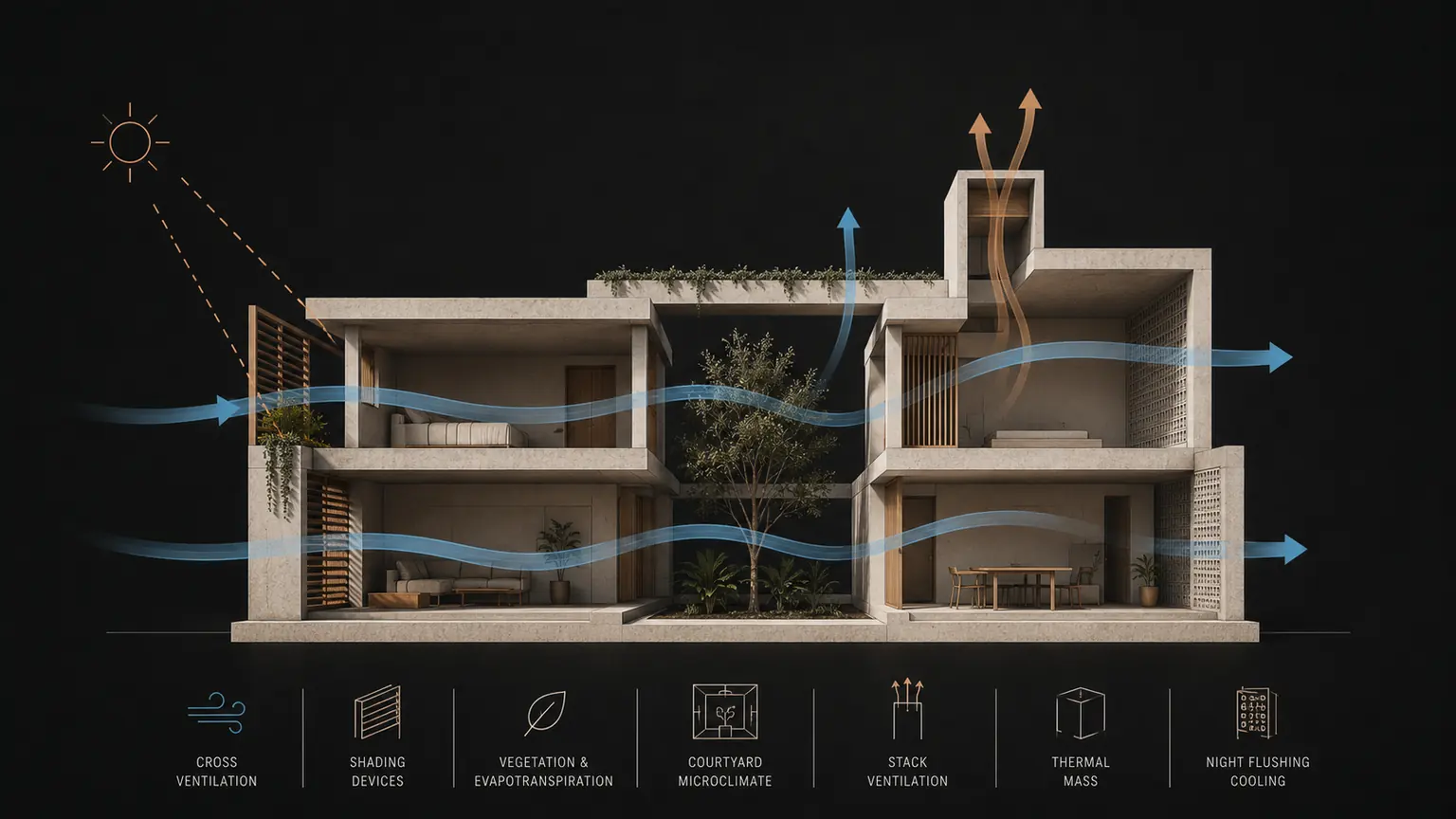
Caption: Cross ventilation performs best when combined with shading, stack ventilation, courtyards, and climate-responsive building design.
Conclusion
Cross ventilation is one of the most important passive cooling strategies in architecture. It is simple in concept, but powerful when designed carefully.
The main idea is to create a clear airflow path through the building. This depends on opening placement, wind direction, room depth, interior layout, privacy, and climate.
For architects, cross ventilation is not just a sustainability feature. It is a design principle that affects comfort, energy use, spatial quality, and the way people experience a building.
In the next article in this series, we will look at stack ventilation and how vertical air movement can be used to release warm air from buildings naturally.
FAQ
What is cross ventilation?
Cross ventilation is a natural ventilation method where air enters a building from one opening and exits through another opening, usually on the opposite or adjacent side.
Why is cross ventilation important in architecture?
It helps improve indoor comfort, remove warm air, increase fresh airflow, and reduce dependence on mechanical cooling.
What is the difference between cross ventilation and stack ventilation?
Cross ventilation depends mainly on horizontal air movement caused by wind pressure. Stack ventilation depends on vertical air movement caused by warm air rising.
Does cross ventilation work in apartments?
Yes, but it works best in dual-aspect apartments with openings on more than one side. Single-facade apartments are harder to ventilate naturally.
Is cross ventilation enough for cooling a building?
Not always. It works best when combined with shading, insulation, courtyards, thermal mass, and other passive cooling strategies.
Where should windows be placed for cross ventilation?
Windows should ideally be placed on opposite or adjacent walls to create a clear path for air to enter and exit the room.
Can cross ventilation reduce energy use?
Yes. By improving natural airflow and passive cooling, cross ventilation can reduce the need for air conditioning in suitable climates.
References and Further Reading
- U.S. Department of Energy — Natural Ventilation
- Your Home — Passive Cooling
- Your Home — Orientation
- Your Home — Design for Climate
- Your Home — Glazing
- ASHRAE — Standards 62.1 and 62.2 for Ventilation and Indoor Air Quality
- Whole Building Design Guide — Cooling Buildings by Natural Ventilation
- Polimi OpenKnowledge — Cross Ventilation and Stack Effect: Concept and Opening Sizing Method