
Stack Ventilation in Architecture: Passive Cooling Strategies, Diagrams, and Design Tips
A clear architectural guide to stack ventilation, how warm air rises through buildings, and how architects can use high openings, atriums, stairwells, shafts, and solar chimneys to improve natural airflow.
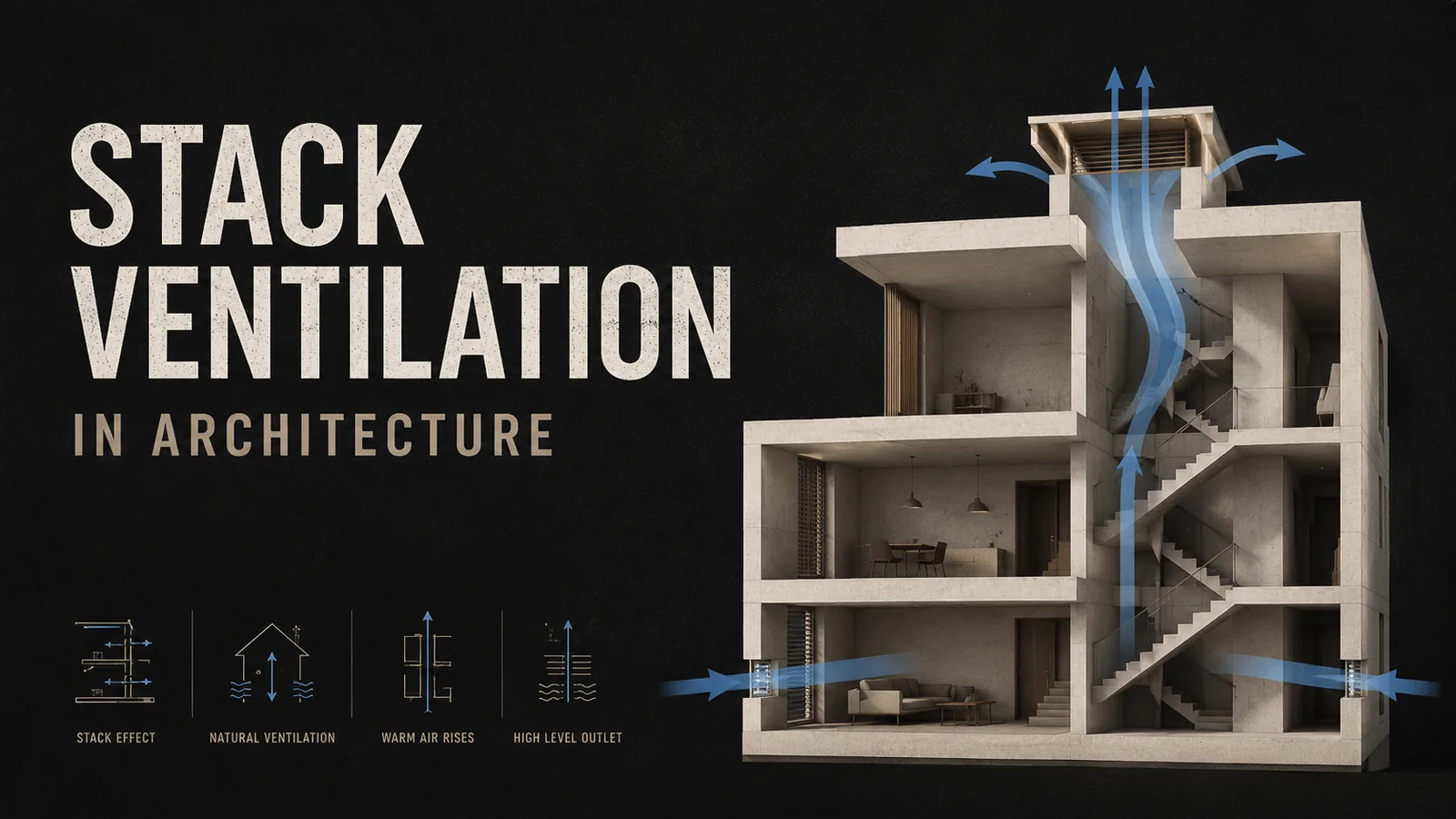
Stack ventilation is one of the most important passive cooling strategies in architecture. It uses a simple natural force: warm air rises.
When indoor air becomes warmer, it becomes lighter and moves upward. If a building has high-level openings, roof vents, clerestory windows, atriums, stairwells, or ventilation shafts, this warm air can escape. As it leaves, cooler air is pulled in from lower openings.
This creates a natural vertical airflow path through the building.
Stack ventilation is especially useful when wind is weak, unreliable, or blocked by surrounding buildings. It can support cross ventilation in architecture, improve indoor comfort, reduce heat buildup, and make buildings feel more breathable.
This guide is part of our natural ventilation and passive cooling series. In the previous article, we covered cross ventilation. Here, we will look at stack ventilation, the stack effect, atriums, stairwells, solar chimneys, high openings, and common design mistakes.
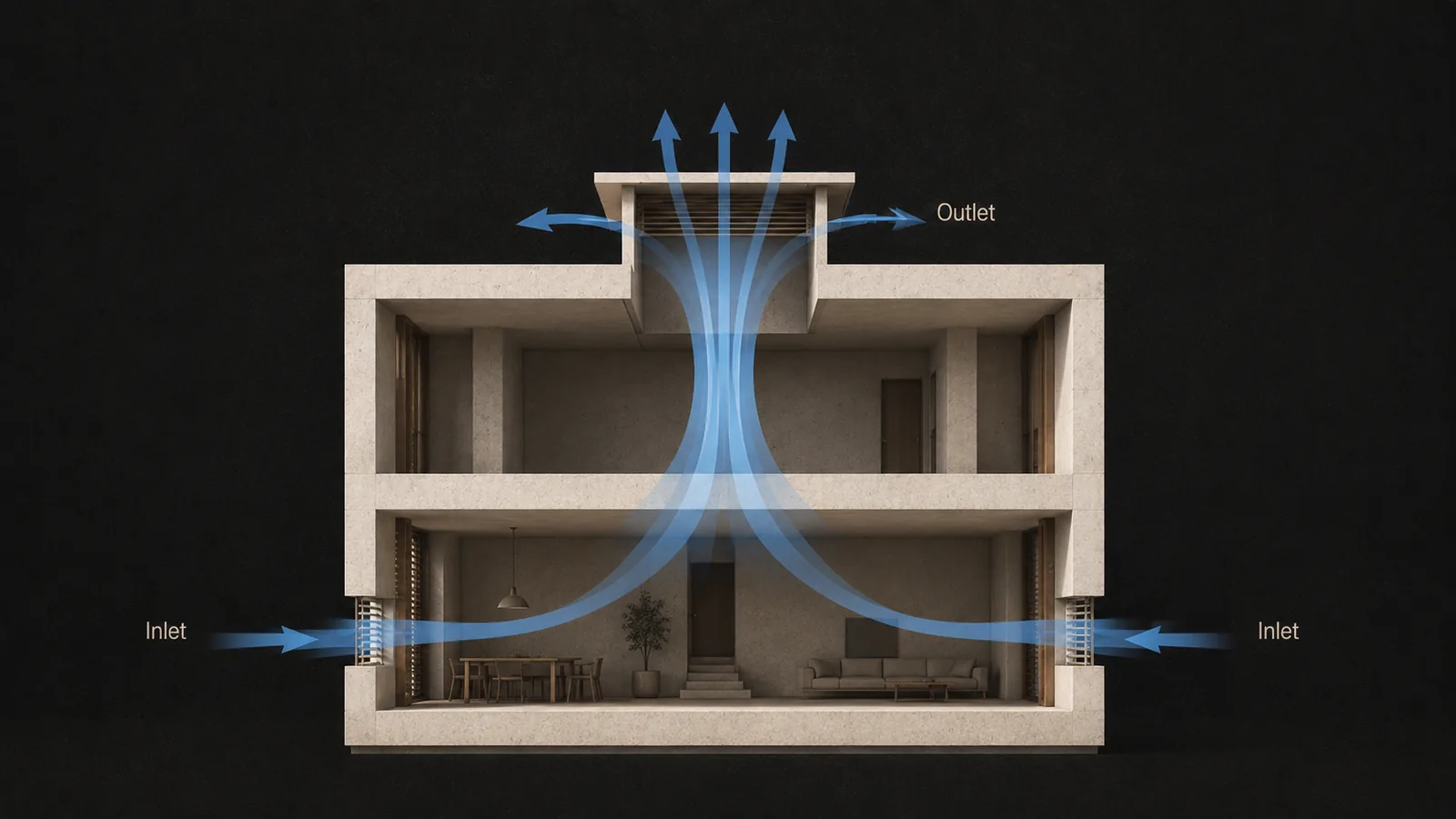
Caption: Stack ventilation works by allowing warm indoor air to rise and escape through high openings, while cooler air enters from lower openings.
What Is Stack Ventilation?
Stack ventilation is a natural ventilation method that uses vertical air movement to remove warm air from a building.
It is also called the stack effect or chimney effect.
The basic idea is simple:
- Warm indoor air rises.
- High openings allow warm air to escape.
- This creates a slight pressure difference.
- Cooler air is pulled in through lower openings.
- The cycle continues as long as there is a temperature difference and a clear airflow path.
In architecture, stack ventilation can happen through:
- Double-height spaces
- Atriums
- Stairwells
- Roof vents
- Clerestory windows
- Ventilation shafts
- Solar chimneys
- Courtyards
- High-level operable windows
- Vented roof ridges
The U.S. Department of Energy’s natural ventilation guide describes the stack effect as a process where cooler air enters through lower openings, absorbs heat, rises, and exits through upper openings.
This makes stack ventilation useful for passive cooling, especially in buildings where horizontal airflow is limited.
Why Stack Ventilation Matters in Architecture
Many buildings depend only on mechanical air conditioning to remove heat. But good architecture can reduce some of that cooling load before mechanical systems even start working.
Stack ventilation matters because it helps buildings release trapped warm air naturally.
It can improve:
- Passive cooling
- Indoor air quality
- Thermal comfort
- Air movement in deep spaces
- Ventilation when wind is weak
- Night cooling
- Energy efficiency
- Building resilience during power outages
In hot climates, warm air often collects near ceilings, roof spaces, upper floors, stair cores, and atriums. If this heat has no way to escape, the building feels heavy, stale, and uncomfortable.
Stack ventilation gives that warm air a route out.
The Your Home passive cooling guide explains that stack ventilation can support cross ventilation and help overcome the limits of unreliable breezes by using convection to move warm air out through high openings.
This is why stack ventilation should not be treated as a small technical detail. It is a spatial design strategy.
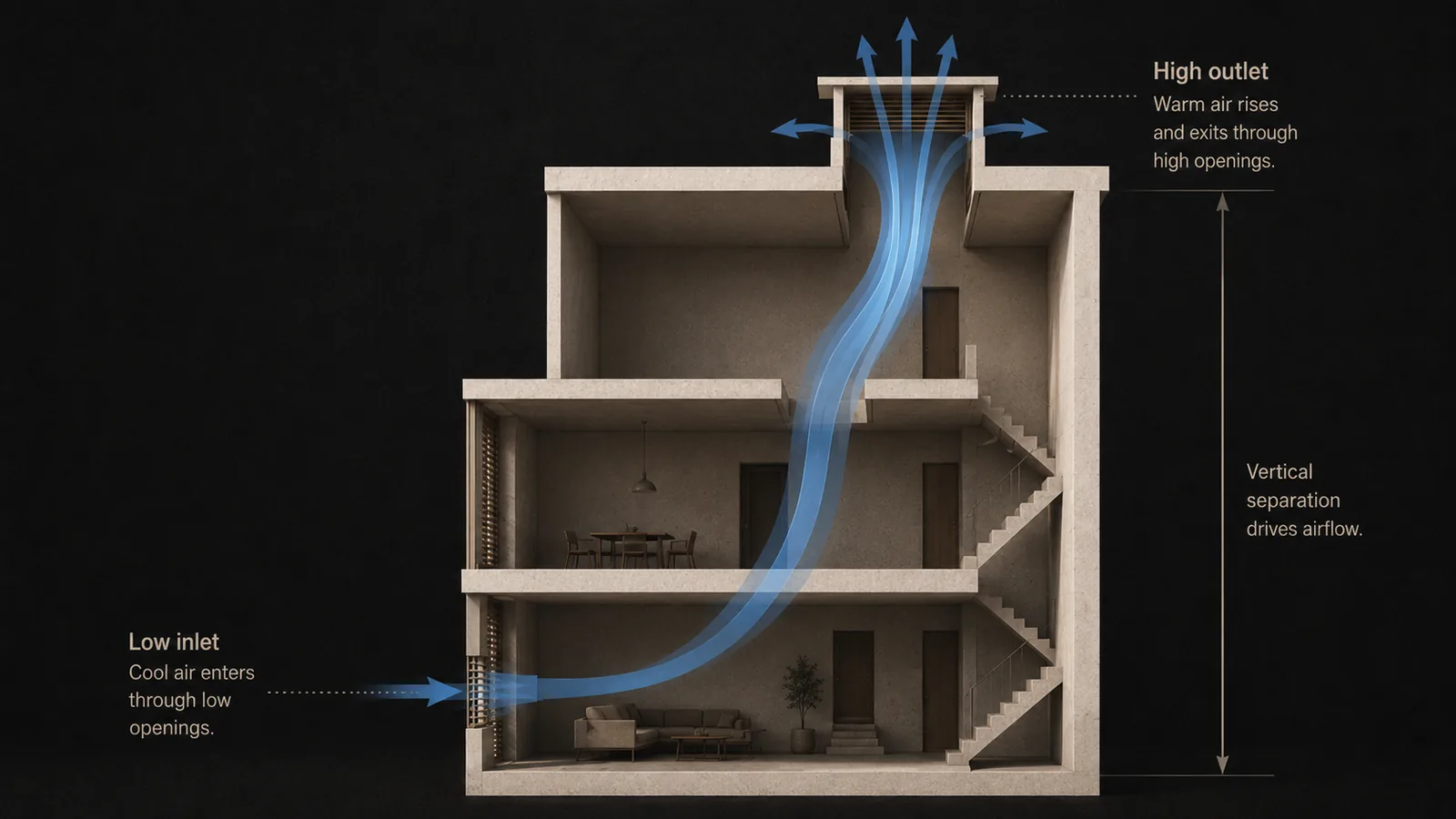
Caption: The distance between low inlets and high outlets is important. A taller vertical path can create stronger stack-driven airflow.
How Stack Ventilation Works
Stack ventilation depends on buoyancy.
When air inside a building gets warmer, it becomes less dense. Because it is lighter than cooler air, it rises.
If the building has a high outlet, the warm air can leave. When it exits, it creates a slight negative pressure inside the lower part of the building. This draws cooler outdoor air in through lower openings.
Architecturally, stack ventilation needs four things:
- A low inlet where cooler air can enter.
- A high outlet where warm air can escape.
- A clear vertical path between the two.
- A temperature difference that keeps air moving.
The larger the height difference between the inlet and outlet, the stronger the stack effect can become.
This is why stack ventilation often works well in buildings with tall spaces, atriums, stairwells, shafts, roof monitors, and double-height rooms.
The Whole Building Design Guide natural ventilation resource explains that natural ventilation can be driven by wind pressure, buoyancy, or a combination of both. Stack ventilation belongs to the buoyancy-driven side of natural ventilation.
Stack Ventilation vs Cross Ventilation
Stack ventilation and cross ventilation are both natural ventilation strategies, but they work in different ways.
Cross ventilation depends mainly on wind pressure. Air enters from one side of a building and exits from another side.
Stack ventilation depends mainly on vertical temperature difference. Warm air rises and exits through high openings, pulling cooler air from below.
In simple terms:
- Cross ventilation moves air horizontally.
- Stack ventilation moves air vertically.
- Cross ventilation needs wind.
- Stack ventilation can work even when wind is weak.
- Cross ventilation needs inlet and outlet openings across the plan.
- Stack ventilation needs low and high openings across the section.
The best buildings often use both.
For example, a house may use cross ventilation during breezy hours and stack ventilation during still, hot periods. A shaded courtyard may bring cooler air into the lower level, while a clerestory window or roof vent releases warm air above.
This is where passive cooling becomes a system, not just one detail.
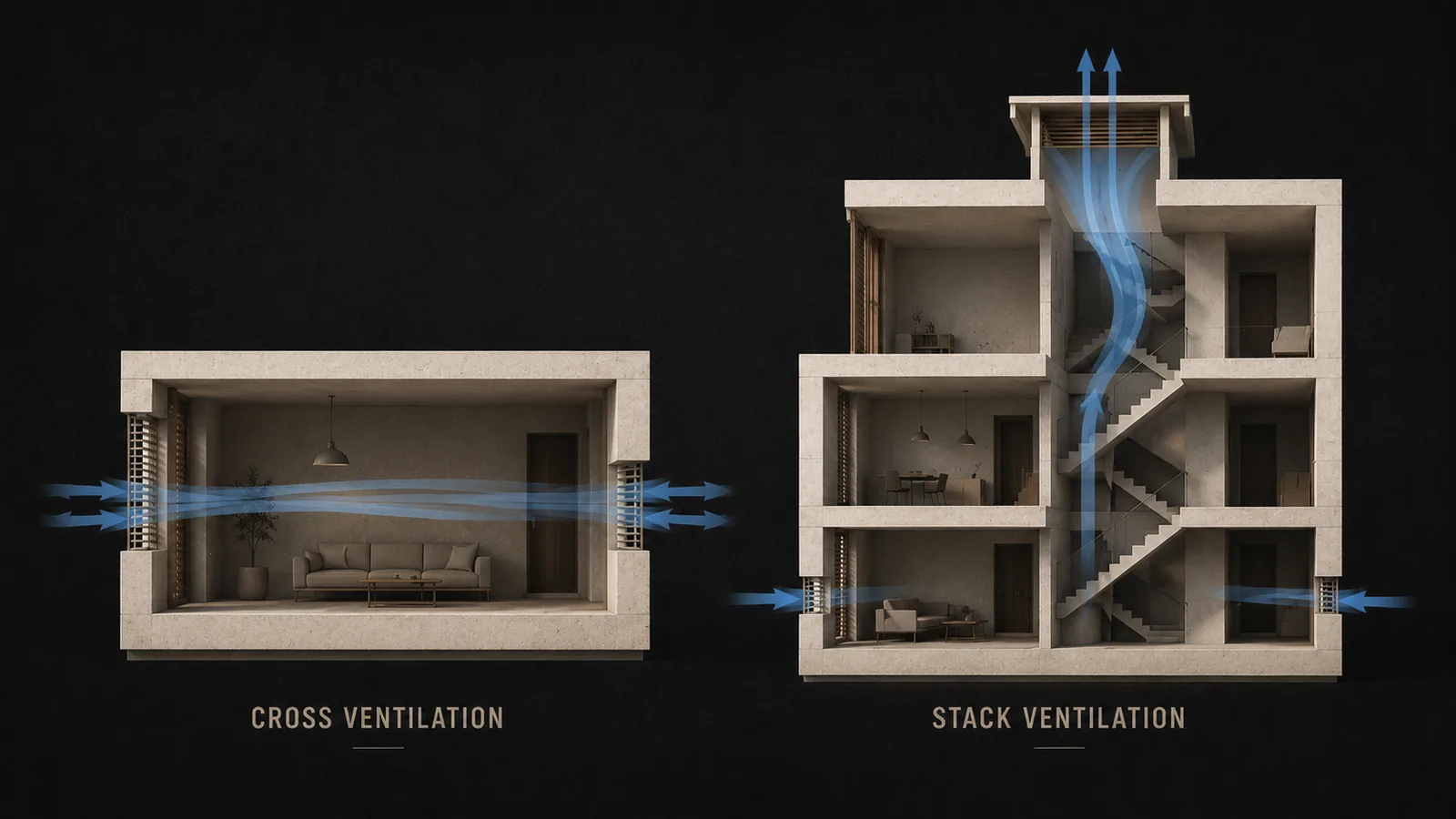
Caption: Cross ventilation uses wind-driven horizontal airflow, while stack ventilation uses warm rising air to create vertical airflow.
Video: Cross Ventilation and Stack Effect Explained
This educational video explains how cross ventilation and stack effect work together in natural ventilation design.
Video: Stack effect and cross ventilation explained through airflow concepts and opening design.
Best Design Strategies for Stack Ventilation
1. Use Low Inlets and High Outlets
The most important rule is simple: air needs a way in and a way out.
For stack ventilation, the inlet should usually be lower than the outlet.
Low inlets can include:
- Operable windows
- Shaded wall vents
- Courtyard openings
- Ventilation blocks
- Low facade openings
- Door grilles
- Louvers
- Cool air intakes
High outlets can include:
- Clerestory windows
- Roof vents
- Operable skylights
- Ventilated roof ridges
- High-level windows
- Atrium vents
- Solar chimney outlets
- Ventilation shafts
A high window without a low inlet will not work well. A low opening without a high outlet will also be limited.
Stack ventilation needs both.
2. Increase the Vertical Distance
The height difference between inlet and outlet affects performance.
A small room with a low window and a slightly higher window can create some airflow, but the effect is usually weak. A taller space with a clear vertical path can create stronger movement.
This is why stack ventilation is often used in:
- Double-height living rooms
- Atriums
- Stairwells
- Tall halls
- Libraries
- Schools
- Public buildings
- Factories
- Museums
- Courtyard houses
The building section matters as much as the floor plan.
A good stack ventilation strategy should be designed in section from the beginning, not added later as a roof vent after the building form is already fixed.
3. Design Atriums as Ventilation Engines
An atrium is not only a visual space. It can also become a natural ventilation engine.
When warm air rises through an atrium and escapes through high vents, cooler air can be drawn from lower shaded spaces. This can help ventilate surrounding rooms and corridors.
Atriums are useful because they create:
- Vertical height
- A shared airflow path
- A warm air collection zone
- Access to high-level openings
- A visual and environmental center
- A way to ventilate deep floor plans
But atriums must be designed carefully.
If the top of the atrium is sealed, heat can collect under the roof and make the building hotter. If the lower openings are too small, the atrium may not pull enough air. If the glass roof is unshaded, the atrium can become a heat trap.
A good atrium for stack ventilation should have controlled high-level exhaust, shaded glazing, and clear lower air paths.
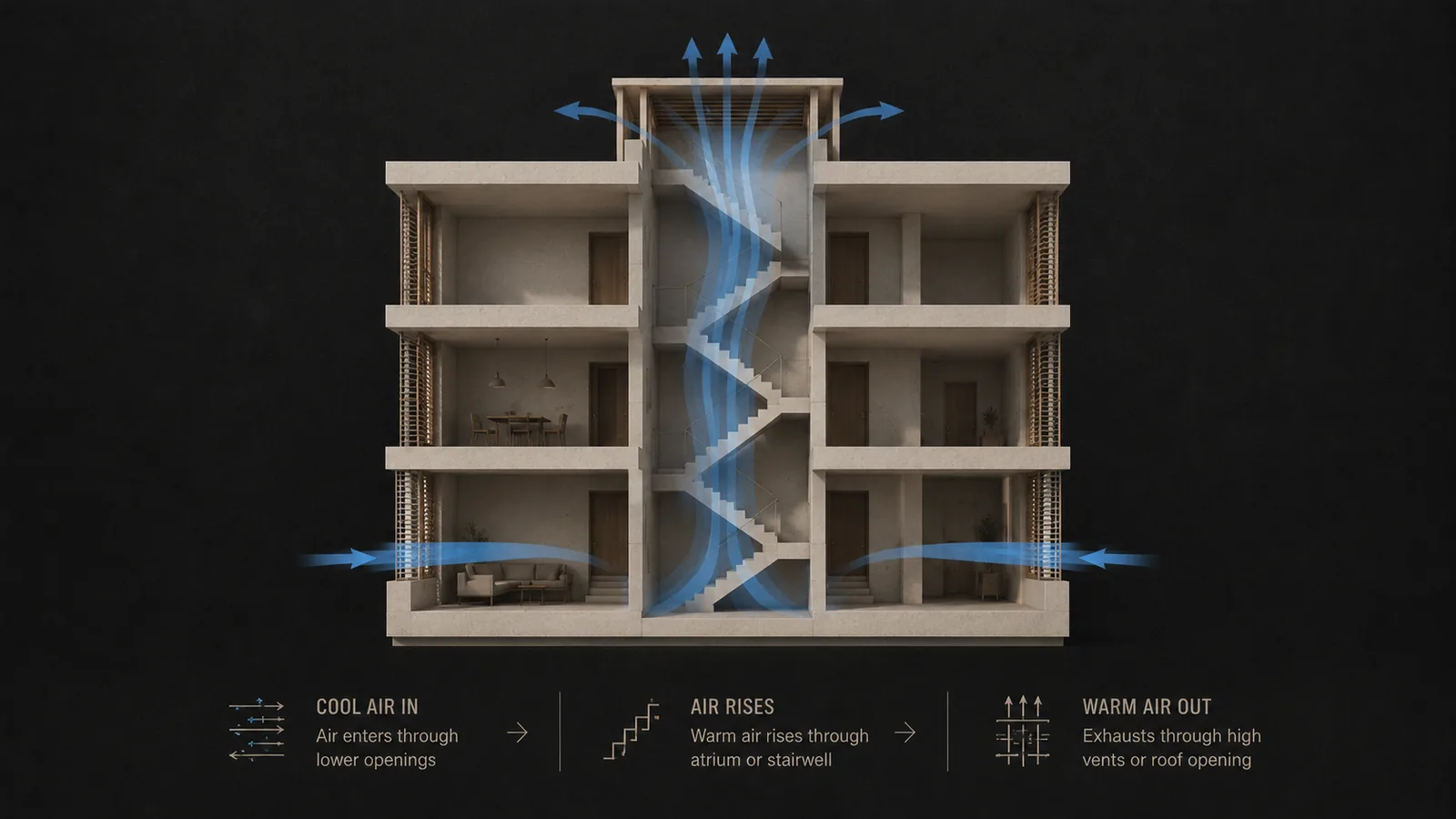
Caption: Atriums and stairwells can work as vertical ventilation paths when they connect lower inlets with high-level exhaust openings.
4. Use Stairwells Carefully
Stairwells can support stack ventilation because they already connect different levels vertically.
In some buildings, a stairwell can help warm air rise toward roof vents or upper windows. This can be useful in houses, schools, offices, apartment buildings, and public buildings.
But stairwells also need careful control.
In real buildings, stairwells may have fire safety requirements, smoke control rules, acoustic issues, and security concerns. They cannot always be treated as open ventilation shafts.
Architects should coordinate stack ventilation strategies with:
- Fire safety
- Smoke control
- Door requirements
- Building codes
- Security
- Acoustic separation
- User comfort
The idea is not to turn every stairwell into a chimney. The idea is to understand when vertical circulation spaces can support natural airflow safely and realistically.
5. Add Clerestory Windows
Clerestory windows are high windows placed above eye level, usually near the upper part of a wall or roof.
They are useful for stack ventilation because they can act as high-level outlets.
They can also bring daylight deeper into the building.
Clerestory windows work best when they are:
- Operable
- Shaded from harsh sun
- Protected from rain
- Easy to control
- Connected to low-level inlets
- Placed near warm air collection zones
A fixed clerestory window may help with daylight, but it will not help with ventilation unless it can open or connect to a venting system.
This is a common mistake in architectural design. The section looks like it supports passive cooling, but the opening does not actually operate.
6. Use Solar Chimneys
A solar chimney is a vertical shaft designed to increase stack ventilation using solar heat.
The chimney absorbs solar radiation. The air inside the shaft becomes warmer, rises faster, and exits at the top. This helps pull air from the building below.
Solar chimneys can be useful when natural stack effect is too weak.
They can support:
- Passive cooling
- Natural exhaust
- Air movement in still weather
- Ventilation of deep rooms
- Reduced mechanical fan use
- Hot climate design
A solar chimney usually works best when it has a dark absorbing surface, good solar exposure, an insulated shaft, a low inlet connection, and a protected high outlet.
However, it should be designed carefully. If the solar chimney overheats nearby spaces or allows unwanted heat gain into the building, it can create discomfort instead of solving it.
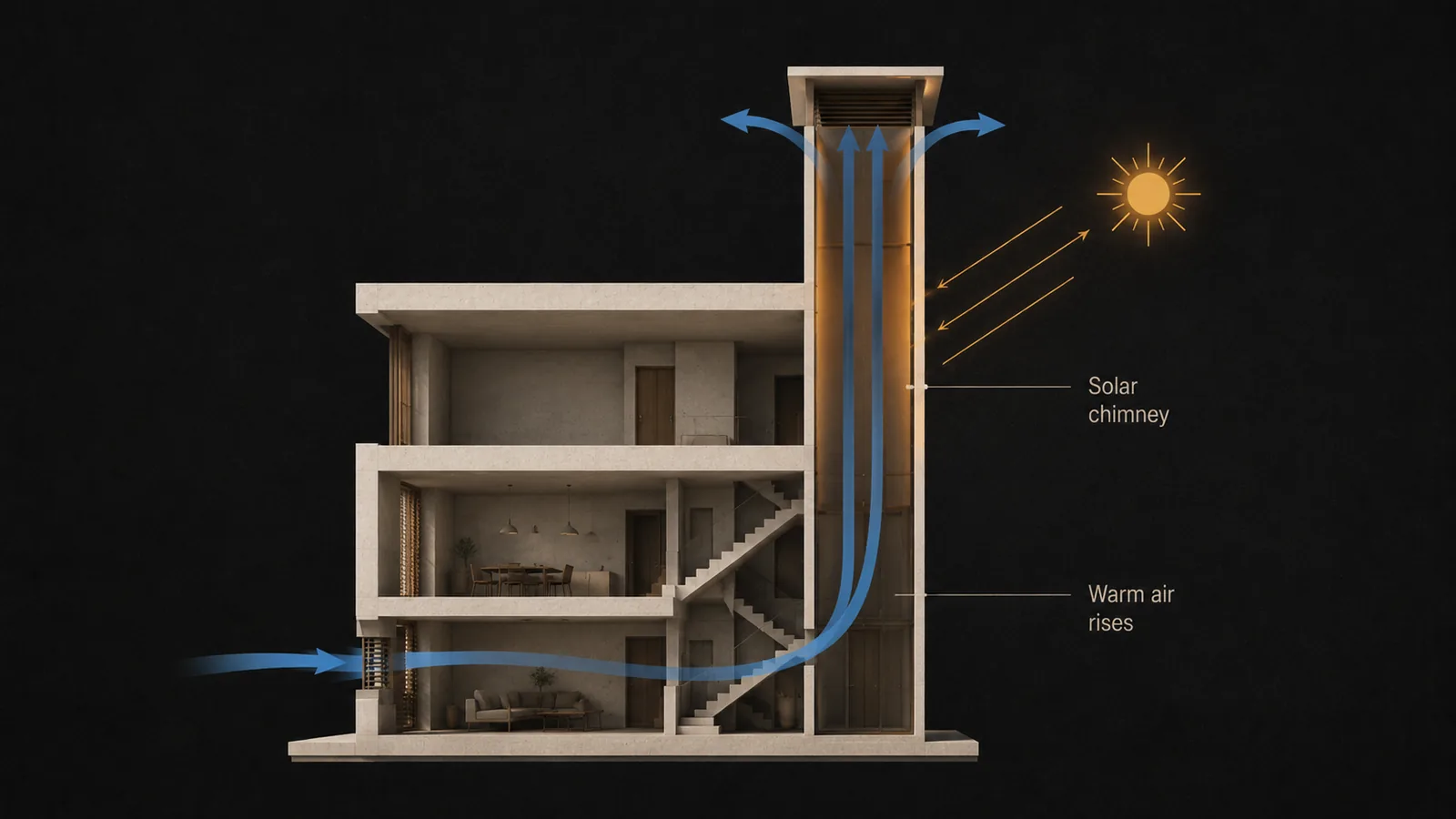
Caption: A solar chimney uses solar heat to strengthen upward air movement and improve passive exhaust from the building.
7. Combine Stack Ventilation With Shading
Ventilation alone is not enough if the building is gaining too much heat.
In hot climates, stack ventilation should always work with shading.
This includes:
- Roof overhangs
- Deep window reveals
- External louvers
- Shaded courtyards
- Pergolas
- Screens
- Light-colored roofs
- Insulated roof assemblies
- Reduced west-facing glazing
If the building absorbs too much solar heat, stack ventilation may only remove part of the problem. The building can still feel hot because the surfaces themselves are radiating heat.
Good passive cooling starts by reducing heat gain, then using ventilation to remove the heat that remains.
8. Support Night Purging
Stack ventilation can be useful at night when outdoor temperatures drop.
Night purging means flushing warm air out of the building during cooler night hours. This can help remove heat stored in walls, floors, ceilings, and internal thermal mass.
A building designed for night purging may use:
- Secure night vents
- High-level openings
- Operable roof vents
- Courtyard openings
- Thermal mass
- Automated windows
- Protected louvers
This strategy works best in climates where nights are cooler than days.
In hot dry climates, night purging can be very useful. In hot humid climates, it needs more care because outdoor air may remain warm and humid at night.
Common Mistakes in Stack Ventilation Design
Mistake 1: Adding High Windows Without Low Inlets
High windows alone do not create good stack ventilation.
Warm air may escape, but without enough lower inlet area, the airflow will be weak. Air cannot leave continuously unless replacement air can enter.
The inlet and outlet must be designed together.
Mistake 2: Making the Air Path Too Complicated
Stack ventilation needs a clear vertical route.
If air must pass through many closed rooms, solid doors, narrow corridors, or blocked ceilings, the airflow becomes weak.
Good stack ventilation needs:
- Open vertical paths
- Transfer grilles
- Internal vents
- High-level openings
- Perforated partitions
- Clear pressure paths
Air should be able to move through the building without fighting the layout.
Mistake 3: Creating a Heat Trap
A double-height space, atrium, or glazed roof can become a heat trap if it has no exhaust.
This happens when warm air rises but cannot escape.
The result is a hot upper zone that radiates heat back into the building.
Any tall space used for stack ventilation should include controlled high-level exhaust.
Mistake 4: Ignoring User Control
Natural ventilation only works if people can actually use it.
Openings may stay closed because of:
- Noise
- Dust
- Insects
- Privacy
- Rain
- Security
- Poor access
- Lack of maintenance
- Difficult controls
A roof vent that nobody can reach may stay closed forever.
Good stack ventilation should include practical control systems, secure openings, insect screens, rain protection, and clear user operation.
Mistake 5: Forgetting Fire and Smoke Safety
Vertical shafts move air upward. In some situations, they can also move smoke.
This is why stack ventilation must be coordinated with fire safety design.
Atriums, stairwells, shafts, and vertical openings can affect smoke movement in a building. Architects should coordinate with mechanical, fire, and code consultants early.
Passive design should never ignore life safety.
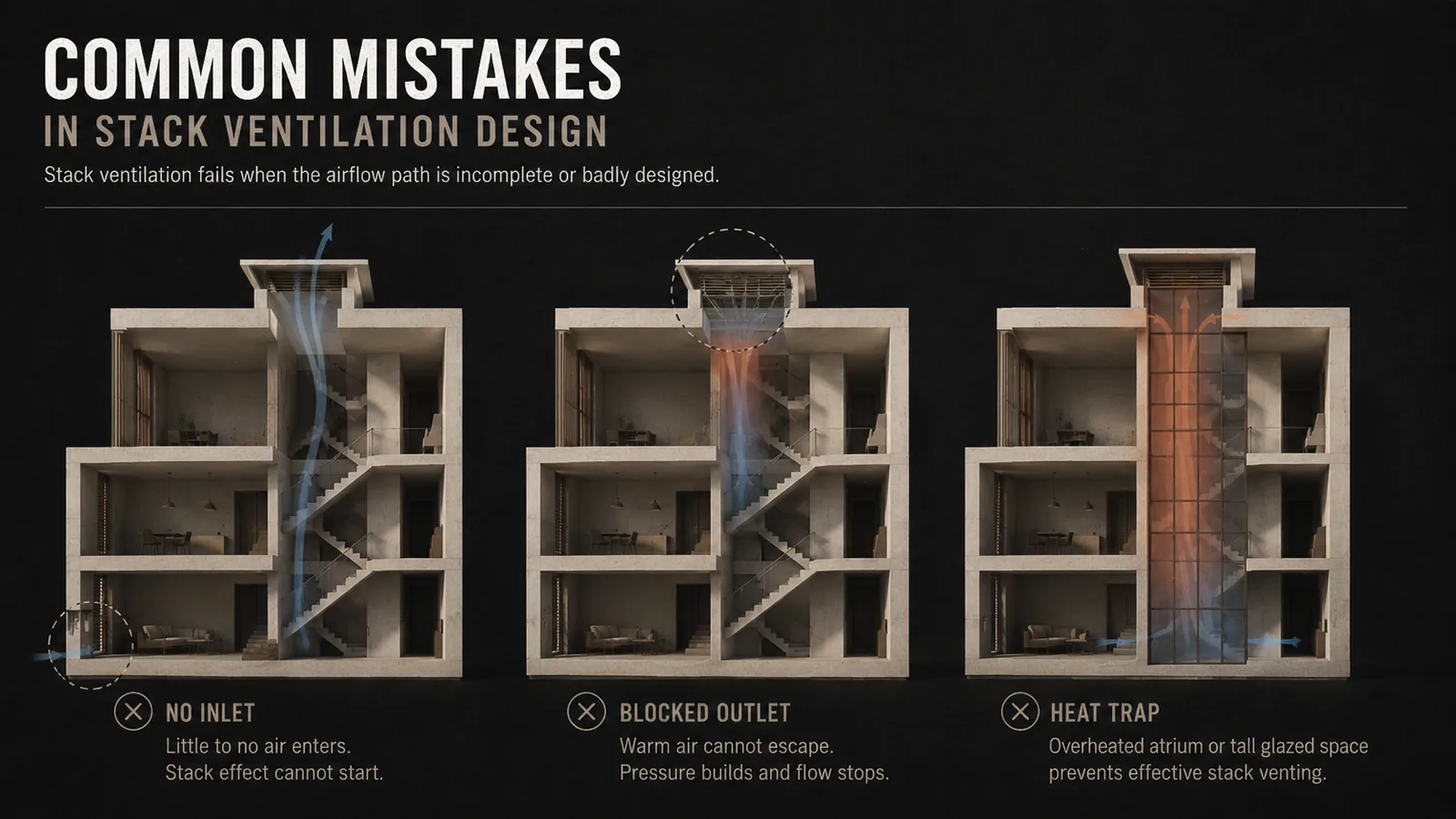
Caption: Stack ventilation can fail when the air path is blocked, the outlet is sealed, the inlet is too small, or the tall space becomes a heat trap.
Stack Ventilation in Hot Climates
Stack ventilation can be very useful in hot climates, but it must be designed as part of a larger passive cooling system.
In hot climates, the building should first reduce heat gain.
This means using:
- Shading
- Insulation
- Light-colored roofs
- Courtyards
- Thermal mass
- Controlled glazing
- Deep overhangs
- Ventilated roof spaces
- Landscape cooling
- External screens
Then stack ventilation can help remove warm air from the interior.
The Your Home design for climate guide recommends climate-specific passive design strategies rather than applying the same solution everywhere.
This matters because stack ventilation behaves differently in different climates.
In hot dry climates, stack ventilation can support night cooling and help release heat after sunset. In hot humid climates, it can improve air movement and freshness, but humidity still needs careful management. In mixed climates, stack ventilation may need seasonal control so the building does not lose heat in winter.
The strategy should match the climate.
Stack Ventilation in Houses
In houses, stack ventilation can be simple and effective.
Architects can use:
- High stairwell windows
- Double-height living rooms
- Operable skylights
- Clerestory windows
- Roof vents
- Courtyard openings
- Low shaded windows
- Ventilated roof ridges
A common strategy is to bring cooler air from a shaded courtyard or garden into the lower level, then release warm air through a high stairwell window or roof vent.
This can make the house feel more alive and breathable.
However, privacy and security matter. Many people do not want to leave large windows open all day or night. Smaller secure vents, louvers, screens, and high-level openings can make natural ventilation more realistic.
Stack Ventilation in Apartments
Apartments are more difficult because they often have limited openings and shared building systems.
Still, stack ventilation can help at the building level.
Architects can use:
- Ventilated stair cores
- Shared atriums
- Open corridors
- Light wells
- Roof exhaust vents
- Courtyard shafts
- Dual-aspect units
- Balcony-to-corridor airflow
- High-level internal vents where allowed
A single apartment may not always have enough height to create strong stack effect by itself. But the building as a whole can use vertical voids and shared spaces to support airflow.
This is especially useful in mid-rise and low-rise housing where courtyards, stairs, and corridors can be designed as environmental spaces instead of leftover circulation.
Stack Ventilation in Public Buildings
Public buildings often benefit from stack ventilation because they usually have larger spaces and taller volumes.
Good examples include:
- Schools
- Libraries
- Museums
- Community centers
- Markets
- Train stations
- Sports halls
- Office atriums
- University buildings
These buildings often have enough height to create meaningful vertical airflow.
A library, for example, can use low shaded openings and high clerestory vents to release warm air from reading halls. A school can use high roof vents in corridors to improve airflow between classrooms. A market hall can use roof monitors to exhaust hot air that collects above people and stalls.
In public buildings, stack ventilation can also improve the spatial experience. The building feels less sealed and more connected to climate, light, and air.
Stack Ventilation and Sustainable Architecture
Stack ventilation is a key part of sustainable architecture because it uses building form, section, and openings to support comfort before relying on machines.
It can help reduce:
- Cooling demand
- Fan energy
- Stale indoor air
- Heat buildup
- Dependence on sealed interiors
- Mechanical system pressure
But stack ventilation is not a complete replacement for mechanical ventilation or air conditioning in every climate.
Many buildings still need mechanical systems for humidity control, filtration, heating, cooling, or code-required ventilation rates. The role of passive design is to reduce the load, improve comfort, and make the building more resilient.
For indoor air quality, architects should also consider recognized ventilation standards. ASHRAE Standards 62.1 and 62.2 are widely used references for ventilation and acceptable indoor air quality.
The best approach is often hybrid: use stack ventilation when outdoor conditions are suitable, and use mechanical systems when natural ventilation is not enough.
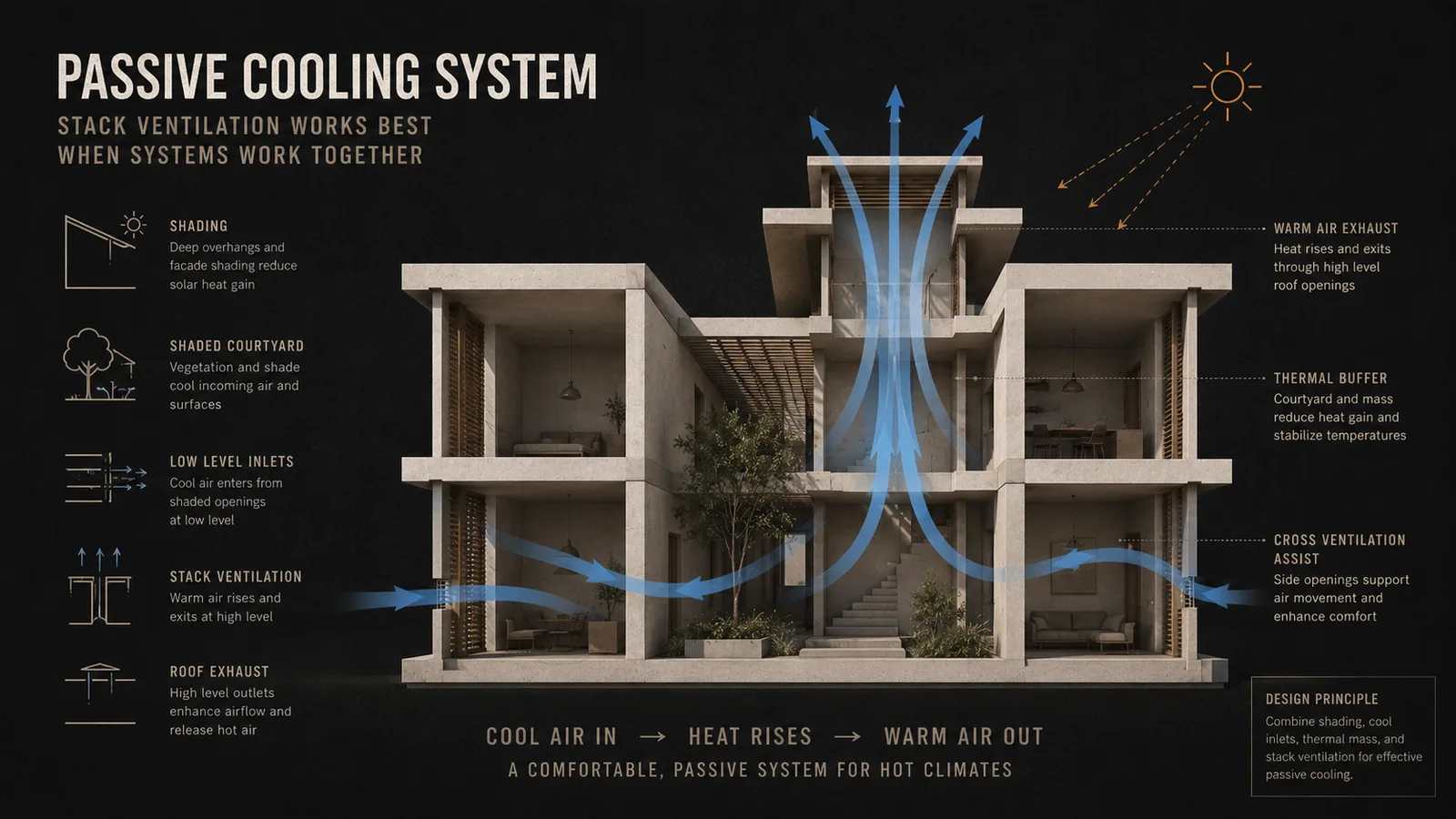
Caption: Stack ventilation performs best when combined with shading, cross ventilation, courtyards, roof insulation, and climate-responsive building design.
Practical Design Checklist
Use this checklist when designing for stack ventilation:
- Is there a low inlet for cooler air?
- Is there a high outlet for warm air?
- Is the vertical distance between inlet and outlet large enough?
- Is the airflow path clear?
- Can warm air escape from the highest part of the space?
- Are the openings protected from rain?
- Are the openings shaded from direct sun?
- Can users operate the vents easily?
- Are privacy, insects, dust, noise, and security considered?
- Can the system work at night for heat purging?
- Does the strategy match the local climate?
- Is fire and smoke safety coordinated?
- Does stack ventilation support cross ventilation?
- Is the roof designed to reduce heat gain?
- Are mechanical systems still available when natural ventilation is not enough?
If most of these questions are ignored, the stack ventilation strategy may look good in section but perform poorly in reality.
Stack Ventilation as Part of a Bigger Passive Design System
Stack ventilation should not be treated as an isolated trick.
It works best when connected with:
- Cross ventilation
- Courtyard cooling
- Solar shading
- Roof insulation
- Thermal mass
- Building orientation
- Window placement
- Atrium design
- Solar chimneys
- Ventilated facades
- Climate-responsive sections
This is why ventilation should be considered early in the design process.
A building that is already too deep, too sealed, too exposed to sun, or too dependent on fixed glass will be harder to ventilate naturally later.
Good passive design starts with form, orientation, section, and airflow.
The details come after.
Conclusion
Stack ventilation is one of the clearest examples of architecture working with physics.
Warm air rises. Cool air replaces it. A building can either block this movement or use it.
When designed well, stack ventilation can help remove warm indoor air, support passive cooling, improve freshness, and reduce dependence on mechanical systems. It is especially powerful when combined with cross ventilation, shading, courtyards, thermal mass, and climate-responsive building design.
For architects, the key lesson is simple: do not only design the plan. Design the section.
The vertical movement of air can shape atriums, stairwells, roofs, windows, shafts, and the whole experience of a building.
In the next articles in this passive cooling series, we will look at courtyard cooling, wind towers, shading strategies, and climate-responsive building forms.
FAQ
What is stack ventilation?
Stack ventilation is a natural ventilation method where warm indoor air rises and exits through high openings, pulling cooler air in through lower openings.
What is the stack effect in architecture?
The stack effect is the vertical movement of air caused by temperature and pressure differences. In buildings, it can be used to move warm air upward and out through high vents or openings.
What is the difference between stack ventilation and cross ventilation?
Cross ventilation uses wind-driven horizontal airflow through opposite or adjacent openings. Stack ventilation uses vertical airflow caused by warm air rising.
Does stack ventilation work without wind?
Yes. Stack ventilation can work without wind because it depends mainly on buoyancy and temperature difference. However, wind can strengthen or weaken it depending on the building design.
Where should openings be placed for stack ventilation?
Openings should be placed low and high. Cooler air should enter from lower inlets, while warm air should exit through high windows, roof vents, clerestories, or shafts.
Is stack ventilation good for hot climates?
Yes, but it works best when combined with shading, roof insulation, courtyards, thermal mass, and cross ventilation. Ventilation alone cannot solve excessive solar heat gain.
Can stairwells be used for stack ventilation?
Sometimes. Stairwells can support vertical airflow, but they must be coordinated with fire safety, smoke control, security, acoustic separation, and building code requirements.
What is a solar chimney?
A solar chimney is a vertical shaft heated by the sun. The heated air inside the shaft rises and exits, helping pull air through the building naturally.
Can stack ventilation reduce energy use?
Yes. In suitable climates and seasons, stack ventilation can reduce cooling and fan demand by supporting natural airflow and passive heat removal.
References and Further Reading
- U.S. Department of Energy — Natural Ventilation
- U.S. Department of Energy — Ventilation
- Your Home — Passive Cooling
- Your Home — Design for Climate
- Whole Building Design Guide — Natural Ventilation
- 2030 Palette — Stack Ventilation
- ASHRAE — Standards 62.1 and 62.2 for Ventilation and Indoor Air Quality
- Polimi OpenKnowledge — Cross Ventilation and Stack Effect: Concept and Opening Sizing Method