
Ramp Calculator: ADA Guidelines, Slope Ratios, and Rise/Run Calculations Explained
Designing accessible building entries requires a solid understanding of ramp slope regulations. This Ramp Calculator helps architects, builders, and property owners estimate compliant ramp configurations. It handles the core calculations required for accessibility planning, including finding the slope (as a ratio, percentage, or angle), calculating the total horizontal run, identifying landing requirements, and checking ADA compliance.
Ramps are defined by three key dimensions: vertical rise (the height to be climbed), horizontal run (the flat distance the ramp spans), and slope (the steepness of the incline). For a ramp to be accessible, building codes globally enforce strict limits on slope to ensure individuals in wheelchairs or with mobility aids can safely use the ramp.
This calculator works in multiple modes: you can calculate the slope from rise and run, determine the horizontal run from rise and a target slope, or figure out the maximum allowable rise for a specific run. It also accounts for intermediate landing requirements, which are mandated by codes like the ADA and International Building Code (IBC) for long ramp runs.
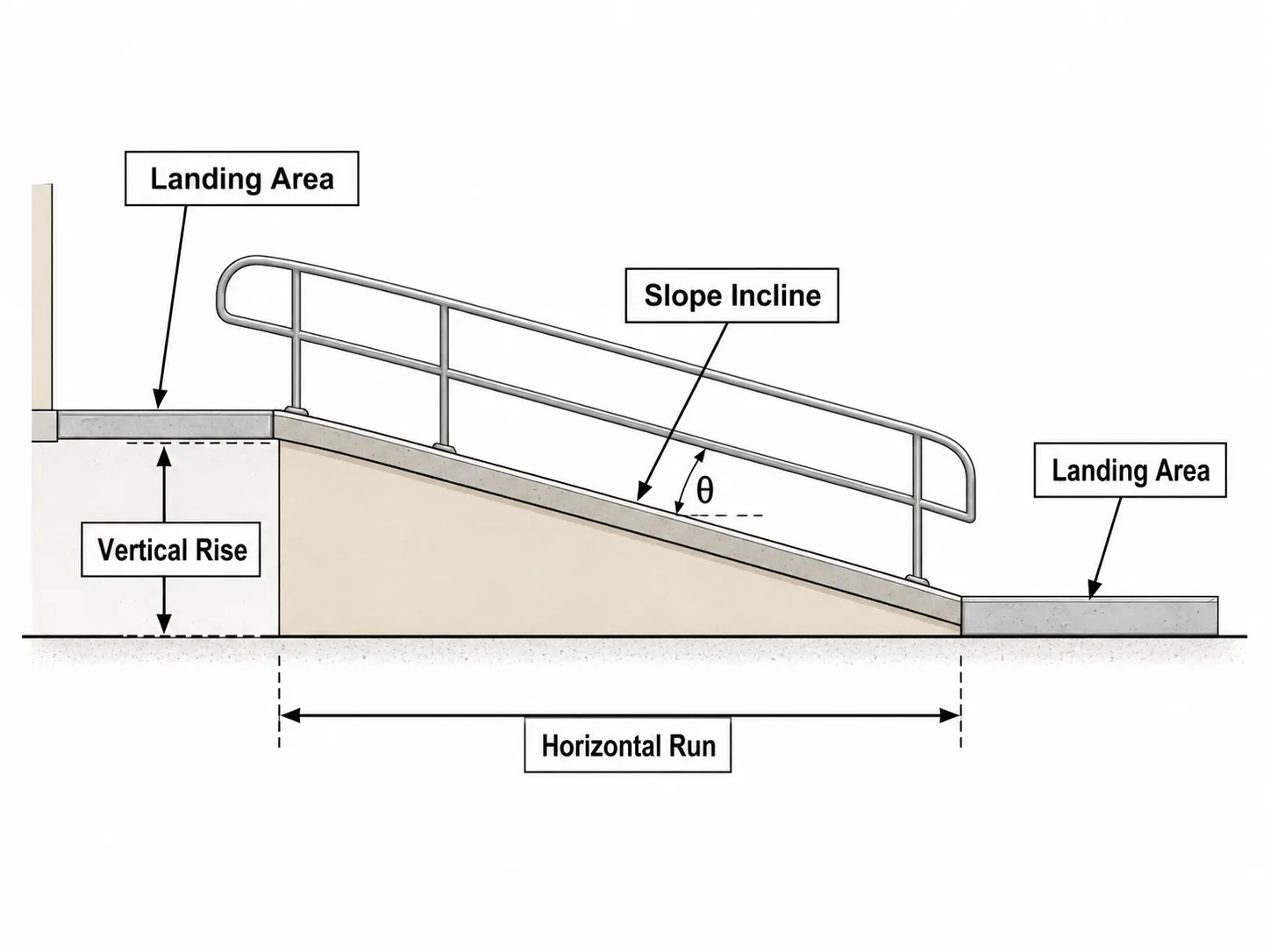
Understanding Ramp Slope: Ratio, Percentage, and Angle
Ramp slope is the rate of incline. In design and building regulations, it is typically expressed in three ways:
- Slope Ratio (1:X): Compares vertical units of rise to horizontal units of run. For example, a 1:12 slope means that for every 1 unit of vertical rise, you need 12 units of horizontal run. This is the standard ADA public ramp designation.
- Slope Percentage (%): Expressed as a percentage of rise over run (Rise ÷ Run × 100). A 1:12 slope corresponds to an 8.33% grade.
- Slope Angle (Degrees): The angular measurement in degrees relative to the horizontal plane. A 1:12 slope is approximately 4.76°.
The flatter the ramp, the easier it is for a person in a wheelchair to ascend. For this reason, building codes enforce maximum steepness thresholds.
Slope Percentage = (Rise ÷ Run) × 100
Slope Angle = arctan(Rise ÷ Run) × (180 ÷ π)
ADA Ramp Guidelines & Slope Limits
The Americans with Disabilities Act (ADA) sets strict requirements for ramps in commercial and public spaces (regulated under ADA Section 405):
- Maximum Slope: The absolute steepest slope permitted for a new public ramp is 1:12 (8.33% or 4.76°). Any slope steeper than this is non-compliant and considered unsafe.
- Maximum Rise per Run: A single continuous ramp run cannot rise more than 30 inches (760 mm or 2.5 feet) without an intermediate flat landing.
- Minimum Ramp Width: The clear width of a ramp run must be at least 36 inches (915 mm) between handrails.
- Minimum Landing Size: Flat landings must be provided at the top and bottom of each ramp run. Landings must be at least 60 inches (1,525 mm or 5 feet) in length and at least as wide as the ramp run itself. If the ramp changes direction at a landing, the landing must be a minimum of 60 inches by 60 inches.
These standards ensure that users have resting points and can control their wheelchairs safely. Residential ramps are sometimes allowed to be slightly steeper (e.g. 1:10) depending on the local building department, but 1:12 remains the gold standard for safety.
How to Calculate Intermediate Landings
If your vertical rise is greater than the maximum allowable rise for a single run (30 inches under ADA), you must break the ramp into multiple runs separated by intermediate landings. Each landing provides a level resting place. The number of runs is determined by dividing the total rise by the maximum rise per run, rounding up to the next integer. The number of intermediate landings required is always one less than the number of runs.
Number of Landings = Number of Runs - 1
Total Spanning Length = Total Run + (Number of Landings × Landing Length)
Total Vertical Rise = 45 inches
Max Rise per Run Limit = 30 inches
Target Slope = 1:12 (Requires 12 inches of run for each inch of rise)
Total Horizontal Run: 45 × 12 = 540 inches (45 feet)
Number of Runs: 45 ÷ 30 = 1.5 -> rounded up is 2 runs
Intermediate Landings: 2 runs - 1 = 1 landing
Total Spanning Length (with 60-inch landing): 540 + (1 × 60) = 600 inches (50 feet)
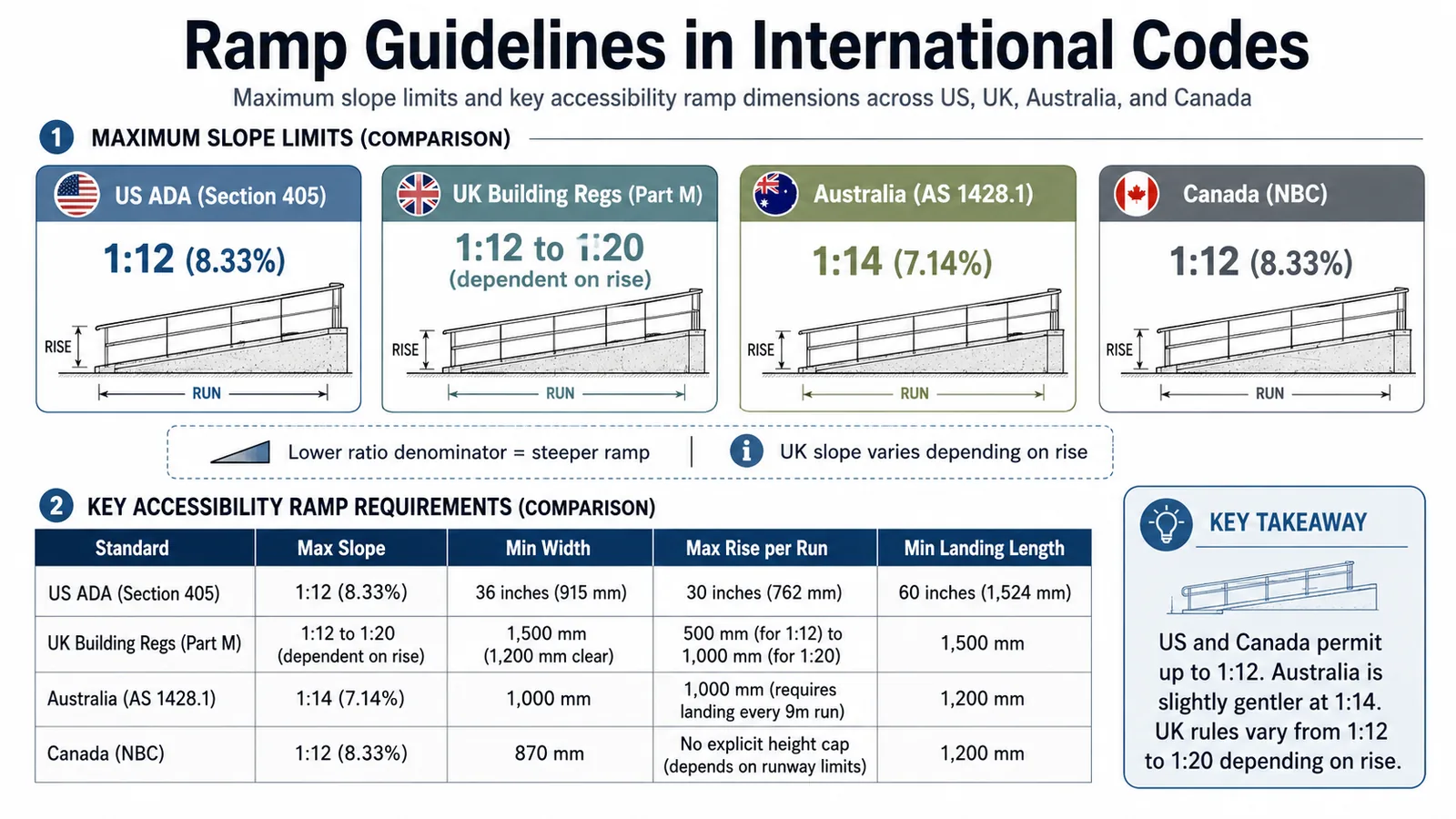
Ramp Guidelines in International Codes
While the ADA governs accessibility in the United States, other countries have similar requirements with minor variations. Below is a comparison of key ramp requirements across major international regulations:
| Standard | Max Slope | Min Width | Max Rise per Run | Min Landing Length |
|---|---|---|---|---|
| US ADA (Section 405) | 1:12 (8.33%) | 36 inches (915 mm) | 30 inches (762 mm) | 60 inches (1,524 mm) |
| UK Building Regs (Part M) | 1:12 to 1:20 (dependent on rise) | 1,500 mm (1,200 mm clear) | 500 mm (for 1:12) to 1,000 mm (for 1:20) | 1,500 mm |
| Australia (AS 1428.1) | 1:14 (7.14%) | 1,000 mm | 1,000 mm (requires landing every 9m run) | 1,200 mm |
| Canada (NBC) | 1:12 (8.33%) | 870 mm | No explicit height cap (depends on runway limits) | 1,200 mm |
Common Mistakes in Ramp Design
Designing accessibility ramps involves several pitfalls. Avoid these common design mistakes:
- Ignoring Handrail Protrusions: The 36-inch minimum width is measured as clear width. Make sure handrails, wall trims, and pipes do not protrude into this clearance.
- Omitting Landing Turnspace: If a ramp makes a L-turn or U-turn, the intermediate landing must be larger (usually 60" x 60" or 5ft x 5ft minimum) to allow a wheelchair to steer and complete the turn.
- Neglecting Drainage: Outdoor ramps must have a cross slope (perpendicular to travel) of no more than 1:48 (2.08%) to allow water run-off without destabilizing the wheelchair user.
- Forgetting Top/Bottom Landing Obstructions: Doors opening onto landings must not encroach into the required clear landing space by more than 12 inches when open.
- Improper Ground Transition: The transition at the top and bottom of the ramp must be flush. Lips or steps as small as 1/4 inch can stop a wheelchair caster wheel.
Frequently asked questions
What is the standard ADA ramp slope?
The standard maximum slope for a public accessibility ramp under the ADA is 1:12 (8.33% incline or 4.76°). For example, every 1 inch of vertical rise requires at least 12 inches of horizontal run.
What is the maximum rise allowed for a single ramp run?
Under ADA guidelines, a single continuous ramp run cannot exceed a vertical rise of 30 inches (2.5 feet or 762 mm). If the total rise is higher, intermediate flat landings must be integrated to divide the ramp into multiple runs.
How long must a ramp landing be?
A flat landing must be at least 60 inches (5 feet or 1,524 mm) in length. If the ramp changes direction at the landing (such as a 90-degree turn or a switchback), the landing must be at least 60 inches by 60 inches.
Are residential ramps required to have a 1:12 slope?
Local residential building codes (like the IRC) often permit steeper slopes for single-family residences, such as 1:10 (10%). However, a 1:12 slope is strongly recommended for safety and ease of use if space permits.
How do you calculate the number of landings needed for a ramp?
Divide the total vertical rise by the maximum allowed rise per run (usually 30 inches or 762 mm), then round up. The number of intermediate landings required is this rounded number minus one.
What is the minimum width of an ADA ramp?
The clear width of a ramp run must be a minimum of 36 inches (915 mm) between handrails or edge protection barriers.
Do walkways with a slope of 1:20 require handrails?
No. Walkways with slopes of 1:20 (5.00%) or flatter are not considered ramps under the ADA, so they do not require handrails, edge protection, or intermediate landings.