
Concrete Calculator: Estimate Volume, Weight, Bags, and Mix Materials
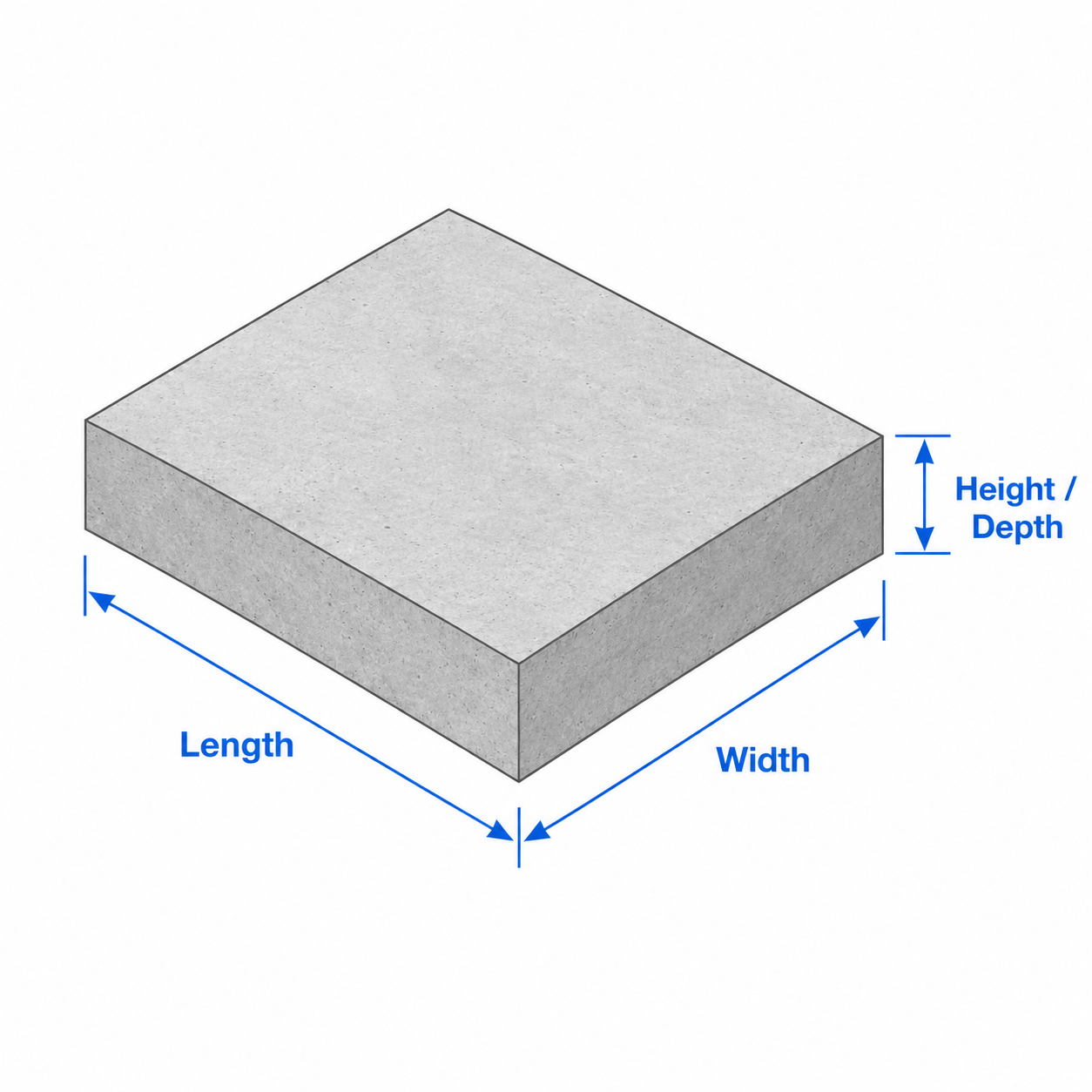
Use this concrete calculator to estimate how much concrete you need for slabs, footings, walls, columns, stairs, and curb or gutter work. Enter the dimensions of your concrete form, choose the unit for each field, and the calculator will convert everything correctly behind the scenes. It can estimate total area, concrete volume, total weight, cement bags, sand, aggregate, and water based on the selected mix.
Whether you are planning a small slab, a footing, a concrete wall, or a stair block, the most important step is knowing the correct concrete volume before ordering materials. Too little concrete can delay the work, while too much concrete increases cost and waste. This tool helps you calculate concrete quantities quickly using mixed units such as meters, centimeters, millimeters, feet, inches, cubic meters, and cubic yards.
What does a concrete calculator do?
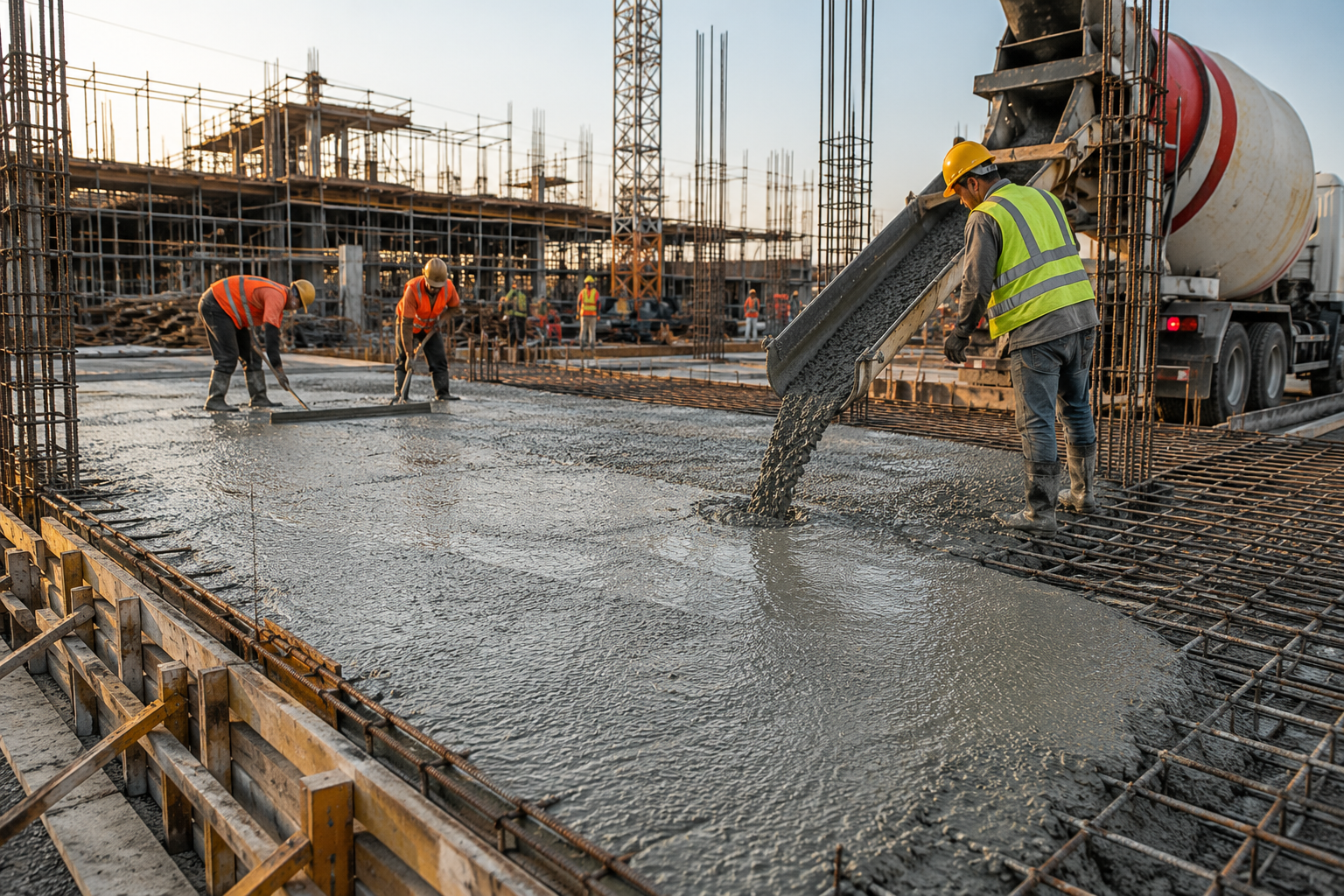
A concrete calculator estimates the amount of concrete required for a construction element. The basic result is usually volume, but a good calculator can also estimate weight, cement bags, sand, aggregate, water, and waste allowance.
This calculator supports different concrete forms:
- Slab
- Footing
- Wall
- Column
- Stairs
- Curb and gutter
Each form uses a different formula. For example, a slab uses length × width × thickness, while a round column uses the area of a circle × height. This is why choosing the correct form is important before entering the dimensions.
How to calculate concrete volume
In most simple cases, concrete volume is calculated by multiplying the main dimensions of the element.
Length = 5 m
Width = 400 cm
Thickness = 250 mm
Converted values: Length = 5 m | Width = 4 m | Thickness = 0.25 m
If quantity is 2: 5 × 2 = 10 m³
Concrete formulas by shape
Different concrete forms need different formulas. Use the correct shape before entering dimensions, because the meaning of height, width, depth, and thickness changes depending on the element.
| Concrete form | Required inputs | Formula | Best used for |
|---|---|---|---|
| Slab | Length, width, thickness, quantity | Volume = Length × Width × Thickness × Quantity | Floors, patios, driveways, roof slabs |
| Footing | Length, width, depth, quantity | Volume = Length × Width × Depth × Quantity | Strip footings, isolated footings, foundation bases |
| Wall | Length, height, thickness, quantity | Volume = Length × Height × Thickness × Quantity | Concrete walls, retaining walls, panels |
| Column | Diameter, height, quantity | Volume = π × (Diameter ÷ 2)² × Height × Quantity | Round concrete columns and piers |
| Stairs | Width, run, rise, platform depth, steps, quantity | Volume = stair step volume + platform volume | Solid concrete stair blocks |
| Curb / Gutter | Length, curb depth, height, gutter width, flag thickness | Volume = Length × cross-section area × Quantity | Road curbs, gutters, edge barriers |
Concrete slab calculation
A concrete slab is one of the most common uses of a concrete calculator. Slabs are used for floors, patios, parking areas, driveways, foundations, and roof decks.
For slab work, thickness has a big effect on the final volume. Increasing thickness from 150 mm to 200 mm can significantly increase the amount of concrete needed.
If a slab is 5 m long, 4 m wide, and 0.25 m thick:
If you need two identical slabs:
Total Volume: 5 × 2 = 10 m³
Concrete footing calculation
Concrete footings support walls, columns, and structural loads. A footing is usually calculated like a rectangular concrete block.
Footings often require accurate depth measurement because they are structural elements. Always confirm the footing size with the project drawings or a structural engineer.
If a footing is 10 m long, 0.6 m wide, and 0.4 m deep:
If there are 4 identical footings:
Total Volume: 2.4 × 4 = 9.6 m³
Concrete wall calculation
A concrete wall uses length, height, and thickness. The visible face area of the wall is length × height, while the concrete volume also includes thickness.
Do not confuse wall width with wall thickness. In wall calculations, the large face is usually length × height, and the smaller dimension is the thickness.
A wall that is 10 m long, 3 m high, and 0.2 m thick needs:
Concrete column calculation
Round concrete columns use the cylinder volume formula. First, calculate the radius from the diameter, then multiply the circle area by the height.
Column Volume = π × Radius² × Height × Quantity
A round column with a diameter of 1 m and height of 3 m:
If there are 2 columns:
Volume = π × 0.5² × 3 ≈ 2.356 m³
Total Volume = 2.356 × 2 = 4.712 m³
Concrete stairs calculation
Concrete stairs need more care because they are not a simple rectangular block. A solid stair block is made from repeated steps plus an optional top platform.
Inputs required: Width, Run, Rise, Platform depth, Number of steps, and Quantity.
The calculator estimates the solid stair volume using the step rise, total run, number of steps, stair width, and platform depth.
Concrete curb and gutter calculation
Curb and gutter calculations are based on the cross-section area multiplied by the length. The calculator uses the curb height, curb depth, gutter width, and flag thickness to estimate the concrete volume.
Volume = Length × Cross-section area × Quantity
Length = 10 m, Curb depth = 0.3 m, Curb height = 0.2 m, Gutter width = 0.5 m, Flag thickness = 0.1 m
Volume: 10 × 0.11 = 1.1 m³
How concrete weight is calculated
Concrete weight depends on volume and density. A common density for normal concrete is about 2400 kg/m³. However, the real value can change depending on aggregate type, mix design, moisture, and reinforcement.
Volume = 10 m³, Density = 2400 kg/m³
How cement, sand, aggregate, and water are estimated
Concrete is made from cement, sand, aggregate, and water. When estimating materials from a mix ratio, the calculator uses the selected concrete volume and applies a dry volume factor. A common dry volume factor is 1.54.
For a mix ratio such as 1 : 1.5 : 3:
- 1 part cement
- 1.5 parts sand
- 3 parts aggregate
The calculator divides the dry volume according to the selected ratio, then converts cement volume to kilograms and bags.
Concrete volume = 10 m³, Dry factor = 1.54, Dry volume = 15.4 m³
Mix ratio = 1 : 1.5 : 3 (Total ratio = 5.5)
Cement weight: 2.8 × 1440 = 4032 kg
50 kg bags: 4032 ÷ 50 = 80.64 bags
Sand: 15.4 × 1.5 ÷ 5.5 = 4.2 m³
Aggregate: 15.4 × 3 ÷ 5.5 = 8.4 m³
Water with w/c ratio 0.50: 4032 × 0.50 = 2016 liters
How much extra concrete should you add for waste?
It is usually safer to add a waste allowance to your concrete quantity. Waste can happen because of spillage, uneven ground, formwork variation, over-excavation, or measurement errors.
Common waste allowance:
- Small accurate work: 3% to 5%
- Normal site work: 5% to 10%
- Irregular excavation or rough ground: 10% or more
Do not add a large waste percentage without reason. Too much concrete can increase cost and may create disposal problems.
Calculated volume = 10 m³, Waste allowance = 5%
Concrete vs cement
Concrete and cement are not the same thing.
Cement is a binding material. When cement is mixed with water, it forms a paste. That paste binds sand and aggregate together to create concrete.
Concrete is the final construction material made from cement, water, sand, aggregate, and optional additives.
Common concrete mix grades
Concrete grades are commonly written as M10, M15, M20, M25, and so on. The number usually refers to compressive strength in MPa after 28 days under standard conditions.
| Grade | Typical ratio | Strength | Common use |
|---|---|---|---|
| M10 | 1 : 3 : 6 | 10 MPa | Leveling and non-structural work |
| M15 | 1 : 2 : 4 | 15 MPa | Plain concrete and light-duty work |
| M20 | 1 : 1.5 : 3 | 20 MPa | General concrete work |
| M25 | 1 : 1 : 2 | 25 MPa | Stronger slabs and structural concrete where approved |
| M30 and above | Design mix | 30 MPa+ | Structural work requiring engineered mix design |
Example concrete calculation
A user wants to pour two concrete slabs.
Inputs:
• Length: 5 m
• Width: 400 cm
• Thickness: 250 mm
• Quantity: 2
• Density: 2400 kg/m³
• Mix: M20
Step 1: Convert units
Width = 400 cm = 4 m
Thickness = 250 mm = 0.25 m
Step 2: Calculate volume for one slab
5 × 4 × 0.25 = 5 m³
Step 3: Multiply by quantity
5 × 2 = 10 m³
Step 4: Calculate weight
10 × 2400 = 24,000 kg
Step 5: Estimate materials for M20
Using 1 : 1.5 : 3 and dry factor 1.54:
• Cement: about 4032 kg
• Cement bags: about 80.64 bags of 50 kg
• Sand: about 4.2 m³
• Aggregate: about 8.4 m³
• Water: about 2016 liters
Tips for accurate concrete estimates
Use these tips before ordering concrete:
- Measure all dimensions carefully.
- Convert small dimensions like thickness from millimeters to meters correctly.
- Check whether the calculator needs total run or single-step tread depth for stairs.
- Use the correct form type before entering values.
- Add a reasonable waste allowance.
- Confirm density and mix details with your supplier.
- For structural concrete, follow the project drawings and engineer specifications.
Frequently asked questions
How do I calculate concrete volume?
For simple rectangular concrete forms, multiply length by width by height or thickness. For example, a slab uses length × width × thickness. Other forms, such as round columns or stairs, use different formulas.
How much concrete do I need for a slab?
Multiply the slab length by width by thickness. If you have more than one slab, multiply the result by the quantity. Always make sure all dimensions are converted to the same unit before calculating.
Can I use centimeters and meters together?
Yes. This calculator supports mixed units. You can enter length in meters, width in centimeters, and thickness in millimeters. The calculator converts the values internally before calculating the result.
How do I calculate concrete weight?
Concrete weight is calculated by multiplying volume by density. A common density for normal concrete is around 2400 kg/m³, but the exact value depends on the concrete mix.
How many cement bags do I need?
Cement bags depend on the concrete volume, mix ratio, dry volume factor, cement density, and bag size. For example, with a 10 m³ M20 mix using a 1:1.5:3 ratio and 50 kg bags, the estimate is about 80.64 bags.
What is the difference between concrete and cement?
Cement is one ingredient in concrete. Concrete is made by mixing cement, water, sand, aggregate, and sometimes additives.
Should I add extra concrete for waste?
Yes. A waste allowance of 5% to 10% is common for many site conditions. Use less for very accurate formwork and more for irregular excavation or rough ground.
Is this calculator enough for structural concrete?
The calculator is useful for estimating quantities, but structural concrete must follow project drawings, local codes, and engineer-approved specifications.