
FAR Calculator: Floor Area Ratio, Floor Space Ratio, FSI, and Building Area Ratio Explained
Use this FAR calculator to estimate Floor Area Ratio, floor space ratio, floor space index, building area ratio, maximum gross floor area, lot coverage, and buildable floor area for a site. FAR is one of the most important numbers in architecture, real estate development, and urban planning because it defines how much floor area can be built compared with the size of the land.
Floor Area Ratio is also known in many places as floor space ratio, building area ratio, plot ratio, or FSI. The name changes by country or municipality, but the core idea is similar: compare the total building floor area with the lot area.
This calculator can help during early feasibility studies, zoning checks, concept design, land development analysis, and schematic design. Enter the lot area, allowed FAR or FSI, building footprint, and lot coverage values to estimate maximum GFA, possible number of floors, and zoning compliance.
What is FAR?
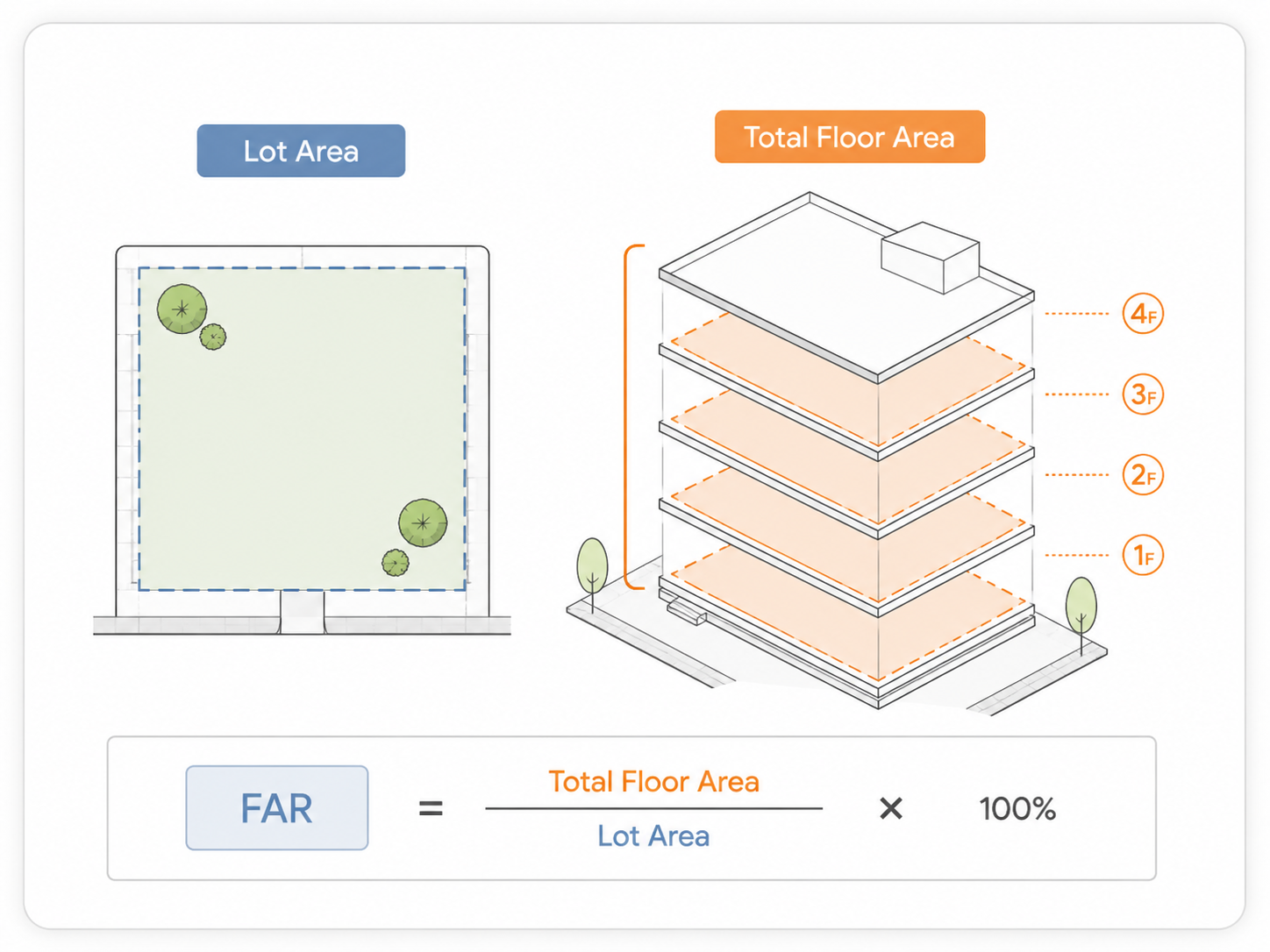
FAR stands for Floor Area Ratio. It is the ratio between the total gross floor area of a building and the area of the lot. A floor area ratio definition tells us that this multiplier is a key zoning control. Knowing how to calculate floor area ratio allows designers to understand buildable parameters immediately. A FAR ratio calculation compares horizontal floor plates across all levels against the horizontal land surface below.
A FAR of 1.0 means the total floor area equals the lot area. A FAR of 2.0 means the total floor area is twice the lot area. A FAR of 0.5 means the total floor area is half the lot area.
Lot area = 1,000 m²
Gross floor area = 1,500 m²
FAR ratio calculation: 1,500 ÷ 1,000 = 1.5
FAR, FSI, floor space ratio, and building area ratio
Different countries and cities use different names for similar zoning concepts. For instance, floor space index means the exact same ratio as FAR, but it is typically expressed as a decimal or percentage in regions like India. Understanding FSI building construction definitions is essential when working in foreign markets, where FSI and FAR calculation guidelines are standard. In addition, terms like building area ratio or FAR plot ratio might appear in local bylaws to control built up area FSI calculation parameters.
| Term | Meaning | Common Use |
|---|---|---|
| FAR | Floor Area Ratio | Common in zoning, architecture, and real estate |
| FSI | Floor Space Index | Common in India and some planning systems (FSI building construction) |
| Floor Space Ratio | Total floor space compared with site area | Common search term and planning term |
| Building Area Ratio | Building floor area compared with lot area | Often used in zoning and property research |
| Plot Ratio | Total floor area compared with plot area | Common in some international planning codes (FAR plot ratio) |
In most practical cases, these terms describe the same basic relationship: Total counted building floor area ÷ land area. However, the exact spaces counted in the calculation can change from one jurisdiction to another. That is why the FAR calculator is useful for early planning, but final compliance must always follow the local zoning code.
FAR formula
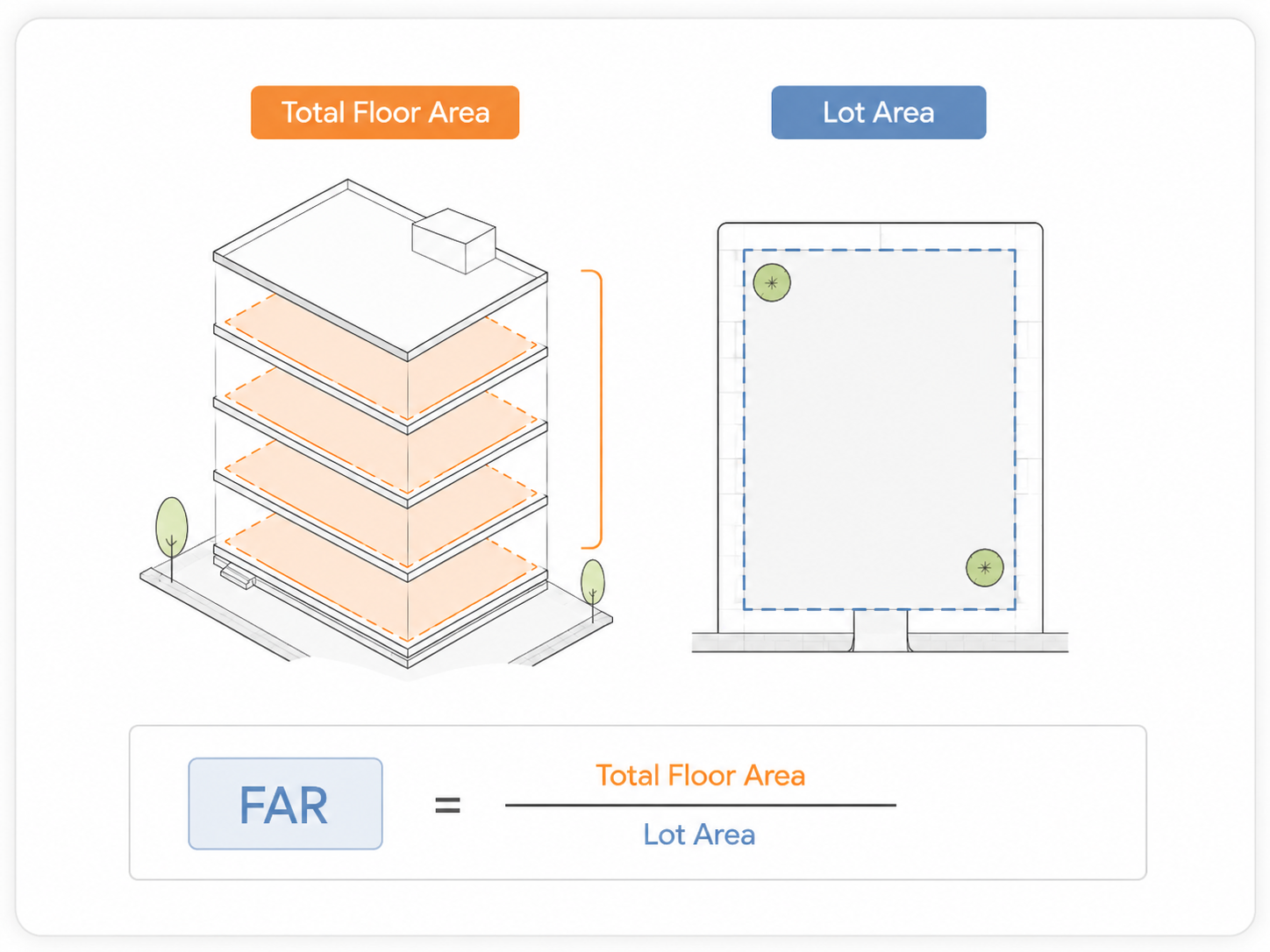
The basic floor area ratio formula is straightforward. When studying a site for development, you can use the formula cards to figure out the FAR ratio or permissible floor area ratio of a project. Using the standard zoning floor area calculation, you can determine how much building area can be constructed on a given site. If you have the total gross floor area and the lot size, you can find the FAR. You can also rearrange the same formula to compute the maximum buildable floor area allowed on the land.
Maximum GFA = Lot Area × Allowed FAR
Required Lot Area = Gross Floor Area ÷ FAR
Lot area = 2,000 m²
Allowed FAR = 3.0
Maximum GFA: 2,000 × 3.0 = 6,000 m²
How to calculate maximum GFA
Maximum GFA means the largest gross floor area allowed by the FAR or FSI limit. This is often one of the first calculations architects, developers, and planners do when studying a site. The GFA is computed by multiplying the lot area by the allowed FAR ratio. It defines the total physical envelope size across all levels before setbacks and height constraints are considered.
Lot area = 1,250 m²
Maximum FAR = 2.4
Maximum GFA: 1,250 × 2.4 = 3,000 m²
How to calculate built-up area from FAR
Many users search for how to calculate built up area from FAR. In simple terms, if your local code treats built-up area and gross floor area similarly, you can estimate the maximum built-up area using the permissible floor area ratio. In India, for example, the FSI in construction means the ratio of total built-up area to the plot size. The built up area FSI calculation determines how much of the building can actually be constructed after excluding exempted amenities.
Plot area = 800 m²
Permissible FAR = 1.5
Maximum built-up area: 800 × 1.5 = 1,200 m²
How to calculate number of floors from FAR
A common design challenge is how to calculate number of floors from FAR. While FAR controls total density, it does not directly set the floor count or building height limit. To estimate floors, you need to know the planned building footprint or the allowed lot coverage. By dividing the total GFA by the footprint area, you get the approximate number of floors that can be built on the site.
Maximum GFA = 3,000 m²
Building footprint = 600 m²
Estimated floors: 3,000 ÷ 600 = 5 floors
Lot coverage vs FAR
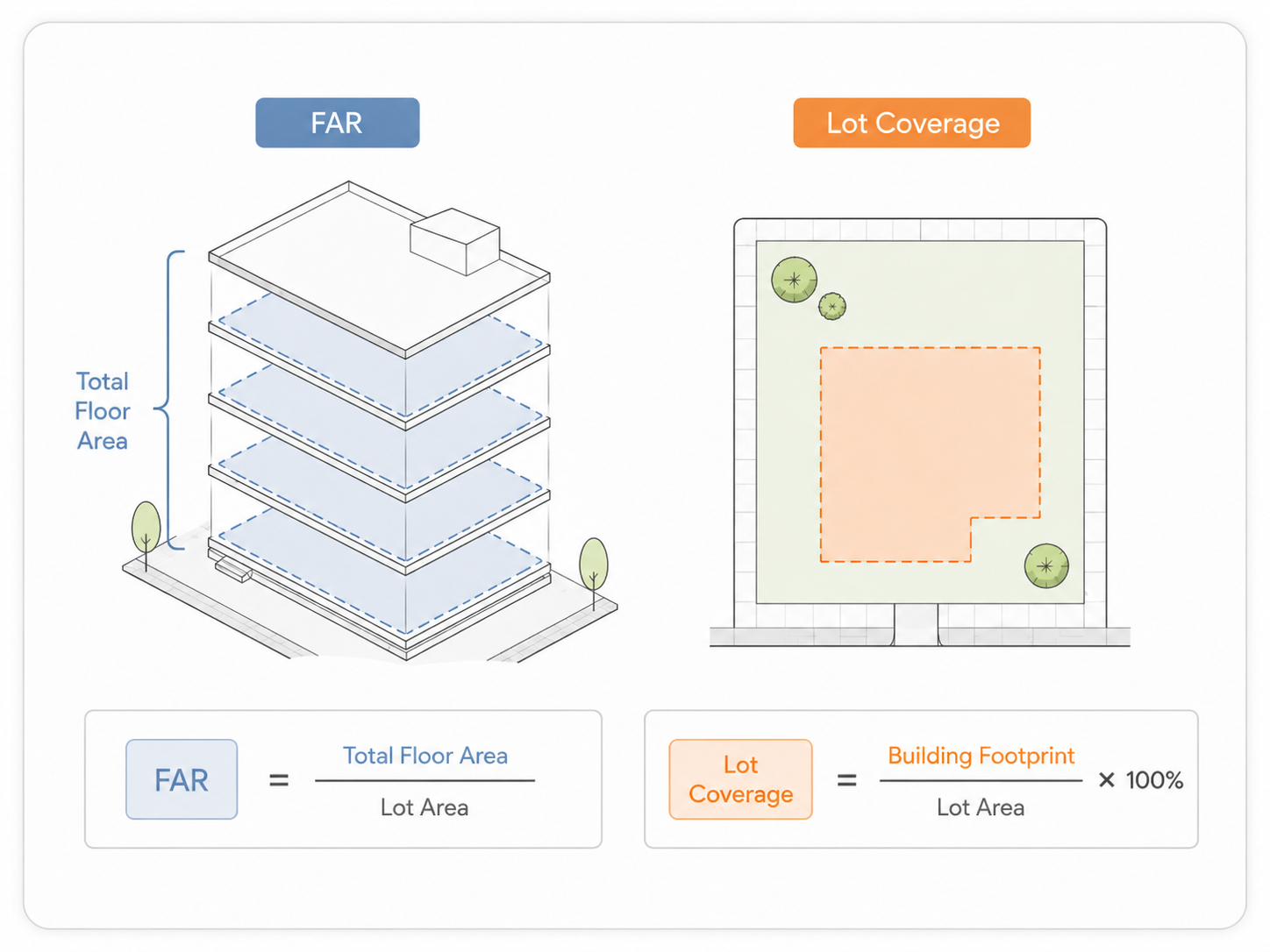
Lot coverage and FAR are related, but they measure different aspects of density. While FAR controls the total gross floor area across all floors, lot coverage controls how much of the land is covered by the building footprint at ground level. Learning how to calculate FAR and coverage together is a standard requirement for zoning compliance. A project might easily satisfy the FAR ratio but fail the lot coverage limit if the footprint is too large.
Lot area = 1,000 m²
Lot coverage limit = 40%
Maximum footprint: 1,000 × 40% = 400 m²
Allowed FAR = 2.0 (Max GFA = 2,000 m²)
Possible massing: 2,000 m² ÷ 400 m² = 5 floors
Building coverage ratio
Building coverage ratio is another way to describe how much of a lot is physically covered by the building footprint. It is expressed as a percentage. Building coverage ratio calculation ensures that developers do not cover too much of the lot, leaving space for landscaping, fire truck access, and storm run-off. A project may satisfy a high FAR limit but be limited in heights if the building coverage ratio restricts the ground floor plates.
Building footprint = 350 m²
Lot area = 1,000 m²
Building coverage ratio calculation: (350 ÷ 1,000) × 100 = 35%
FAR calculation example
To perform a complete zoning floor area calculation, we must look at how to calculate FAR of a building along with coverage. Here is a step-by-step example using typical zoning numbers. By following this method, developers can run a quick feasibility analysis on a plot to determine the GFA and physical footprint limits.
Lot area = 1,000 m²
Maximum FAR = 1.5
Maximum lot coverage = 30%
Step 1 (Max GFA): 1,000 × 1.5 = 1,500 m²
Step 2 (Max Footprint): 1,000 × 30% = 300 m²
Step 3 (Estimated Floors): 1,500 ÷ 300 = 5 floors
Residential FAR example
Residential zoning districts often use a lower FAR ratio to control the size of single-family homes and duplexes. For example, local planners might enforce a floor area ratio for residential building structures of 0.75, which maintains low-density neighborhood character. This prevents the construction of oversized homes (mansions) that take up the entire site and block sunlight for neighbors.
Residential lot area = 600 m²
Permissible FAR = 0.75
Maximum residential GFA: 600 × 0.75 = 450 m²
Possible configuration A: 2 floors × 225 m²
Possible configuration B: 3 floors × 150 m²
Zoning density scenarios
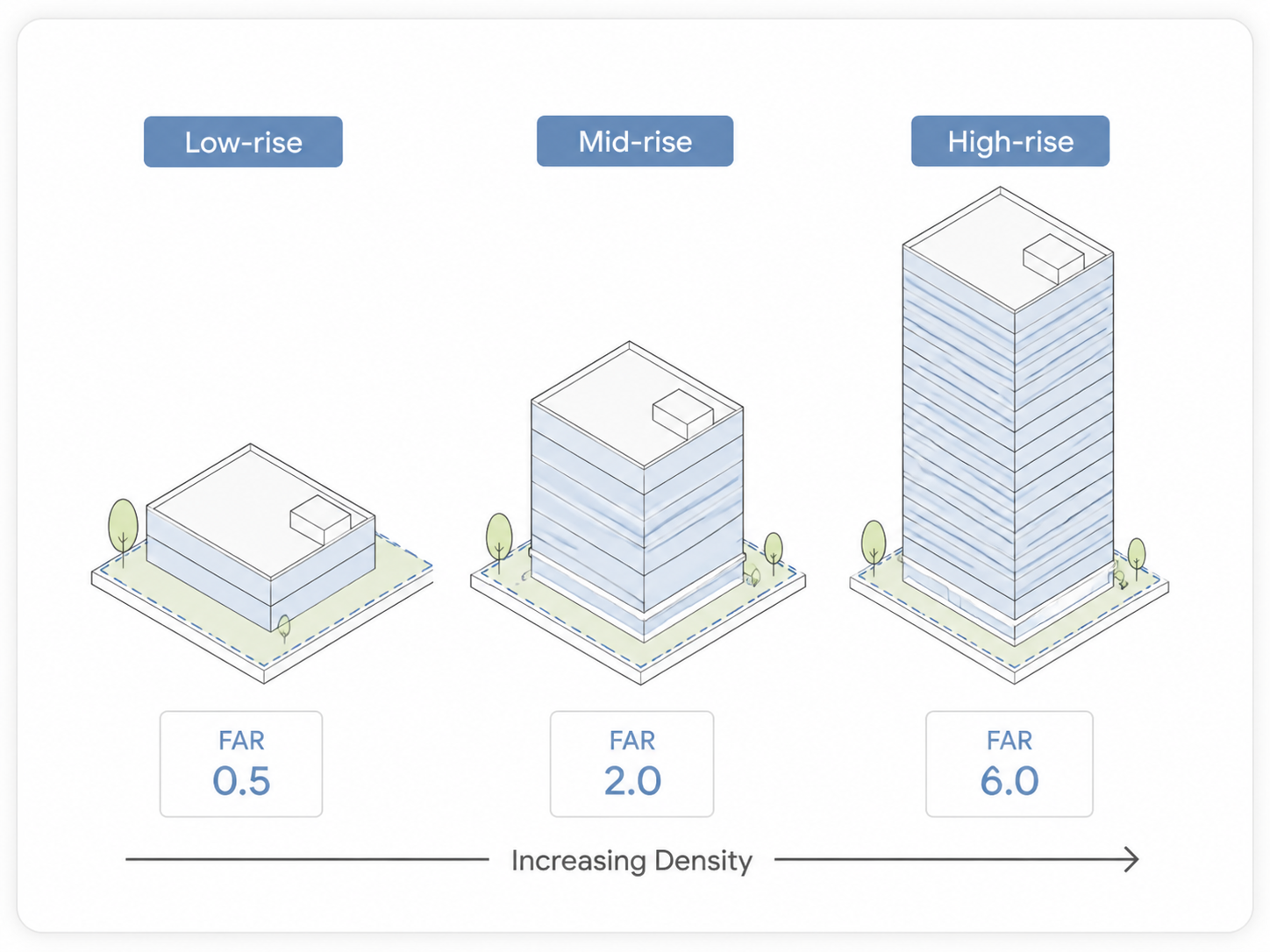
The same lot can produce completely different building forms depending on the allowed FAR, FSI, lot coverage, and heights. Low-density residential districts restrict building bulk, while high-density commercial centers allow multi-story office towers.
Below is a responsive table showing typical zoning density scenarios on a 1,000 m² plot:
| Scenario | Lot Area | FAR Limit | Max GFA | Lot Coverage | Max Footprint | Sample Massing |
|---|---|---|---|---|---|---|
| Low-Density Residential | 1,000 m² | 0.5 | 500 m² | 30% | 300 m² | 2 floors of 250 m² |
| Small Mixed-Use | 1,000 m² | 1.2 | 1,200 m² | 40% | 400 m² | 3 floors of 400 m² |
| Mid-Rise Urban Block | 1,000 m² | 3.0 | 3,000 m² | 50% | 500 m² | 6 floors of 500 m² |
| High-Density Center | 1,000 m² | 6.0 | 6,000 m² | 60% | 600 m² | 10 floors of 600 m² |
What counts toward GFA?
Gross Floor Area, or GFA, usually means the total enclosed floor area of a building measured across all counted levels. It often includes:
- residential units
- offices
- retail areas
- corridors
- lobbies
- stair cores
- elevator cores
- enclosed amenity spaces
- service rooms
- mechanical rooms, depending on local code
- mezzanines, depending on local code
The exact definition depends on the zoning ordinance. Some cities measure GFA from the exterior face of walls, while others use different rules for common areas, basements, parking, or service spaces.
What may be excluded from FAR?
Some spaces may be excluded from FAR or floor space index calculations depending on local rules. Common possible exclusions include:
- underground parking
- open balconies
- roof terraces
- mechanical penthouses
- basement storage
- uncovered parking
- exterior stairs
- service shafts
- public arcades
- utility rooms
- loading areas
Why FAR matters in architecture, real estate, and planning
FAR matters because it affects building size, density, land value, and design strategy.
For architects: FAR helps define massing, floor count, building footprint, open space, and early concept options. Understanding FAR in building construction is critical because it tells design teams exactly what parameters are buildable on a site.
For developers: The FAR in real estate meaning relates to density, site capacity, and property valuation. FAR helps estimate development yield, sellable or rentable area, and land value.
For planners: FAR helps manage density, traffic, infrastructure load, sunlight access, street character, and neighborhood scale.
For property owners: FAR helps estimate whether a site has unused development potential or whether an extension may be possible.
Common mistakes
Avoid these mistakes during FAR area calculations:
- Confusing FAR with lot coverage: FAR is total floor area divided by lot area. Lot coverage is only ground footprint.
- Using net area instead of gross floor area: FAR usually uses gross floor area, not only usable or rentable area.
- Forgetting upper floors: All counted floors must be included.
- Ignoring basements, balconies, parking, or mechanical rules: These may be included or excluded depending on local code.
- Assuming maximum FAR is always buildable: Setbacks, height limits, site shape, and parking may reduce the practical buildable area.
- Mixing units: Lot area and gross floor area must use the same unit.
- Confusing FAR with FSI: They are often similar, but the local representation (decimal vs percentage) may be different.
Frequently asked questions
What is floor space ratio?
Floor space ratio is another term used for Floor Area Ratio. It compares the total counted floor area of a building with the area of the lot.
What is Floor Area Ratio?
Floor Area Ratio is the relationship between a building’s total gross floor area and the size of the lot. It is calculated by dividing gross floor area by lot area.
How do I calculate FAR?
Use the formula FAR = Gross Floor Area ÷ Lot Area. For example, if a building has 2,000 m² of gross floor area on a 1,000 m² lot, the FAR is 2.0.
How do I calculate maximum GFA from FAR?
Use the formula Maximum GFA = Lot Area × Allowed FAR. For example, a 1,000 m² lot with an allowed FAR of 1.5 can have up to 1,500 m² of gross floor area.
How do I calculate built-up area from FAR?
Multiply the plot area by the allowed FAR. For example, an 800 m² plot with FAR 1.5 allows about 1,200 m² of counted built-up or gross floor area, depending on local definitions.
How do I calculate number of floors from FAR?
Divide the allowed gross floor area by the planned building footprint. For example, 3,000 m² of GFA with a 600 m² footprint gives about 5 floors.
Is FAR the same as FSI?
FAR and FSI are often used for the same idea: total floor area divided by plot area. However, local codes may define them differently, so always check the official zoning rules.
Is FAR the same as lot coverage?
No. FAR measures total floor area across all floors, while lot coverage measures how much of the lot is covered by the building footprint.
Can FAR be greater than 1?
Yes. FAR can be greater than 1 in medium-density and high-density areas. A FAR of 3 means the building can have three times the lot area in total gross floor area.
Does basement area count in FAR?
It depends on the local zoning code. Some cities exclude fully underground basements, while others count basement areas if they are used for certain purposes or exposed above grade.
Does parking count toward FAR?
Parking may or may not count toward FAR depending on local rules. Underground parking is often excluded, but above-grade parking structures may be counted in some jurisdictions.
What is building area ratio?
Building area ratio usually refers to the relationship between building floor area and lot area. In many contexts, it is similar to FAR or floor area ratio.
What is permissible FAR?
Permissible FAR is the maximum floor area ratio allowed by the zoning code for a specific site or district.