
Floating House Architecture: Design Ideas, Flood-Resilient Strategies, and Examples
A clear architectural guide to floating houses, how they work, where they make sense, and how buoyancy, mooring, structure, utilities, and flood-resilient design shape homes built on water.
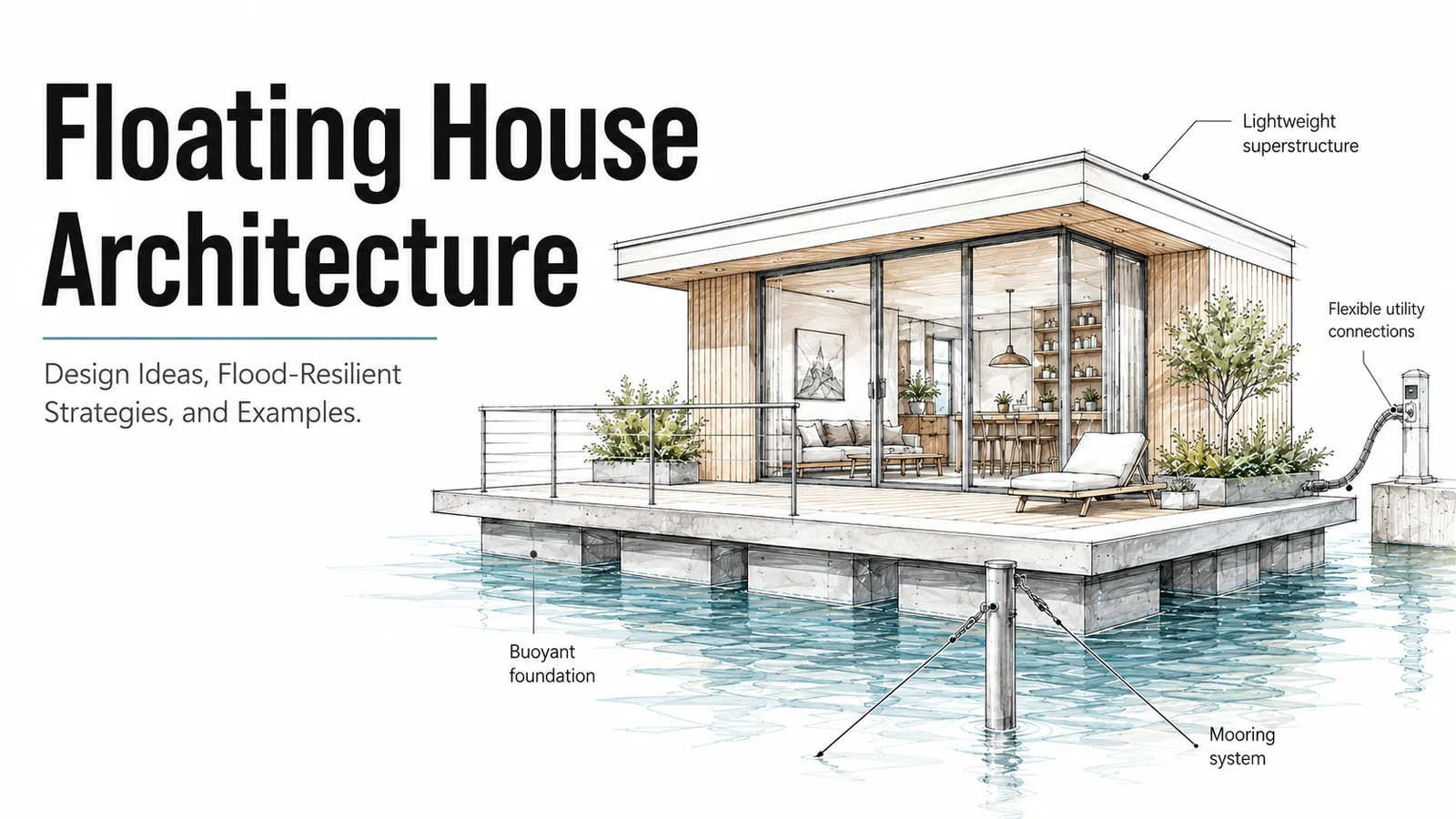
A floating house is one of the most fascinating ideas in architecture because it challenges a basic assumption: that a building must always sit firmly on land.
Instead of resisting water completely, a floating house accepts water as part of the site. It rises, moves, or rests with changing water levels, depending on how it is designed.
This makes floating house architecture especially interesting for waterfront sites, flood-prone areas, river communities, coastal cities, and climate-resilient housing design.
But a floating house is not just a normal house placed on water. It needs a different way of thinking about structure, stability, access, utilities, maintenance, safety, and daily comfort.
This guide explains how floating houses work, the difference between floating and amphibious houses, the main design strategies, the common mistakes, and what architects should consider before designing homes on water.
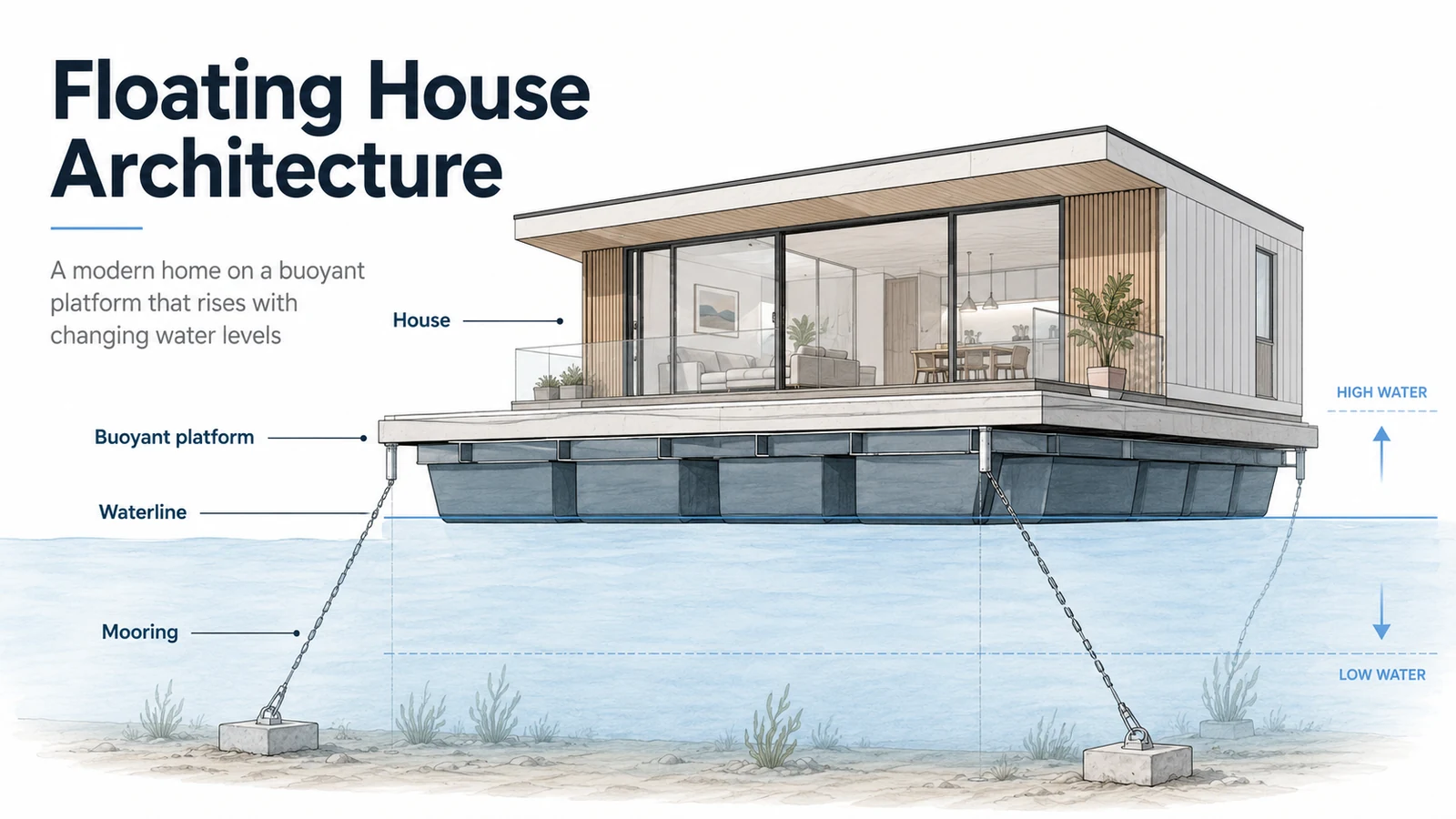
Caption: A floating house uses buoyancy, anchoring, and flexible connections to adapt to changing water levels.
What Is a Floating House?
A floating house is a home designed to sit on water using a buoyant foundation or floating platform.
Unlike a typical land-based house, the lower structure is designed to float. The house may be permanently located on a canal, lake, river, marina, or protected water body.
A floating house usually includes:
- A buoyant base or hull
- A lightweight superstructure
- Mooring or anchoring systems
- Flexible utility connections
- Safe access from land
- Protection from waves, wind, and water movement
- Careful balance and weight distribution
Floating houses are different from ordinary boats because they are usually designed as permanent or semi-permanent homes, not as vehicles.
They are also different from normal waterfront houses because the foundation responds to water instead of only resisting it.
The Climate-ADAPT guide to floating and amphibious housing explains that floating houses remain permanently in water and can accommodate fluctuating water levels caused by river floods and storm surges.
This is why floating houses are becoming more relevant in architecture, especially as cities look for new ways to live with water instead of only building higher walls against it.
Floating House vs Amphibious House
Floating houses and amphibious houses are related, but they are not the same.
A floating house is permanently located on water. It is always floating.
An amphibious house usually sits on land during normal conditions, but rises and floats when floodwater arrives.
In simple terms:
- A floating house lives on water.
- An amphibious house waits on land and floats during floods.
- A floating house needs permanent water-based access and services.
- An amphibious house needs a system that allows vertical movement during flood events.
- Both use buoyancy.
- Both need anchoring or guidance systems.
- Both require careful structural and utility design.
The UNHCR flood risk mitigation compendium describes amphibious construction as a system where the structure can float during flooding while being guided or anchored so it does not drift away.
For architects, the difference is important because the site logic changes completely.
A floating house is designed as water-based architecture from the beginning. An amphibious house is usually designed as flood-resilient land-based architecture.
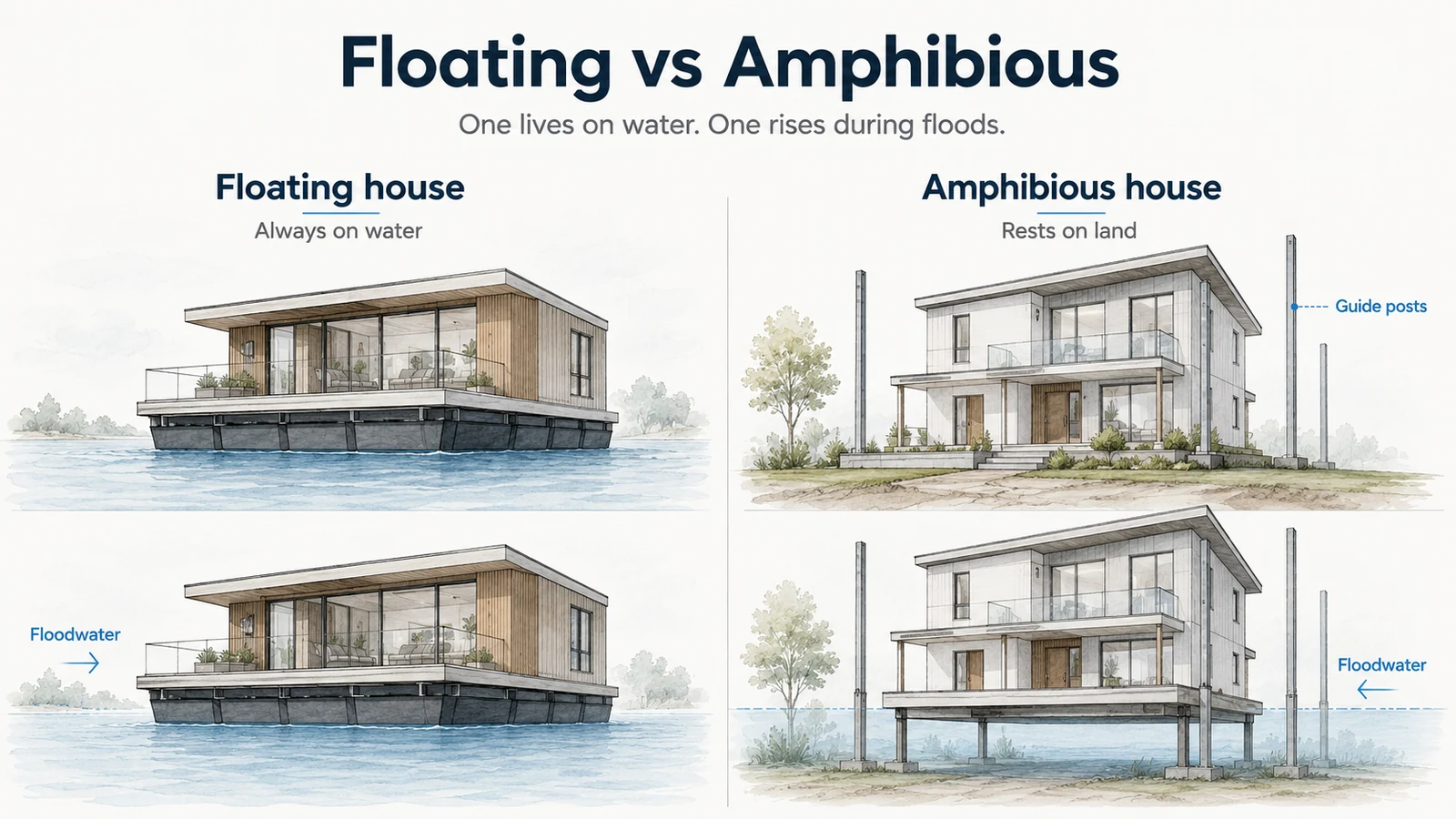
Caption: Floating houses remain on water, while amphibious houses usually rest on land and rise only when floodwater arrives.
Why Floating Houses Matter in Architecture
Floating houses are not just strange or beautiful objects. They are part of a bigger architectural question: how should buildings adapt to water?
Many cities are dealing with:
- River flooding
- Coastal flooding
- Storm surges
- Land scarcity
- High waterfront demand
- Climate adaptation pressure
- Urban expansion near water
- Changing ideas about resilient housing
In some places, the old strategy was simple: keep water out.
But in many flood-prone areas, this is becoming harder. Architects and planners are now exploring more adaptive strategies, including raised buildings, amphibious structures, floating homes, wetland urbanism, and water-based communities.
Floating houses can offer:
- New housing options in water-rich cities
- Better adaptation to changing water levels
- Reduced pressure on limited urban land
- Stronger connection with nature and landscape
- Opportunities for renewable energy and water systems
- New forms of waterfront living
Climate-ADAPT notes that floating and amphibious housing can provide alternative housing solutions in low-lying areas and places below sea level, while also responding to fluctuating water levels.
Still, floating houses are not a universal solution. They need the right site, water conditions, regulations, maintenance systems, and engineering.
A floating house can be elegant, but it must also be precise.
How Does a Floating House Work?
A floating house works by using buoyancy.
The base of the house displaces water. If the displaced water weighs more than the house, the house can float.
This is the same basic principle that allows boats, pontoons, and floating platforms to stay above water.
Architecturally, the floating system usually includes three main parts:
- A buoyant foundation or hull
- A structural frame above it
- A mooring or anchoring system that controls movement
The buoyant base may be made from concrete, steel, expanded polystyrene blocks, pontoons, barrels, fiberglass, or composite systems, depending on the project.
The structure above should usually be relatively lightweight and well-balanced. Heavy loads should be carefully placed so the house does not tilt or become uncomfortable.
A floating house also needs to resist more than gravity. It must respond to:
- Water level changes
- Wind loads
- Wave movement
- Current
- Impact from floating debris
- Corrosion
- Moisture
- Long-term maintenance
- Access and evacuation
The design is not only about making the house float. It is about making it stable, livable, durable, and safe.
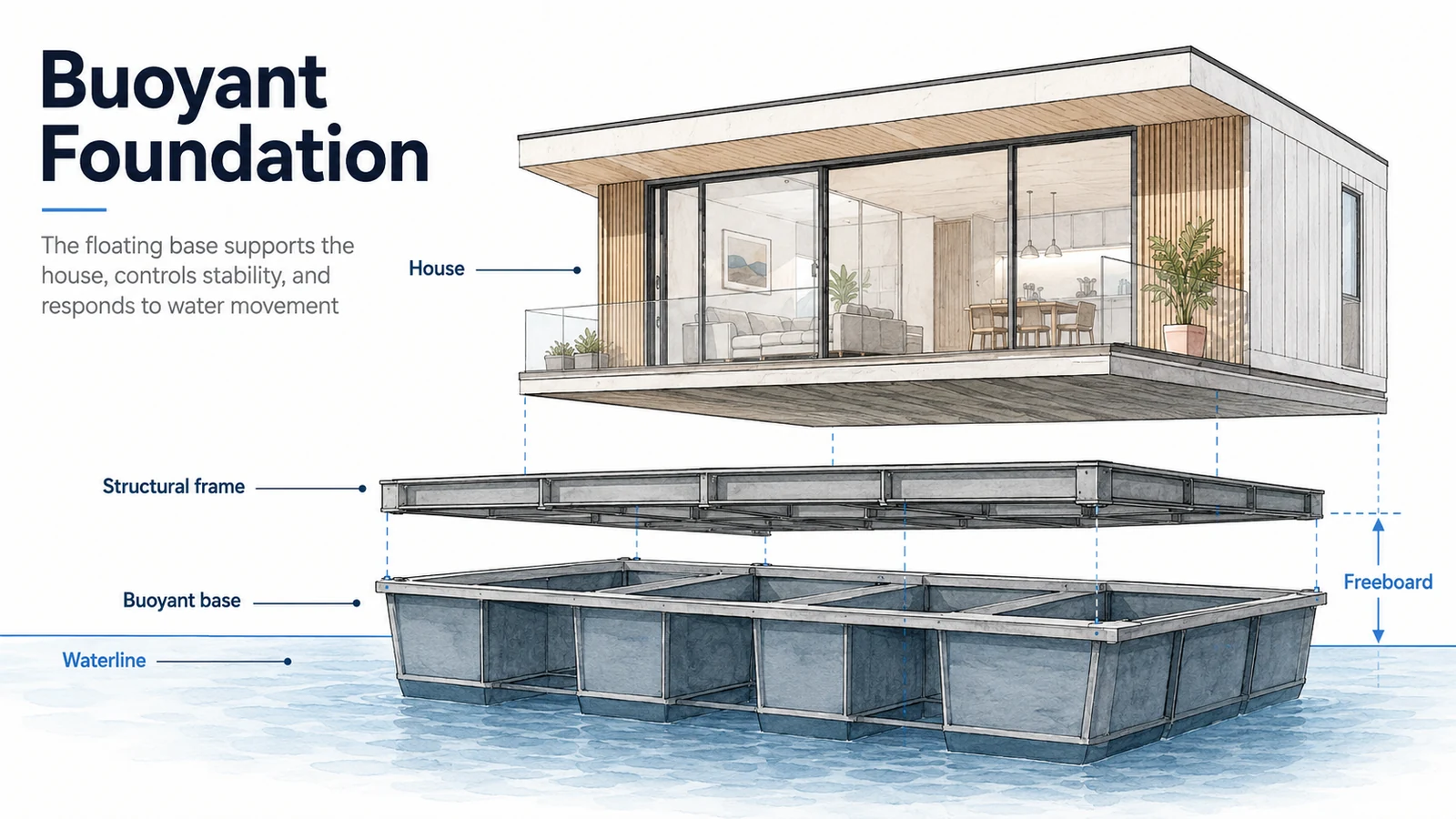
Caption: The buoyant foundation is the most important part of a floating house. It must support the house, keep it stable, and respond safely to water movement.
Main Design Strategies for Floating Houses
1. Start With the Water, Not the House
A floating house should begin with the water conditions.
Before designing the form, architects need to understand:
- Water depth
- Seasonal water level change
- Flood levels
- Wave height
- Current direction
- Wind exposure
- Ice risk in cold climates
- Floating debris
- Water quality
- Navigation routes
- Access points
- Local regulations
A calm canal is very different from an exposed coast.
A floating house that works in a protected marina may not work in open water.
This is why site selection is one of the most important decisions. Climate-ADAPT notes that marine applications are possible, but only with careful site selection to avoid dangerous or uncomfortable conditions caused by currents and waves.
A floating house should look peaceful, but its site analysis should be serious.
2. Design a Stable Buoyant Base
The floating base must carry the house safely.
It must provide:
- Buoyancy
- Stability
- Structural support
- Moisture resistance
- Maintenance access
- Protection from impact
- Long-term durability
A common architectural mistake is to focus too much on the visible house and not enough on the floating platform below it.
But the platform is the real foundation.
If the buoyant base is too small, too narrow, badly balanced, or poorly detailed, the house may move too much, tilt, or feel uncomfortable.
The wider and more stable the base, the calmer the house usually feels. But a larger base can also cost more, affect waterways, and create regulatory issues.
The design needs balance.
3. Keep the Superstructure Lightweight
A floating house should not be unnecessarily heavy.
Heavy construction can increase the size and cost of the buoyant foundation. It can also affect stability and freeboard.
Freeboard is the vertical distance between the waterline and the top of the floating platform or deck edge.
More freeboard usually means better protection from small waves and splashing, but the exact design depends on the site.
Good materials for the upper structure may include:
- Timber framing
- Light steel framing
- Engineered wood
- Lightweight panels
- Fiber cement boards
- Insulated lightweight wall systems
- Carefully detailed cladding
This does not mean floating houses must look temporary or weak. They can feel solid and architectural, but the weight needs to be controlled.
The key is to design the house as a floating system, not as a normal concrete villa copied onto water.
4. Use Mooring and Guidance Systems
A floating house should not drift away.
It needs a system that allows controlled movement while keeping the building in place.
This may include:
- Mooring piles
- Guide posts
- Flexible anchors
- Dock connections
- Sliding collars
- Tension cables
- Fixed marina systems
- Protected berth structures
In amphibious houses, vertical guidance posts are especially important because the house must rise and fall during flood events without moving sideways.
An MDPI review on amphibious architecture identifies buoyancy elements, vertical guidance posts, and structural sub-frames as key foundation components in amphibious building systems.
For floating houses, the same logic applies in a broader way: the house can move, but the movement must be controlled.
A successful floating house feels free, but it is never uncontrolled.
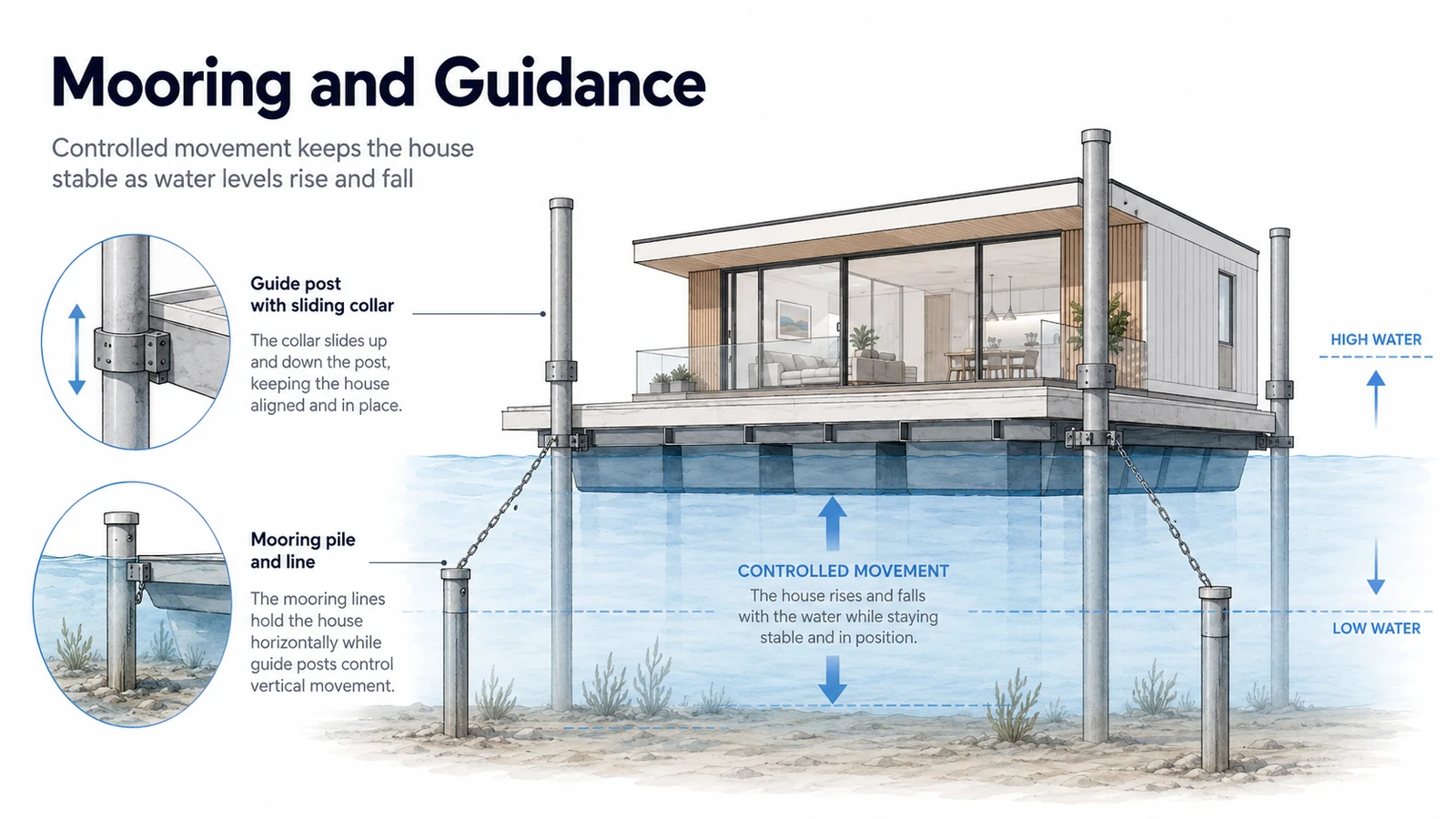
Caption: Mooring and guidance systems allow a floating house to respond to changing water levels without drifting away.
5. Plan Flexible Utilities Early
Utilities are one of the hardest parts of floating house design.
A floating house still needs:
- Fresh water
- Wastewater
- Electricity
- Heating and cooling
- Internet
- Fire safety systems
- Drainage
- Maintenance access
Because the house moves with water, utility lines often need flexible connections.
This may include:
- Flexible water pipes
- Flexible electrical conduits
- Floating or hinged service arms
- Dock-based service points
- Pump-out systems
- Sewage holding tanks
- Greywater treatment systems
- Solar panels and battery systems
- Rainwater collection
Utilities should not be treated as an afterthought.
A beautiful floating house can fail in daily life if the services are unreliable, hard to maintain, or unsafe during flood events.
The best floating houses make infrastructure part of the architecture.
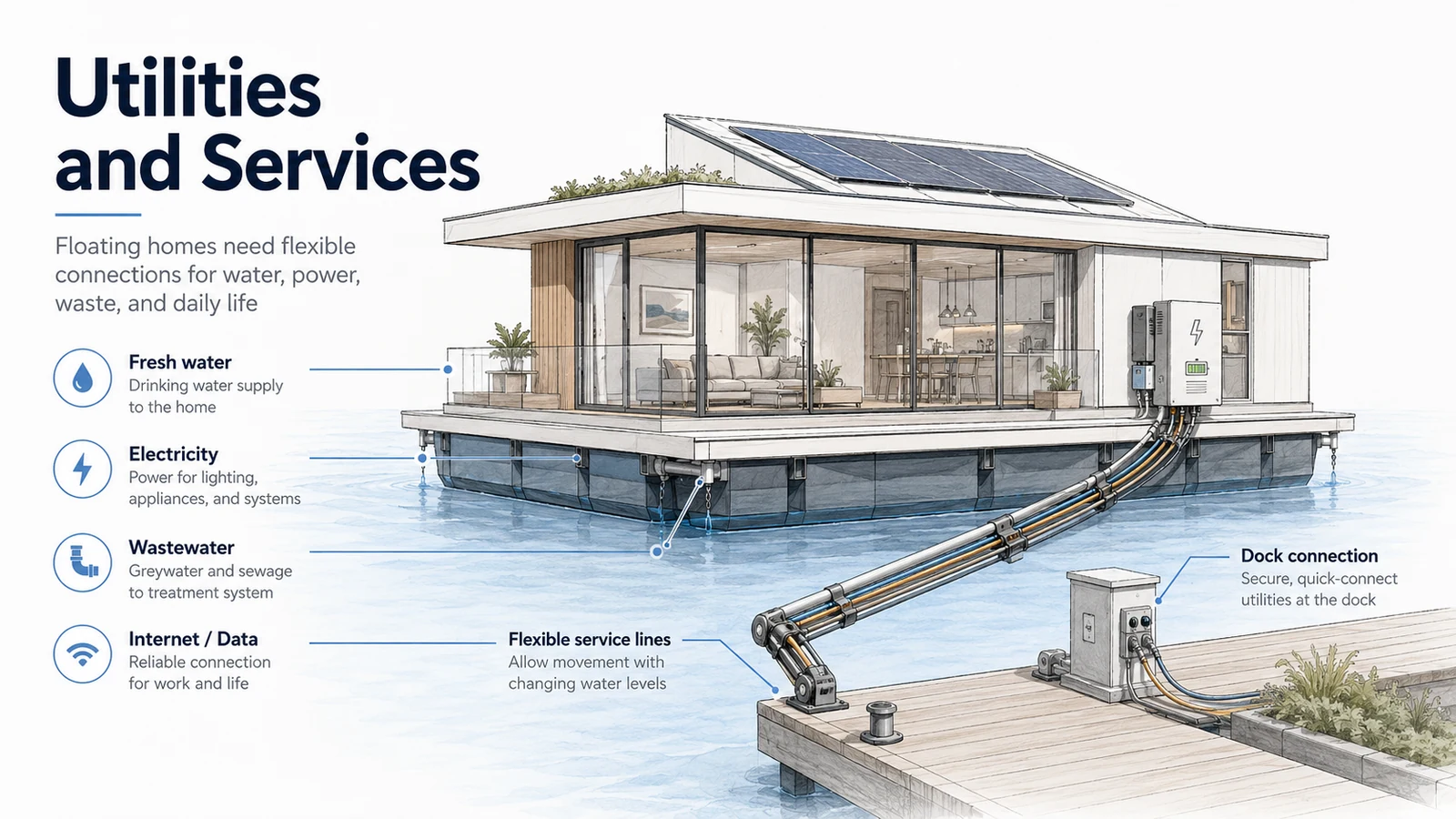
Caption: Flexible service lines allow floating homes to stay connected to water, electricity, wastewater, and data systems while the house moves with changing water levels.
6. Protect Access From Land
A floating house needs safe access as water levels change.
This can be done through:
- Floating docks
- Hinged gangways
- Adjustable ramps
- Stepped access
- Marina walkways
- Raised platforms
- Flexible bridges
The access system must remain usable during normal water changes and emergency conditions.
This is especially important for:
- Children
- Older residents
- People with mobility needs
- Delivery access
- Maintenance crews
- Emergency services
The house may float beautifully, but if the access fails, the project fails.
Architects should draw the access section at low water, normal water, and high water.
7. Design for Moisture, Corrosion, and Maintenance
Water-based architecture is exposed to more moisture than normal housing.
This affects:
- Structure
- Cladding
- Fasteners
- Insulation
- Joints
- Windows
- Decking
- Mechanical systems
- Electrical systems
- Interior finishes
Materials should be selected for long-term wet conditions.
Important details include:
- Ventilated cavities
- Corrosion-resistant fixings
- Durable exterior finishes
- Raised service zones
- Drainage gaps
- Replaceable deck boards
- Accessible inspection points
- Protection from splash zones
A floating house must age well.
If the details are too delicate, the house may look good in photos but become expensive to maintain.
Floating House Design Ideas
Floating houses can take many architectural forms.
Some are small cabins. Others are full modern homes. Some are part of floating neighborhoods.
Useful design ideas include:
- Compact rectangular volumes for balance
- Wide floating decks
- Lightweight roof forms
- Deep overhangs
- Large openings facing calm water
- Protected outdoor terraces
- Built-in storage to reduce clutter
- Green roofs for insulation and water management
- Solar panels
- Rainwater harvesting
- Natural ventilation
- Shaded facades
- Warm timber interiors
- Simple modular construction
The best floating houses are not only visually dramatic. They are calm, efficient, and practical.
A floating house should feel connected to water without feeling fragile.
Floating House Plans and Layout Tips
The layout of a floating house should respond to balance, views, services, and movement.
Important planning tips:
- Keep heavy rooms near the center where possible.
- Avoid placing all heavy loads on one side.
- Keep mechanical and service zones easy to access.
- Use simple structural grids.
- Plan decks carefully so they do not overload edges.
- Keep the plan compact if the platform is small.
- Use sliding doors to connect interior and exterior spaces.
- Place bedrooms in calmer, more private zones.
- Place living spaces toward the best views.
- Avoid unnecessary corridors.
A floating house plan should be beautiful, but also balanced.
The section is just as important as the plan. The relationship between waterline, platform, deck, floor level, openings, and roof must be carefully designed.
Floating Houses and Flood-Resilient Design
Floating houses are often discussed as part of flood-resilient architecture.
But not every flood-prone site is suitable for a floating house.
A good flood-resilient strategy should compare several options:
- Elevated house
- Amphibious house
- Floating house
- Wet-proof lower level
- Dry floodproofing
- Relocation
- Landscape flood storage
- Raised infrastructure
- Floodable outdoor space
FEMA’s coastal construction guidance emphasizes that flood-resistant residential design must consider natural hazards, site conditions, foundations, and long-term durability.
This is important because floating architecture should not be treated as a fantasy solution. It is one tool among many.
In some locations, raising a house on piles may be simpler. In others, amphibious construction may be more suitable. In protected waterfront settings, a floating house may make sense.
The right solution depends on the water, the risk, the budget, the code, and the community.
Floating House vs Houseboat
People often confuse floating houses with houseboats.
A houseboat is usually a boat adapted for living. It may have propulsion or be registered as a vessel, depending on the location.
A floating house is usually designed as a building on a floating foundation. It may be permanently moored and connected to services.
The difference can affect:
- Building permits
- Insurance
- Tax status
- Safety rules
- Utility connections
- Ownership rights
- Marina regulations
- Maintenance responsibilities
This legal gray area is one reason floating housing can be difficult. Climate-ADAPT lists regulatory uncertainty as one of the disadvantages of floating and amphibious housing because these projects can sit between real estate and transport categories.
Architects should not assume the approval process will be simple.
Before designing a floating house, the legal status of the project must be clear.
Common Mistakes in Floating House Design
Mistake 1: Treating It Like a Normal House
A floating house is not a normal house on a dock.
The foundation, structure, services, access, and maintenance all change.
If the project is designed like a normal land house, problems will appear later.
Mistake 2: Ignoring Stability
Small weight changes can matter.
A heavy kitchen, water tank, battery system, or rooftop feature can affect balance.
Even furniture placement can matter more than usual.
The floating platform should be engineered for real loads, not just the empty architectural model.
Mistake 3: Forgetting Utility Movement
If the house rises and falls, the utilities must move with it.
Rigid pipes and cables can fail.
Flexible service connections should be designed from the start.
Mistake 4: Designing for Calm Weather Only
Renderings often show perfect water.
Real sites may have wind, waves, debris, storms, and seasonal changes.
A floating house should be tested against uncomfortable conditions, not only beautiful ones.
Mistake 5: Poor Maintenance Access
The underside, platform, mooring points, and service connections need inspection.
If maintenance access is difficult, small problems can become expensive.
A floating house should be designed to be maintained, not just photographed.
Mistake 6: Ignoring Environmental Impact
Floating houses can affect water ecosystems, especially if many are built together.
Potential issues include:
- Shading of water surfaces
- Changes to water flow
- Wastewater risk
- Disturbance of habitats
- Construction pollution
- Navigation conflicts
Climate-ADAPT notes that environmental impacts depend on the scale and number of floating houses, and that ecosystem effects may require monitoring.
Good floating architecture should work with the water body, not damage it.
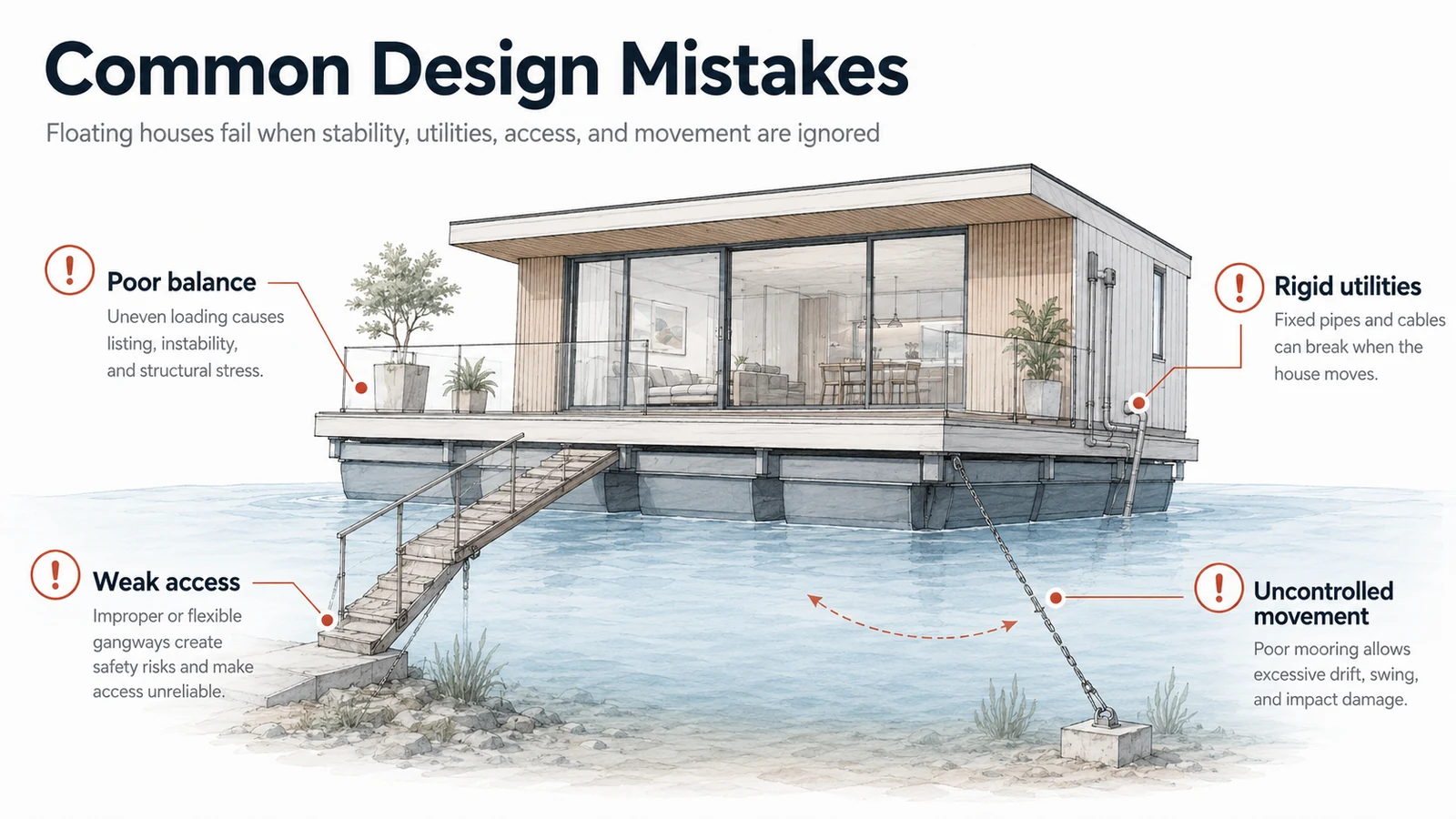
Caption: Floating houses can fail when architects ignore stability, services, access, maintenance, and real water conditions.
Floating House Materials
Material choice is critical because floating houses face moisture, movement, and corrosion.
Common material strategies include:
- Concrete floating hulls for durability and mass
- Steel pontoons where strength and fabrication control are needed
- Timber superstructures for lightness
- Engineered wood panels for prefabrication
- Composite cladding for weather resistance
- Marine-grade fasteners
- Lightweight insulated roof systems
- Non-slip exterior decking
- Corrosion-resistant railings and hardware
The material strategy should match the site.
A protected canal house can use a different system from a coastal floating structure.
Architects should also think about repair. Materials that are easy to inspect, replace, and maintain are often better than perfect-looking materials that fail quietly.
Floating House Sustainability
Floating houses can support sustainable design, but they are not automatically sustainable.
A floating house can include:
- Solar panels
- Battery storage
- Rainwater harvesting
- Greywater reuse
- Natural ventilation
- Heat pumps
- Water-source heating and cooling
- Green roofs
- Lightweight low-carbon materials
- Shared infrastructure in floating communities
The Schoonschip floating neighborhood in Amsterdam, mentioned by Climate-ADAPT, integrates floating housing with sustainable systems such as energy generation, water use, heating and cooling, waste treatment, mobility, and community life.
This shows that floating house design becomes more powerful when it is not only a single object, but part of a wider infrastructure system.
A floating house can be sustainable, but only if energy, water, waste, materials, and ecosystem impact are designed carefully.
Floating Houses in Cities
Floating houses can help cities think differently about waterfront development.
They may be useful where:
- Urban land is limited
- Canals or docks are underused
- Waterfront demand is high
- Flood adaptation is needed
- Existing industrial waterfronts are being transformed
- Communities want flexible housing models
But floating neighborhoods need more than beautiful homes.
They need:
- Shared docks
- Emergency access
- Waste systems
- Fire safety planning
- Public realm design
- Water management
- Transportation links
- Long-term maintenance rules
- Clear legal ownership
A floating neighborhood is closer to urban design than simple house design.
The architecture is only one layer. The infrastructure is just as important.
Practical Design Checklist
Use this checklist when designing or studying a floating house:
- Is the water body suitable for floating housing?
- What are the normal, low, and high water levels?
- What are the flood levels?
- Are waves, currents, wind, and debris understood?
- Is the buoyant foundation properly engineered?
- Is the superstructure lightweight enough?
- Is the house balanced?
- Is the freeboard sufficient?
- Are the mooring systems safe and flexible?
- Can the house rise and fall without damage?
- Are utility connections flexible?
- Is land access safe at different water levels?
- Are materials resistant to moisture and corrosion?
- Is maintenance access available?
- Are fire safety and emergency access solved?
- Are environmental impacts studied?
- Are local permits and legal status clear?
- Is the project better as floating, amphibious, or elevated?
If these questions are ignored, a floating house may look exciting but perform poorly in real life.
Floating House as a Bigger Architectural Idea
Floating house architecture is not only about living on water.
It is about adaptation.
It asks architects to think differently about:
- Ground
- Foundation
- Movement
- Climate risk
- Infrastructure
- Water ownership
- Urban expansion
- Resilient communities
- The relationship between architecture and nature
In the past, buildings were often designed as fixed objects. Floating houses show another possibility: buildings that can respond to changing environmental conditions.
This does not mean every future house should float.
But it does mean architects should become more comfortable designing with water instead of only against it.
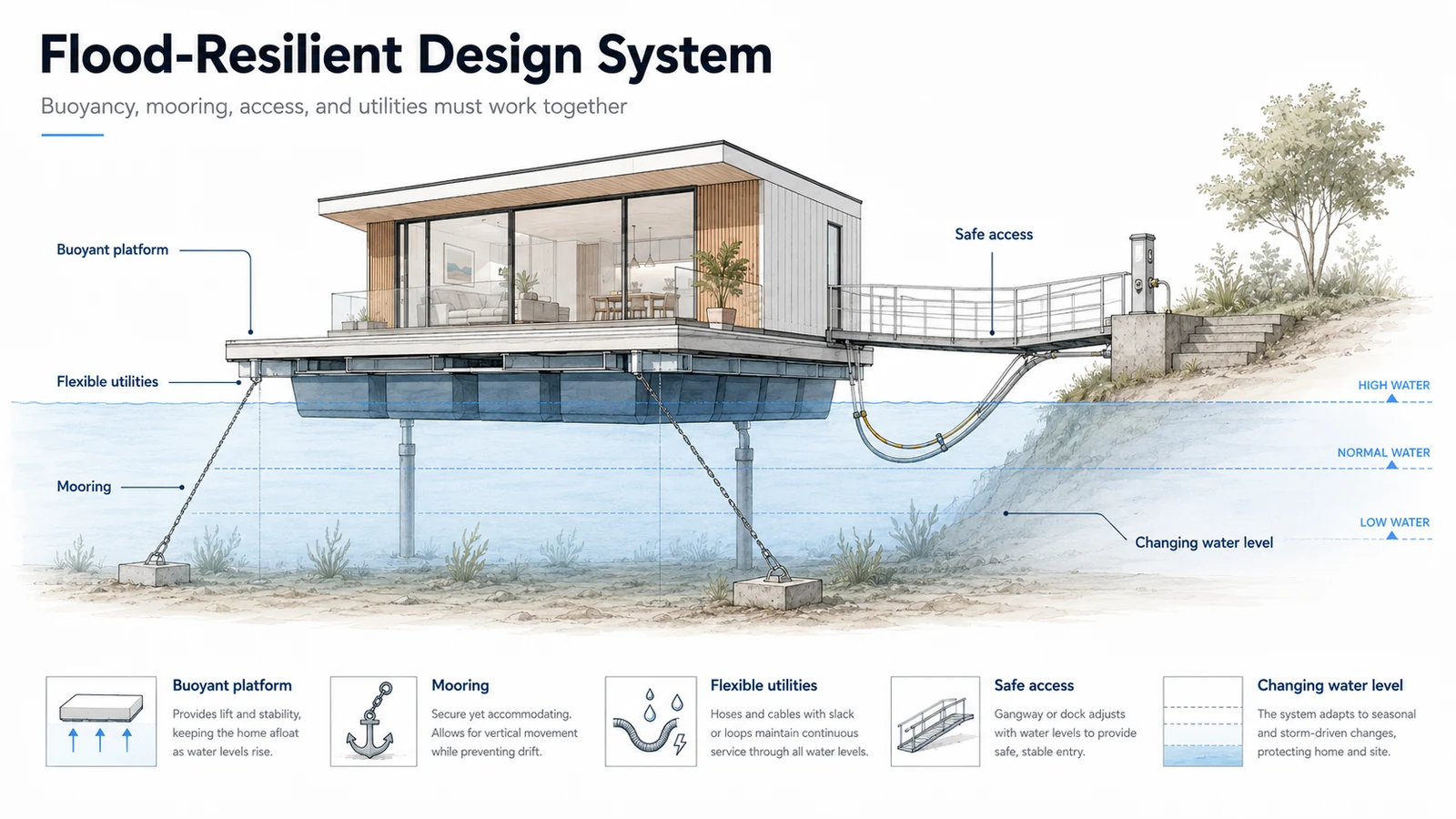
Caption: A successful floating house is a complete system: buoyancy, structure, mooring, access, utilities, safety, and environmental response must work together.
Conclusion
Floating houses are one of the most interesting forms of climate-responsive architecture.
They combine structure, water, landscape, engineering, and daily life into one design problem.
A good floating house is not just a beautiful object on water. It is a carefully balanced system that responds to buoyancy, movement, flood risk, utilities, access, comfort, and maintenance.
For architects, the main lesson is simple: do not design the house first and the floating base later.
Design the whole system from the beginning.
The future of waterfront architecture may not only be about higher walls and stronger barriers. In some places, it may also be about learning how to live with water.
FAQ
What is a floating house?
A floating house is a home built on a buoyant foundation or floating platform, usually located permanently on a canal, lake, river, marina, or protected water body.
How does a floating house work?
A floating house works by using buoyancy. Its base displaces enough water to support the weight of the house, while mooring or guidance systems keep it in position.
What is the difference between a floating house and an amphibious house?
A floating house is permanently on water. An amphibious house usually rests on land but rises and floats during flood events.
Is a floating house the same as a houseboat?
Not exactly. A houseboat is usually a boat adapted for living, while a floating house is usually designed as a building on a floating foundation. The legal difference depends on local regulations.
Are floating houses safe?
Floating houses can be safe when properly engineered for buoyancy, stability, mooring, fire safety, utilities, access, waves, wind, and maintenance. They should not be designed without specialist engineering.
Are floating houses good for flood-prone areas?
Sometimes. Floating and amphibious houses can help adapt to changing water levels, but they are not suitable for every flood-prone site. Site conditions, regulations, cost, and water behavior must be studied first.
What materials are used for floating houses?
Common materials include concrete hulls, steel pontoons, timber frames, engineered wood, composite panels, marine-grade fasteners, and weather-resistant cladding.
Can floating houses be sustainable?
Yes, but only if they are designed carefully. Sustainable floating houses may use solar panels, water-source heat pumps, rainwater collection, greywater systems, green roofs, and low-impact materials.
What is the biggest challenge in floating house architecture?
The biggest challenge is designing the whole system together: buoyancy, structure, stability, mooring, utilities, access, maintenance, and environmental impact.
References and Further Reading
- Climate-ADAPT — Floating and Amphibious Housing
- UNHCR — Amphibious Construction
- MDPI Sustainability — Amphibious Architecture: A Biomimetic Design Approach to Flood Resilience
- FEMA — Coastal Construction Manual
- FEMA — Highlights of ASCE 24 Flood Resistant Design and Construction
- Munich Re Foundation — Floating Homes Final Report