
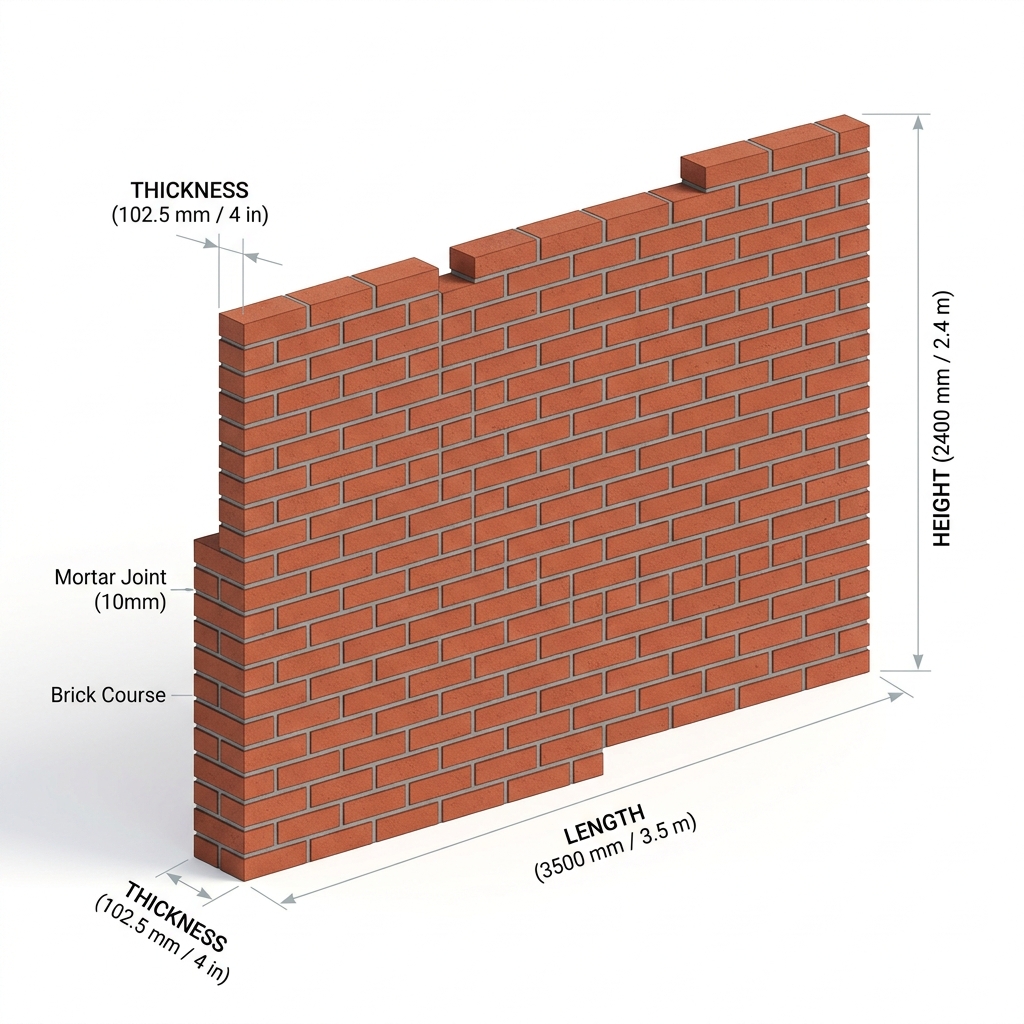
Brick Calculator: How to Estimate Bricks, Mortar, Cement, and Sand
Use this brick calculator to accurately estimate how many bricks and how much mortar are required for a brick wall project. Whether you are building a single-skin garden wall, a double-skin boundary wall, or a cavity wall with insulation space, this tool calculates the exact materials needed. By specifying the wall length, wall height, brick dimensions, and mortar joint size, you can avoid ordering too few bricks or wasting money on excess materials.
This calculator supports both Metric and Imperial units, allowing you to mix inputs such as meters, feet, inches, centimeters, and millimeters. It deducts any doors, windows, or custom openings from the gross wall area to ensure your results are precise. It also estimates the bag counts for cement and lime, sand volumes, and approximate water requirements based on your choice of simple or specialized mortar mixes.
How to calculate brick quantity
The number of bricks required for a wall is calculated using the face-area method. First, the gross area of the wall is calculated by multiplying length and height. Then, the combined area of all doors, windows, and openings is subtracted to find the net wall area. To find the number of bricks per skin, the net wall area is divided by the nominal face area of a single brick (which includes the brick size plus the mortar joint around it).
Net Wall Area = (Wall Length × Wall Height) - Openings Area
Base Brick Count = Skins × (Net Wall Area / Nominal Face Area)
How many bricks per square meter?
For standard UK brickwork projects using metric dimensions, the quantity of bricks needed depends on the wall thickness (skins) and brick format. Below is a quick answer cheat sheet for standard UK bricks:
- Single Skin (Half-Brick Wall): Requires approximately 60 bricks per m² (exactly 59.26).
- Double Skin (One-Brick Wall): Requires approximately 120 bricks per m² (exactly 118.52).
| Wall Area | Single Skin Wall | Double Skin Wall |
|---|---|---|
| 1 m² | 60 bricks | 120 bricks |
| 5 m² | 300 bricks | 600 bricks |
| 10 m² | 600 bricks | 1,200 bricks |
| 20 m² | 1,200 bricks | 2,400 bricks |
| 50 m² | 3,000 bricks | 6,000 bricks |
* These values are quick estimates. The calculator above gives a more accurate result because it includes wall dimensions, openings, brick size, mortar joint thickness, wall type, and wastage.
Brick wall calculator with openings and example calculations
Subtracting door and window gaps is critical for accurate material estimates. Here are three step-by-step example calculations using standard UK bricks (215 × 102.5 × 65 mm) and a 10 mm joint:
Example 1: 1 m² UK Brick Wall
• Wall size: 1m × 1m (Area = 1 m²)
• Nominal brick face area: (0.215 + 0.01) × (0.065 + 0.01) = 0.016875 m²
• Base count: 1 ÷ 0.016875 ≈ 59.26 bricks (rounded to 60 bricks).
Example 2: 10 m × 2.4 m Garden Wall
• Wall area: 10m × 2.4m = 24 m²
• Single-skin base count: 24 ÷ 0.016875 ≈ 1,422.2 bricks (approx. 1,422 bricks).
• With 10% wastage: 1,422 × 1.10 = 1,565 bricks to order.
Example 3: Double-skin Cavity Wall with an Opening
• Wall size: 10m × 2.4m = 24 m² gross.
• Opening size (Door): 1m × 2m = 2 m².
• Net wall area: 24 - 2 = 22 m².
• Double-skin base count (2 skins): 2 × (22 ÷ 0.016875) ≈ 2,607.4 bricks.
• Note: The cavity gap affects the overall thickness of the wall, but does not increase mortar volume since mortar is only applied to the active brick leaves.
How to estimate mortar for brickwork
Mortar is the mixture of cement, sand, water, and sometimes lime that binds the masonry. The wet mortar volume is calculated by finding the total volume of the brick leaves (Skins × Net Area × Brick Width) and subtracting the solid volume occupied by the bricks themselves. This provides the exact volume of the joints, which is then adjusted for wastage and multiplied by a dry volume factor (default 1.25) to account for dry material compaction when water is added.
Cement and sand calculator for brickwork
To calculate the bags of cement and weight of sand, the dry volume of mortar is divided according to the selected volumetric mix ratio. This tool supports two mix categories:
- Simple cement:sand ratios: Mixes like 1:3, 1:4, 1:5, and 1:6 containing only cement and sand (lime is zero).
- Type M/S/N/O mixes (ASTM C270): Ratios containing Portland cement, hydrated lime, and sand to provide workability. Hydrated lime is outputted separately.
Single-skin, double-skin, and cavity walls
Walls are designed in various leaf thicknesses to support loads and block weather:
- Single Skin (Half-Brick): A wall thickness equal to the width of one brick (102.5 mm). Generally used for low boundary walls and internal partitions.
- Double Skin (One-Brick): A thickness equal to two brick widths plus a collar joint (215 mm). Used for standard structural boundary walls.
- Cavity Wall: Two separate brick leaves built parallel to each other with an insulation space/gap (e.g. 50mm). This stops dampness. The cavity gap does not affect mortar volume calculations.
- Triple Skin: Three layers of brickwork for heavy structural or heritage masonry.
Brick wastage and ordering extra materials
When ordering bricks, always account for wastage. Common wastage defaults are:
- Bricks: 5% to 10% to cover cuts at edges, corner adjustments, and transport breakage.
- Mortar: 10% for spills and joint depth inconsistencies.
Why this brick calculator is different
Unlike simple brick calculators that only estimate brick count from wall area, this tool supports openings, cavity walls, mortar joint thickness, brick wastage, mortar wastage, cement, sand, lime, bag quantities, and cost estimation. This makes it useful for garden walls, boundary walls, double-skin walls, and early material takeoff planning.
Explore these other tools to plan your building materials:
- Use the Concrete Calculator if your brick wall also needs a footing or concrete base.
- Use the Rebar Calculator for reinforced concrete elements connected to the wall.
- Use the Block Calculator if you are estimating concrete masonry units (CMU blocks) instead of bricks.
Common brick sizes
Standard brick dimensions vary by country. Selecting the correct size preset is important for calculating the number of bricks per square meter:
- UK Standard: 215 × 102.5 × 65 mm
- US Modular: 194 × 92 × 57 mm
- US Standard: 203 × 92 × 57 mm
- US Utility: 295 × 92 × 92 mm
- Australian Standard: 230 × 110 × 76 mm
- European NF: 240 × 115 × 71 mm
Estimate assumptions and limitations
These calculations are intended for early material estimates and planning. Actual quantities may vary depending on brick bond, cutting, workmanship, site conditions, local brick dimensions, mortar mix, and construction tolerances.
Frequently asked questions
How many bricks are needed per square meter?
For a standard UK single-skin (half-brick) wall using 215 × 65 mm bricks and a 10 mm joint, you need approximately 60 bricks per square meter. A double-skin wall requires about 120 bricks per square meter.
How do I calculate bricks for a wall?
Find the wall area by multiplying length by height, subtract any window or door opening areas, and divide the net area by the brick nominal face area (brick size plus mortar joint width).
How many bricks do I need for a 10 m wall?
If the wall is 10 m long and 2.4 m high, the gross area is 24 m². For a single-skin wall with UK bricks, you would need about 1,440 bricks. Adding 10% wastage brings the order to approximately 1,584 bricks.
Does the calculator subtract windows and doors?
Yes. The calculator includes an openings manager where you can add doors and windows with custom dimensions. It deducts the opening areas from the gross wall area before estimating bricks and mortar.
Does cavity width affect mortar volume?
No. The cavity gap between double-skin walls is not filled with mortar. The calculator isolates mortar estimates strictly to the active brick leaves, ensuring your cement and sand quantities remain accurate.
How much mortar do I need for brickwork?
The wet volume of mortar required is calculated by subtracting the solid volume of all bricks from the total volume of the brick skins. This counts the mortar joints precisely and adds a wastage factor.
How much cement and sand do I need for brickwork?
This depends on the wet mortar volume, dry volume factor (normally 1.25), and mix ratio. A 1:4 mix uses 1 part cement and 4 parts sand. Hydrated lime is added and outputted if Type M, S, N, or O mixes are chosen.
What mortar joint thickness should I use?
The standard mortar joint thickness is 10 mm (3/8 inch). You can customize this in the calculator to match historic restorations or special architectural bricks.
What is the difference between single-skin and double-skin walls?
A single-skin wall is one brick leaf thick (102.5 mm), suitable for internal partitions or low garden borders. A double-skin wall is two leaves thick (215 mm), providing high stability and insulation space.
Should I add waste when ordering bricks?
Yes. Adding a 5% to 10% wastage allowance is highly recommended to cover edge cuts, transport chips, breakage, and construction tolerances.