
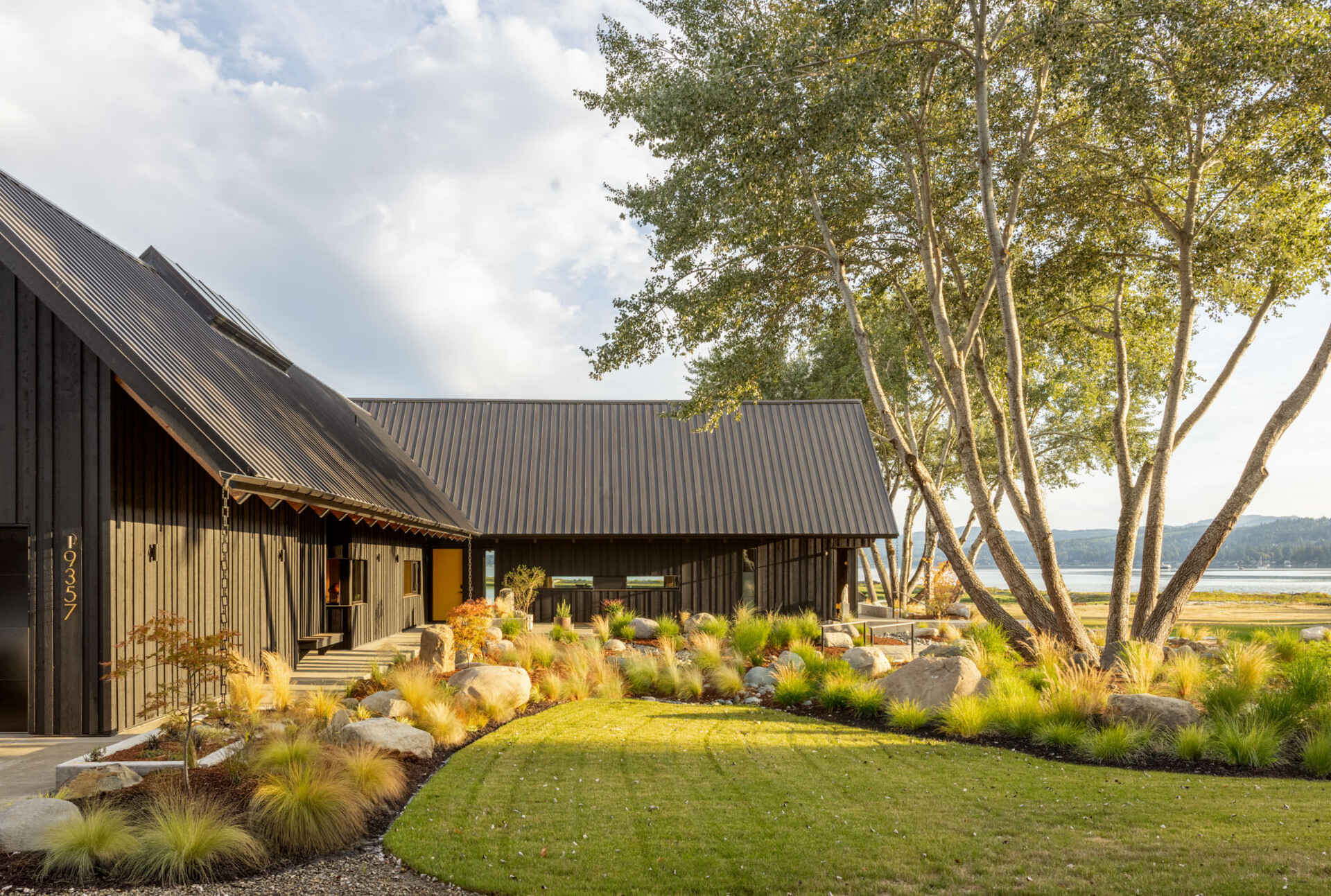
The Dyes Inlet House showcases modern Scandinavian-inspired architecture with a distinctive T-shaped design.
Story
A Scandinavian-inspired modern house organized by intersecting gabled volumes and oriented to the views of Dyes Inlet
Project Overview
Dyes Inlet House by SHED Architecture & Design is a Scandinavian-inspired modern house—a work of contemporary architecture—positioned above the waters of Dyes Inlet in Silverdale, Washington. The residence draws on the simple, functional language of Swedish farm complexes, combining clean geometry, gabled volumes, and landscape design to structure a multi-generational living family compound. Designed as the primary home within a property that also includes a renovated guest house, the project prioritizes long-term comfort and accessibility. Energy-efficient construction supports year-round performance, while the plan organizes daily life around framed views, natural light, and clear circulation.
Site and Urban Context
Set on Washington’s Kitsap Peninsula, the house surveys the shoreline to the south while maintaining privacy to the north. Landscape design screens nearby development on the north side and opens the site to water and sky on the south, extending living spaces outdoors and visually linking the new residence to the adjacent renovated guest house as a cohesive family property.
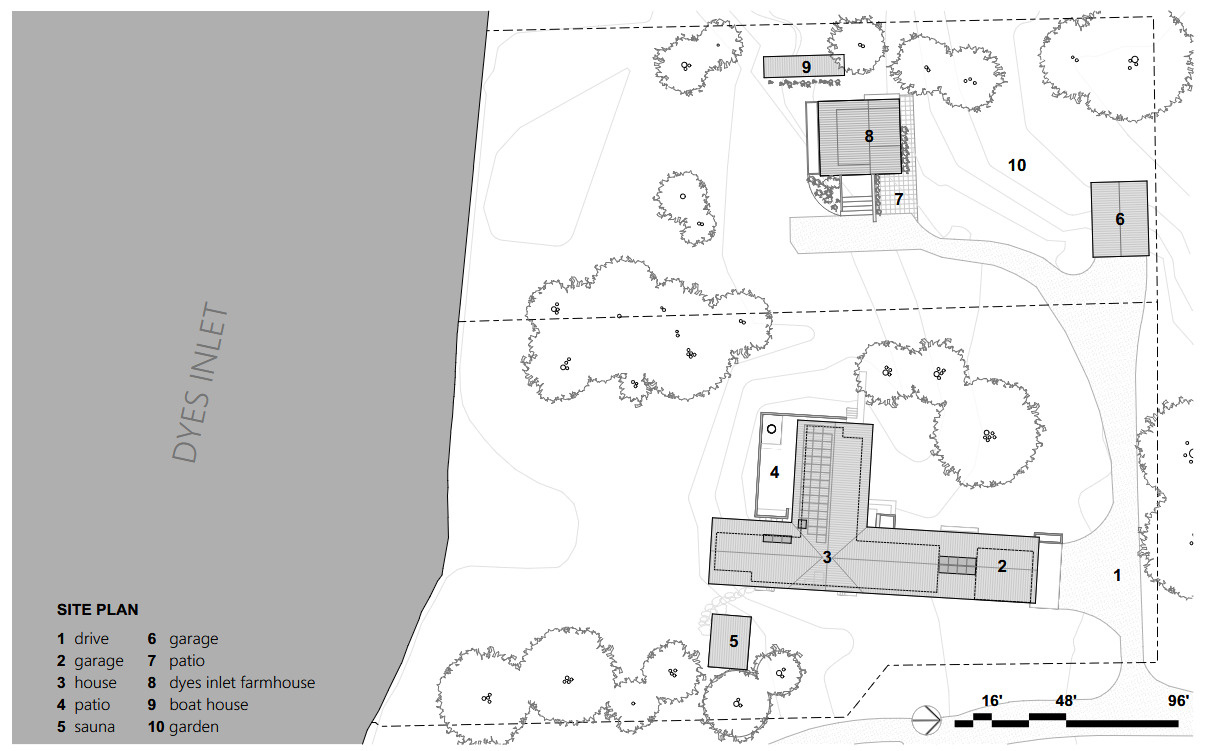
Design Concept: A Scandinavian-Inspired Modern House
Two intersecting gabled volumes establish a T-shaped plan that references traditional Swedish farmhouses. This arrangement shapes a sheltered north courtyard for arrival and service functions while directing the southern edge toward expansive inlet views. The form clearly separates shared and private zones and creates a legible sequence of spaces.
Spatial Organization
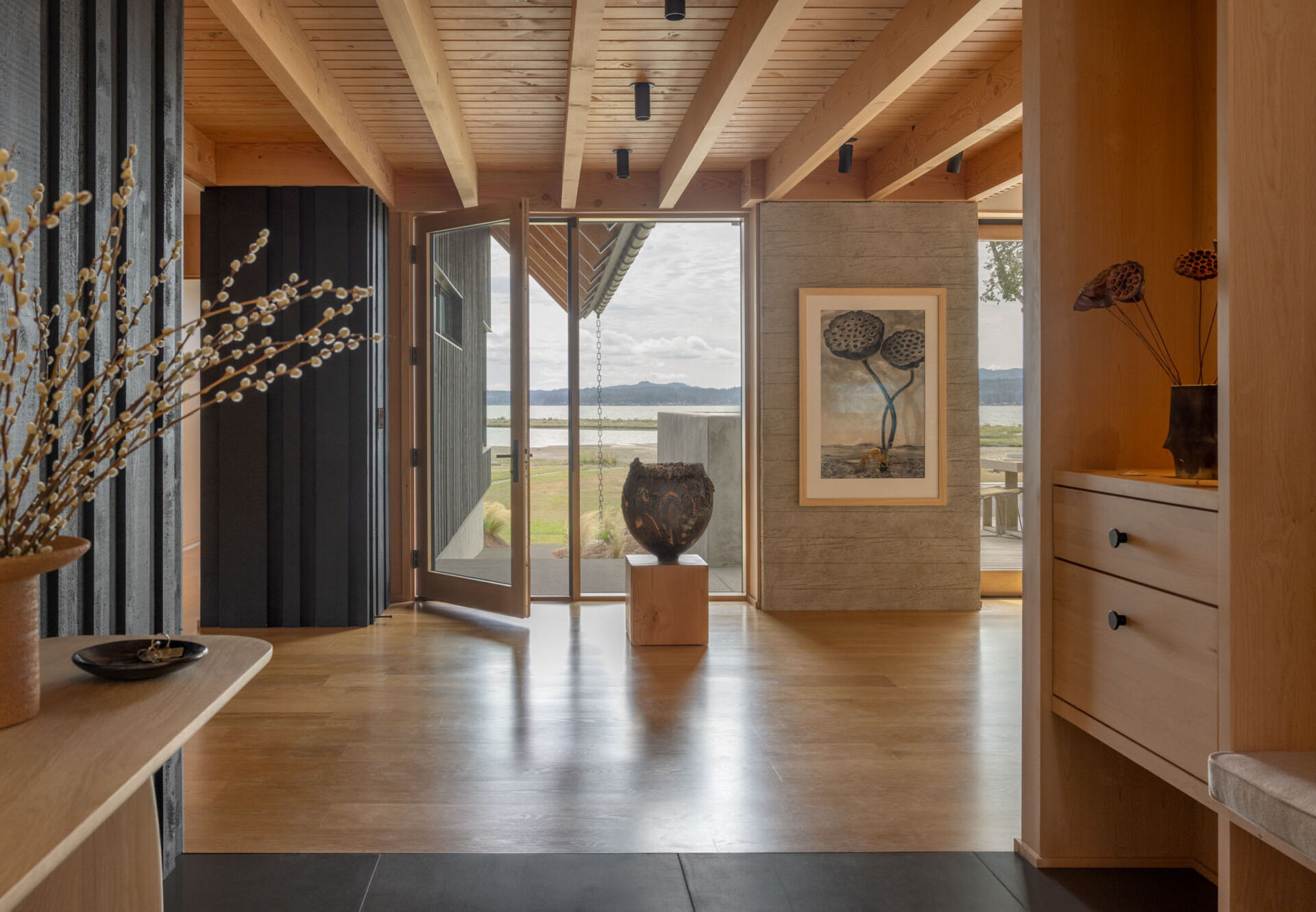
Arrival occurs through the protected courtyard. At the intersection of the two wings, the foyer frames a first, axial view to the shoreline; a loft above gently compresses the entry before the interior opens into taller volumes.
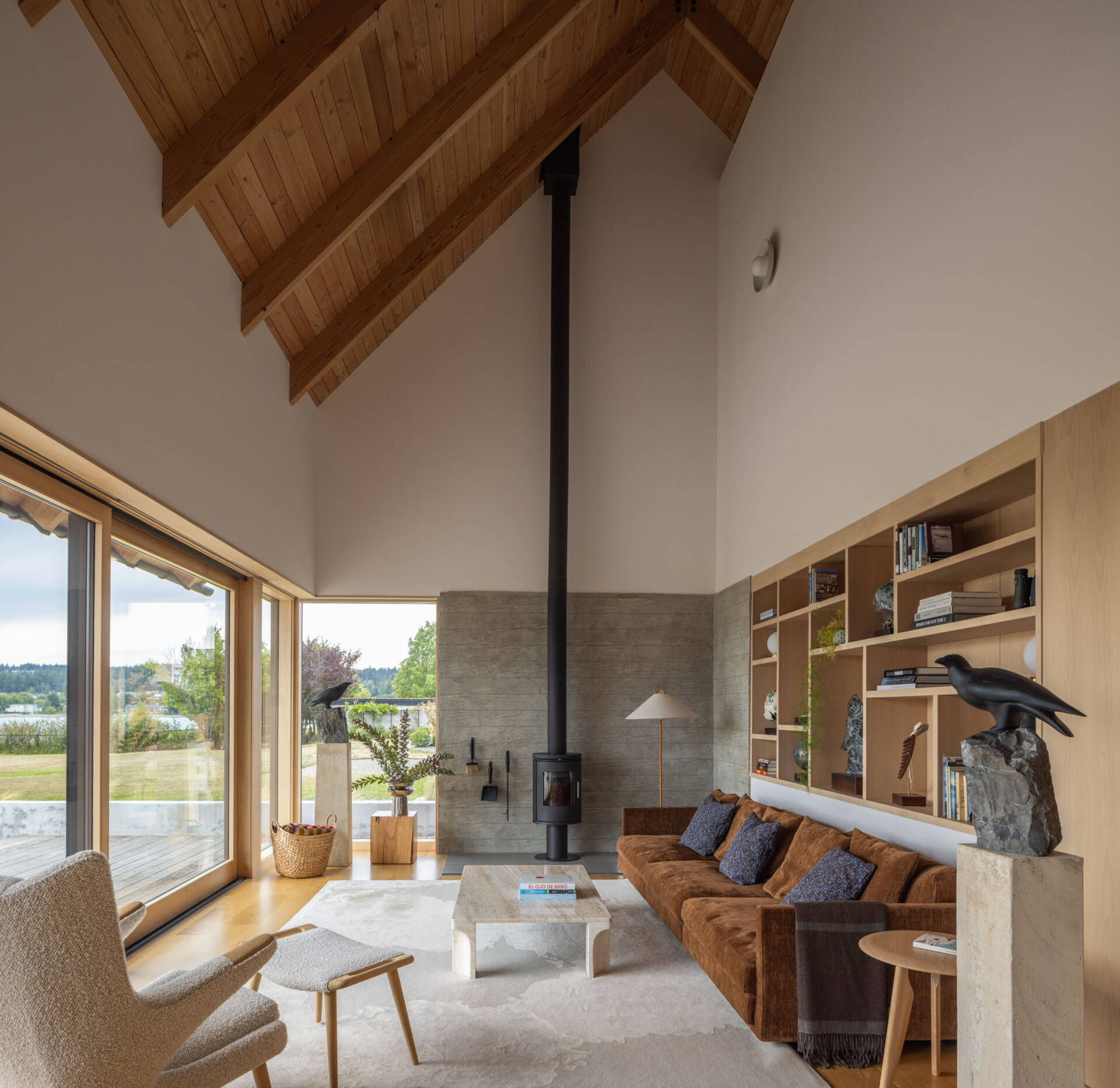
The east–west wing hosts the shared living spaces. A vaulted, double-height living room opens to the southern patio and water beyond, with large openings admitting daylight and emphasizing the horizon.
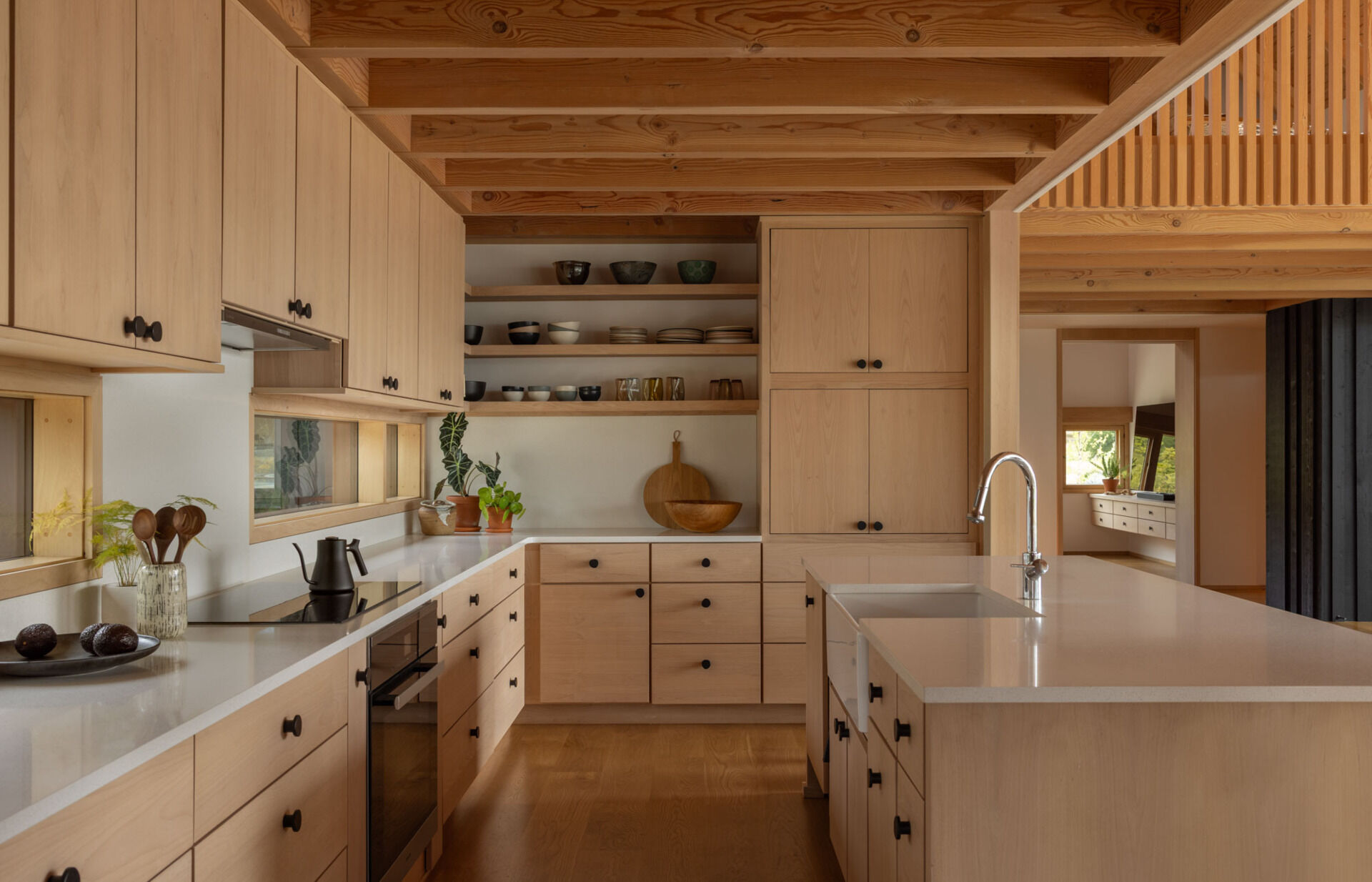
Adjacent dining and a centrally positioned kitchen support gatherings and everyday routines, maintaining visual continuity and connection to the landscape.
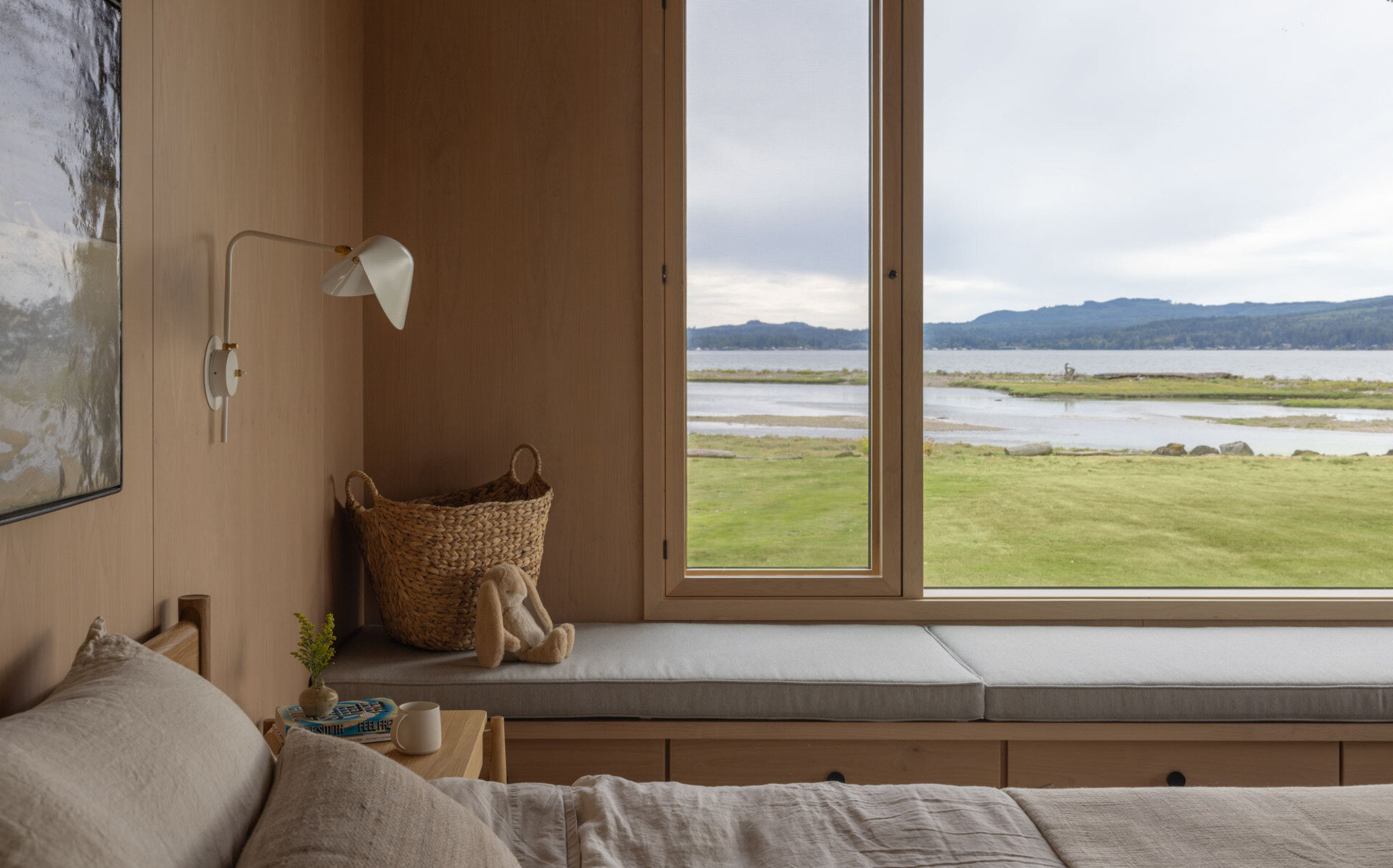
The north–south wing is dedicated to private rooms. The primary suite occupies the southern end, with broad glazing toward the inlet and a wraparound bench with integrated storage. Additional bedrooms include a flexible guest room that can function as a workspace. A media room provides an enclosed setting for quieter activities, while the loft above the foyer offers adaptable space for office use and storage. A sauna completes the wellness-focused program.
Materials and Facade
Materiality emphasizes Pacific Northwest character through natural finishes such as wood and expanses of glass. Durable interior surfaces support daily use, and the restrained palette allows views, daylight, and changing conditions on the water to define the atmosphere. Openings are composed to balance privacy toward the courtyard with outlooks to the south.
Light, Climate, and Atmosphere
Daylight is a primary driver: large glazed areas and vaulted volumes draw sunlight deep into the plan, while the courtyard approach provides a calm threshold before the interior opens to the inlet. Energy-efficient systems and an envelope tuned for performance support comfort across seasons without distracting from the straightforward architectural expression.
Design Highlights
Intersecting gabled volumes establish a T-shaped plan referencing Swedish farm complexes North courtyard creates a sheltered arrival and buffers adjacent development Entry sequence frames a direct view to Dyes Inlet with a loft-compressed threshold Vaulted living room along the east–west wing opens to a south-facing patio Central kitchen and adjacent dining enable fluid circulation for family gatherings Primary suite at the quiet end of the private wing with a wraparound bench and storage Flexible guest bedroom doubles as a workspace to support changing needs Dedicated media room and a sauna expand daily living options within the house
Key Facts
| Field | Details |
|---|---|
| Project | Dyes Inlet House |
| Architect | SHED Architecture & Design |
| Location | Silverdale, Kitsap Peninsula, Washington, United States |
| Year | — |
| Status | Built |
| Program | Private residence; part of a family compound with a renovated guest house |
| Main Materials | Wood, glass, natural finishes |
| Keywords | residential architecture; Scandinavian-inspired; gabled volumes; courtyard; natural light; energy efficiency; Pacific Northwest |
Frequently Asked Questions
What informed the overall form of the house?
The form is derived from the simple, intersecting gabled volumes of traditional Swedish farmhouses, producing a T-shaped plan with a north courtyard and south-facing outlooks.
How are public and private spaces organized?
Shared living spaces occupy the east–west wing, while bedrooms line the north–south wing. The foyer at their intersection establishes orientation and circulation.
Which spaces directly face the water?
The vaulted living room, dining area, kitchen, and the primary suite are oriented south toward Dyes Inlet to capture views and daylight.
How does the landscape contribute to privacy and views?
Planting and site shaping screen the house from development to the north, while the south side is opened to the shoreline, extending living outdoors.
What features support long-term living?
The plan is clear and accessible, spaces are adaptable (including a guest room/office and loft), and the house employs energy-efficient construction for comfort over time.
Technical Summary
Material Strategy
The project relies on a contextual material palette chosen for tactile clarity and durability:
| Material | Application |
|---|---|
| wood | Exterior cladding; interior vaulted ceilings and beams; kitchen cabinetry; sauna lining |
| glass | Large windows and doors providing inlet views and daylighting |
| concrete | Exterior pathways and hardscape at entry/courtyard |
| stone | Landscape boulders and planters |
| ceramic tile | Bathroom walls and floors in distinct color schemes |
| stainless steel | Kitchen appliances |
| metal | Solar panel array and rain chain/downspout components |
Facade and Envelope
- Daylighting and glazing: Large window expanses and double-height volumes pull light deep into interior spaces
Structure and Construction
- Massing and plan: Two intersecting gabled volumes form a T-shaped layout that organizes public and private zones
- Site orientation and outdoor rooms: Sheltered courtyard on the north; southern edge opens toward expansive inlet views
- Entry sequence: Covered walkway leading to a protected front door within the courtyard
- Vertical volume: Vaulted living room with double-height space
- Foyer and loft: Loft above entry lowers initial scale before rooms open to taller spaces
- Program zoning: Shared living in the east-west wing; bedrooms in the north-south wing for privacy
- Energy strategy: High-performance and energy-efficient construction with systems supporting long-term comfort
- On-site renewable energy: Rooftop photovoltaic panels on gabled roof
- Wellness amenity: Integrated sauna for comfort and longevity
- Landscape strategy: Plantings screen the north edge for privacy; broad opening to the south frames water views
Interior Finishes
- exterior cladding: Dark wood siding on gabled volumes
- entry feature: Yellow-painted front door within covered approach
- ceilings: Vaulted wood ceilings with exposed beams in main living areas
- kitchen millwork: Light wood cabinetry with contrasting black hardware and open shelving
- bathroom finishes: Blue tile with wood vanity and inlet view
- bathroom finishes: Patterned floor tile with wood vanity; adjacent green-tiled space visible
- bathroom finishes: Yellow tile backsplash with wood vanity
- built-ins: Wraparound window bench with storage in the primary suite
- site elements: Stone boulders and planters integrated into landscaping
- sauna interior: All-wood benches and lining
Lighting and Atmosphere
Colors: black exterior cladding, yellow front door, natural light wood tones (ceilings, cabinetry), blue bathroom tile, yellow bathroom tile, patterned bathroom floor tile, black dining table, pink sofa accent. Lighting: Daylighting via large south-facing glazing and a skylight; ambient and task lighting include a dining pendant and floor/desk lamps..
Products and Manufacturers
- Renewable energy: Photovoltaic panels by unspecified (used for Rooftop PV array mounted to gabled roof)
- Rainwater management: Rain chain (chain downspout) by unspecified (used for Directs roof runoff at entry landscape)
- Fireplace: Fireplace (type unspecified) by unspecified (used for Living room focal point and heat source)
- Kitchen appliances: Stainless steel appliances by unspecified (used for Cooking and refrigeration in open kitchen)
Project information and images courtesy of SHED Architecture & Design. Originally published by contemporist.com.
Similar projects
More houses
Amagansett House
Bates Masi + Architects
A family house in Amagansett by Bates Masi + Architects, organized as interlinked gabled volumes with weathered shingles, thatch infill, breezeways, and warm na…

Big Sur Residence
Studio Schicketanz
A modern home in Northern Big Sur, designed by Studio Schicketanz, featuring stone walls, an inner courtyard, and expansive coastal views.

Elemental
OPAL Architecture
Elemental, designed by OPAL Architecture, is a sculptural modern home in Maine blending dark charred wood exteriors with bright, airy interiors.

Tarrytown Residence: Contemporary Architecture in Austin
Alterstudio Architecture
The Tarrytown Residence presents a modern, courtyard-centered family home in Austin, defined by black brick, ebony-stained cedar, and carefully framed connectio…

Inside a Sydney Home: House Design With a Gravity-Defying Kitchen Island
Manolev Architects
A multi-level Sydney residence by Manolev Architects pairs concrete structure with layered gardens and daylight, anchored by a cantilevered kitchen island and a…

Black A-Frame Cabin
Stephenson Design Collective
A modern A-frame cabin in the Washington mountains, featuring a black metal exterior and warm wood interior, designed for snowy winter conditions.
Projects by the architect
View SHED Architecture & DesignNo other projects found for this architect yet.