
Window Types in Architecture: The Complete Guide to Fenestration Design
A complete architectural guide to window types, covering operation, placement, performance, materials, advantages, disadvantages, and best uses for each major window style.
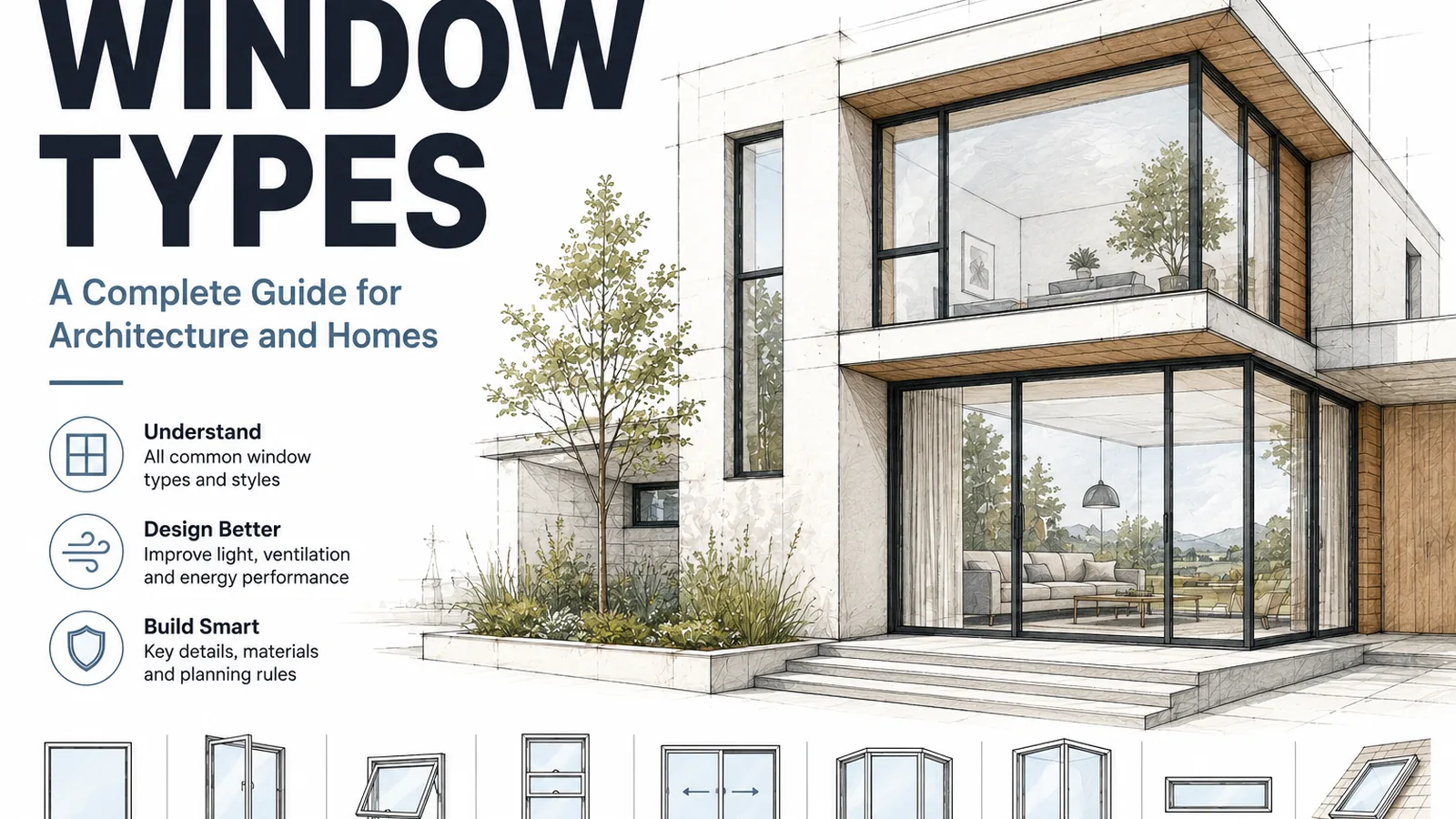
Windows are among the most important elements in architecture. They define how natural light enters a building, how air circulates through rooms, how occupants experience views, and how a facade communicates character and scale. A well-designed window can transform an ordinary room into a bright, comfortable, and memorable space. A poorly chosen window can cause overheating, glare, privacy problems, water infiltration, and energy loss.
In architecture, windows are far more than openings in walls. They are critical components of the building envelope, influencing energy performance, indoor comfort, sustainability, and aesthetics. Throughout history, advances in construction technology, glass manufacturing, and environmental design have continually expanded the possibilities of window design.
This comprehensive guide explores the major window types used in residential, commercial, and institutional architecture. It explains how windows are classified, how they function, where they are best used, and how architects integrate them into successful building designs.
{{image_01}}
Understanding Window Classification
Window types can be classified in several different ways. While many people think of windows simply as fixed, sliding, or casement units, architects evaluate windows according to their operation, geometry, location, performance characteristics, and architectural role.
Classification by Operation
The most common classification method is based on how a window opens and closes.
Major operational window types include:
- Fixed windows
- Casement windows
- French casement windows
- Awning windows
- Hopper windows
- Sliding windows
- Single-hung windows
- Double-hung windows
- Pivot windows
- Tilt-turn windows
Each system offers different advantages in terms of ventilation, weather resistance, maintenance, and energy performance.
Classification by Form
Windows can also be categorized according to shape and composition.
Examples include:
- Picture windows
- Bay windows
- Bow windows
- Palladian windows
- Venetian windows
- Arched windows
- Circular windows
- Corner windows
- Ribbon windows
These forms influence both the interior experience and the visual character of a building.
Classification by Position
Architects frequently classify windows according to where they are located within the building envelope.
Examples include:
- Clerestory windows
- Transom windows
- Skylights
- Roof windows
- Lantern windows
- Monitor windows
- Basement windows
- Egress windows
Position often determines the quality of daylight, privacy, and ventilation.
Classification by Architectural Function
Windows may also be categorized according to their primary purpose.
These purposes include:
- Daylighting
- Ventilation
- View framing
- Privacy
- Solar control
- Emergency escape
- Architectural expression
The most successful window designs typically fulfill multiple functions simultaneously.
Why Window Types Matter
The choice of window type affects:
- Daylight quality
- Energy efficiency
- Thermal comfort
- Ventilation performance
- Building appearance
- Construction cost
- Maintenance requirements
- Building code compliance
Selecting the correct window type early in the design process allows architects to optimize both building performance and user experience.
{{image_02}}
Fixed Windows
Fixed windows are non-operable windows designed primarily for daylight and views. Because they contain no moving parts, they are often among the most airtight window types available.
Fixed windows are common in:
- Living rooms
- Stair halls
- Double-height spaces
- Atriums
- Scenic locations
Their simplicity allows designers to create large uninterrupted glass areas that maximize visibility and daylight penetration.
Advantages
- Excellent air tightness
- Minimal maintenance
- Large glazing sizes possible
- Maximum daylight transmission
- Strong visual connection to the outdoors
Limitations
- No ventilation
- Exterior cleaning can be difficult
- Solar gain must be carefully managed
Fixed windows are often combined with operable windows to balance ventilation and views.
Picture Windows
Picture windows are large fixed windows specifically designed to frame views. Unlike ordinary fixed windows, picture windows are typically positioned to capture a particular landscape, garden, skyline, or architectural feature.
Architects often use picture windows to create a visual focal point within a room.
Common applications include:
- Mountain houses
- Coastal residences
- Forest retreats
- Urban penthouses
- Modern living rooms
A properly designed picture window transforms the exterior environment into part of the interior experience.
Single-Hung Windows
Single-hung windows are among the most common residential window types. They consist of one fixed upper sash and one movable lower sash. The lower sash slides vertically while the upper sash remains stationary.
Single-hung windows are frequently used in traditional houses, apartment buildings, and residential renovations.
Advantages
- Cost-effective
- Familiar operation
- Traditional appearance
- Simple maintenance
Disadvantages
- Limited ventilation area
- More difficult exterior cleaning
- Less flexible than double-hung systems
Single-hung windows remain popular because of their affordability and compatibility with traditional architecture.
Double-Hung Windows
Double-hung windows improve upon the single-hung design by allowing both sashes to move. This creates more flexible ventilation options. Warm air can exit through the upper opening while cooler air enters through the lower opening, improving natural airflow.
Advantages
- Improved ventilation
- Easier cleaning
- Traditional architectural character
- Flexible operation
Common Applications
- Bedrooms
- Residential renovations
- Historic preservation projects
- Traditional architecture
Many modern double-hung windows also include tilt-in mechanisms for easier maintenance.
{{image_03}}
Casement Windows
Casement windows are side-hinged windows that swing outward or inward like a door. They are widely regarded as one of the most efficient operable window types for ventilation.
When positioned correctly, the open sash can capture prevailing breezes and direct airflow into a room.
Benefits
- Excellent ventilation
- Strong weather sealing
- Unobstructed glass area
- Energy-efficient operation
Common Applications
- Kitchens
- Bedrooms
- Contemporary homes
- Passive houses
Because casement windows rely on compression seals, they often outperform sliding systems in air-tightness tests.
French Casement Windows
French casement windows consist of two side-hinged sashes that open from the center without a fixed mullion. When opened fully, they provide a completely unobstructed opening.
These windows are frequently used in:
- Traditional European architecture
- Luxury residences
- Garden-facing rooms
- Balcony openings
French casements combine elegance with excellent ventilation performance.
Awning Windows
Awning windows are hinged at the top and open outward from the bottom. Their configuration allows them to remain partially open during light rain while still protecting the interior.
Ideal Applications
- Bathrooms
- Kitchens
- Basements
- High-level windows
- Wet climates
Advantages
- Good weather protection
- Effective ventilation
- Strong air sealing
- Compact proportions
Awning windows are frequently combined with fixed glazing in contemporary facade compositions.
Hopper Windows
Hopper windows are hinged at the bottom and open inward from the top. They are commonly used in basements, utility rooms, service areas, and mechanical spaces.
Their inward-opening design makes them particularly suitable for below-grade applications where exterior clearance is limited.
Sliding Windows
Sliding windows move horizontally along tracks. They are especially common in modern residential construction due to their simplicity and ease of use.
Advantages
- Smooth operation
- No swing clearance required
- Wide horizontal openings
- Contemporary appearance
Limitations
- Track maintenance
- Reduced ventilation area
- Potential air leakage compared to compression-sealed systems
Sliding windows work particularly well in apartments, balconies, and compact urban sites.
{{image_04}}
Pivot Windows
Pivot windows rotate around a central or offset pivot point rather than traditional hinges. They are often used in contemporary architecture to create dramatic visual effects and larger operable openings.
Because the sash rotates around an axis, pivot windows can accommodate larger dimensions than many conventional systems.
Tilt-Turn Windows
Tilt-turn windows originated in Europe and have become increasingly popular worldwide.
They offer two operating modes:
Tilt Mode
The top of the window tilts inward slightly, providing secure background ventilation.
Turn Mode
The entire sash swings inward like a door.
This dual functionality makes tilt-turn windows one of the most versatile window systems available.
Benefits
- Excellent energy performance
- Easy cleaning
- Secure ventilation
- High air-tightness
- Flexible operation
They are commonly used in passive house projects, high-performance buildings, multi-family housing, and contemporary residences. The combination of ventilation, safety, and energy performance has made tilt-turn windows a benchmark for advanced residential construction.
<!-- Next sections to be expanded: specialty window types, modern architectural glazing systems, position-based window types, frame materials, glazing technologies, daylighting, ventilation, construction details, planning rules, climate selection, documentation, common mistakes, workflow, FAQ, and references. -->